
Before a Canadian hotel releases a cleaning chemical for use, the receiving team should match the delivered product to the approved order, confirm that the applicable safety information is available, and resolve changes affecting how staff will handle or use it. An unfamiliar label or a revised safety data sheet (SDS) is a review trigger. It does not, by itself, establish that the supplier changed the formula or shipped the wrong product. The useful question is whether the hotel can explain what changed and show that its operating controls still fit the product received.
That question matters during routine replenishment as much as during a supplier switch. A familiar carton can contain a different concentration, a replacement product code, or packaging with updated precautions. Receiving may see the change first, while housekeeping still has yesterday’s instructions on its cart. If the carton goes straight into available stock, the discrepancy can disappear into normal operations before anyone compares the documents.
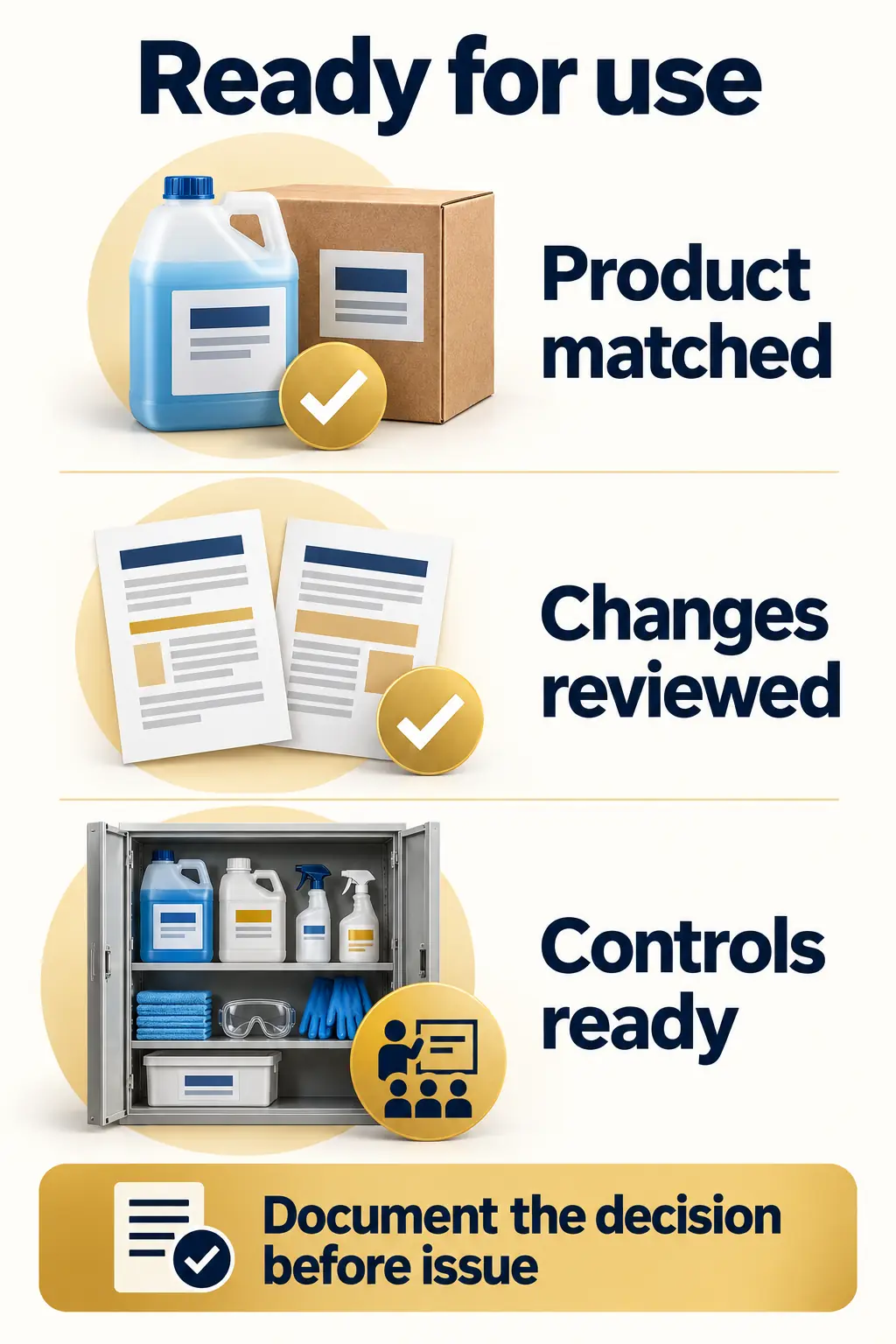
A workable review connects three records: what purchasing approved, what physically arrived, and what the property is prepared to use. The comparison should end with a recorded decision, an owner for unresolved questions, and a clear boundary between held stock and stock authorized for issue. It should also distinguish routine documentation questions from damaged or leaking packages that require the property’s established response procedures.
This guide explains the Canadian requirements that shape that decision, then provides a practical receiving review and examples of how to close discrepancies. The workflow and downloadable form are suggested hotel controls, not a government-prescribed inspection form. Regulatory information was reviewed on September 24, 2026; the property must apply the workplace rules for its province, territory, or federal jurisdiction and the requirements for the particular product category.

Identify Which Canadian Requirements Apply
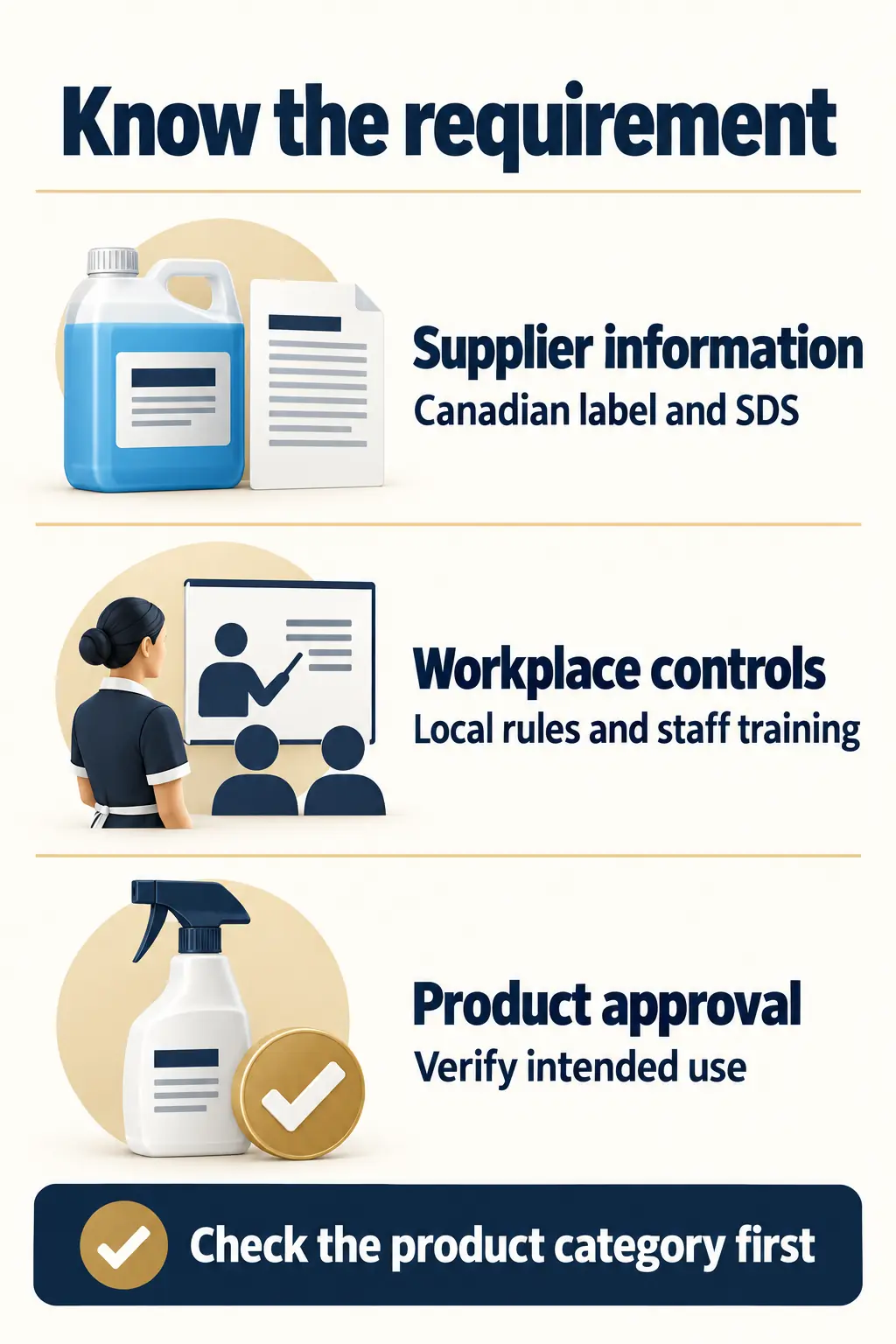
Start by establishing what kind of product the hotel is buying and which requirements govern its supply and workplace use. Cleaning chemicals do not all follow an identical documentation route. A commercial hazardous product, a consumer cleaner, and a product making disinfectant claims can require different checks. Assign that classification question to purchasing and the property’s safety lead before the next replenishment arrives, so a receiver does not have to interpret an unfamiliar exemption on a busy loading dock. The approved product record should state the applicable route, the documents expected, and the person who can resolve an exception.
Separate supplier duties from the hotel’s workplace duties
The Workplace Hazardous Materials Information System (WHMIS) combines supplier hazard information with workplace education and controls. Federal supplier requirements and employer obligations are distinct; employer rules depend on the applicable workplace jurisdiction. The CCOHS WHMIS program guidance connects procurement with product inventories, SDS access, labeling, training, and safe procedures.
For a hotel, this means naming both a document owner and an operational approver. Purchasing can obtain a revised file; housekeeping and the safety lead need to decide whether changed precautions affect the work. A receiver should be able to pause issue and reach those people without needing authority to approve a new chemical.
Confirm the product category before demanding an SDS
Health Canada’s supplier guidance describes WHMIS supplier exclusions, including consumer products and certain other regulated categories. Not every cleaning product used in a hotel legally requires a supplier SDS.
CCOHS explains that consumer chemical products in workplaces are exempt from WHMIS supplier SDS and label requirements, while workplace safety and training duties remain. Frequent occupational use can create exposure patterns different from occasional household use. Record the supplier’s explanation of the category and the information the hotel will use to assess the task; “sold at retail” should not become a shortcut for approving professional use.
If a required document is absent, ask for it. If the supplier says it is not required, ask for the basis and send the answer to the safety lead. Neither answer should be replaced by the receiver’s guess.
Account for the amended Canadian requirements
Health Canada states that the transition to the amended Hazardous Products Regulations ended December 14, 2025. Changes included hazard classifications and SDS information elements. As of this review, its approach emphasizes compliance promotion until July 19, 2027, with measures to compel compliance still possible during that period. That enforcement approach does not extend the legal transition.
Accordingly, a supplier’s explanation that “the artwork changed for updated Canadian requirements” is plausible, but incomplete as a receiving decision. Request the affected product codes and lots, the revised documents, and an explanation of any consequences for use. A regulatory update, an administrative correction, and a reformulation should be recorded as different causes.

Compare the Delivery With the Approved Product Record
Use the physical container as the starting point, then compare its identity with the order and the supplier’s documents. A catalog family name is not enough when the range contains several strengths or application formats. Keep the approved record specific enough to distinguish a concentrate from a ready-to-use product and one product code from a near-identical substitute. Record the lot and photograph the actual label when a discrepancy appears. This creates evidence that the supplier can investigate without relying on a verbal description of a bottle that has already been moved into storage.
Match the product before comparing revision dates
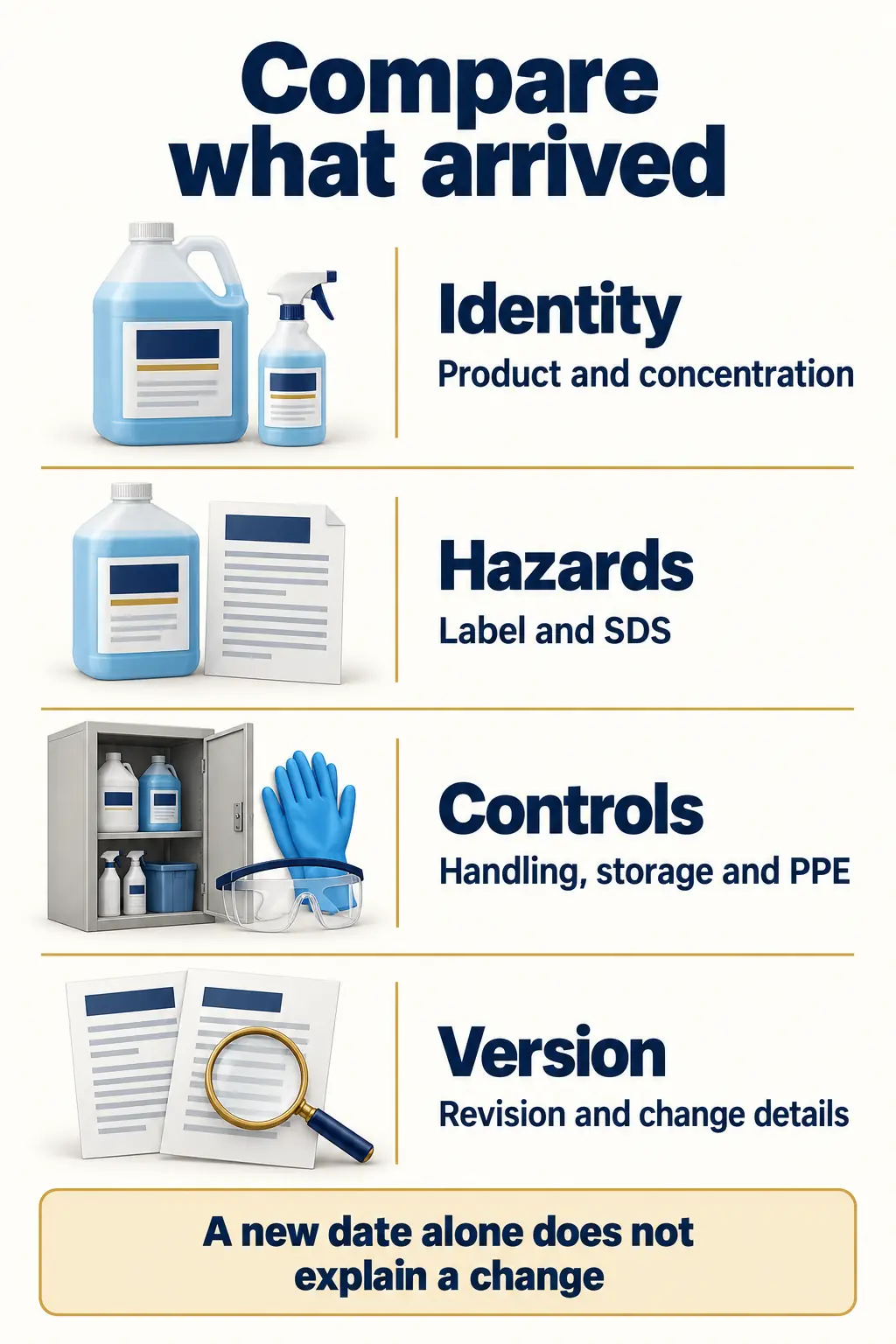
Check the label name, code, concentration, form, container size, and ordered quantity. An internal hotel nickname can help staff locate an item, but it should not replace the supplier’s identity in the receiving record. WHMIS requires the product identifier on the SDS to match the label. If purchasing uses a different code, keep an approved cross-reference rather than treating similar wording as a match.
The CCOHS SDS guide explains the document’s structure. Compare identity and hazards in Sections 1 and 2, relevant emergency information in Sections 4 and 6, and handling, exposure controls, and incompatibilities in Sections 7, 8, and 10. Section 16 supplies the revision date. Review other sections when the change points there; this is a focused comparison, not a substitute for reading the applicable SDS.
A supplier has no universal obligation to renew an SDS every three years. Employer verification or renewal rules can differ by jurisdiction. Treat the date as a way to identify the version, then establish whether it is current for the delivered product. A newly dated file can still belong to the wrong item.
Read the container label as well as the SDS
For products subject to the WHMIS supplier rules, required label and SDS information must be available in English and French. Separate language versions are possible. Use the CCOHS label guidance to review the product identifier, supplier details, and applicable hazard communication elements. Some classifications require neither a pictogram nor a signal word, so their absence alone does not prove a defect.
Look for text that has become unreadable, a changed product name, a different strength, or directions that conflict with the hotel’s approved use. A replacement label lying loose in a carton does not normally satisfy a container-label requirement. Refer missing or unreadable required labels for correction before use. Do not cover the supplier label with a stockroom sticker.
Use a consistent receiving review
The following checklist is an operational template. Complete it against the actual delivery and record the evidence, rather than checking boxes from memory. Mark each item Match, Review, or N/A; explain every N/A. A pending Review is not approval. A leak or unsafe package moves to the site’s response procedure, not a longer paperwork queue.
Record the property, province or territory, delivery date, purchase order, supplier, product/code, concentration/form, lot, and SDS revision before completing the rows.
| Review item | Evidence to record |
| Product identity | Label name, product code, concentration and form match order |
| Container condition | Seal, closure, leakage or damage |
| SDS applicability | Product category and basis if SDS not required |
| Current SDS | Matching supplier file and revision date |
| Language versions | Required English and French information available |
| Label comparison | Identifier, supplier and applicable hazard elements |
| Change explanation | Written reason, affected lots and effective date |
| Protective measures | Changes to PPE, handling, storage or emergency response |
| Use directions | Dilution, contact time and intended use changes |
| Antimicrobial authorization | Applicable Canadian authorization checked where claimed |
| Workplace readiness | Worker access, workplace labels and staff briefing completed |
| Release decision | Release/hold/escalate, owner, date and evidence reference |
Record the reviewer, release date when approved, hold location where relevant, and supplier response reference. The editable versions add space for status and notes beside each review item.

Decide What Can Be Released and What Must Be Held
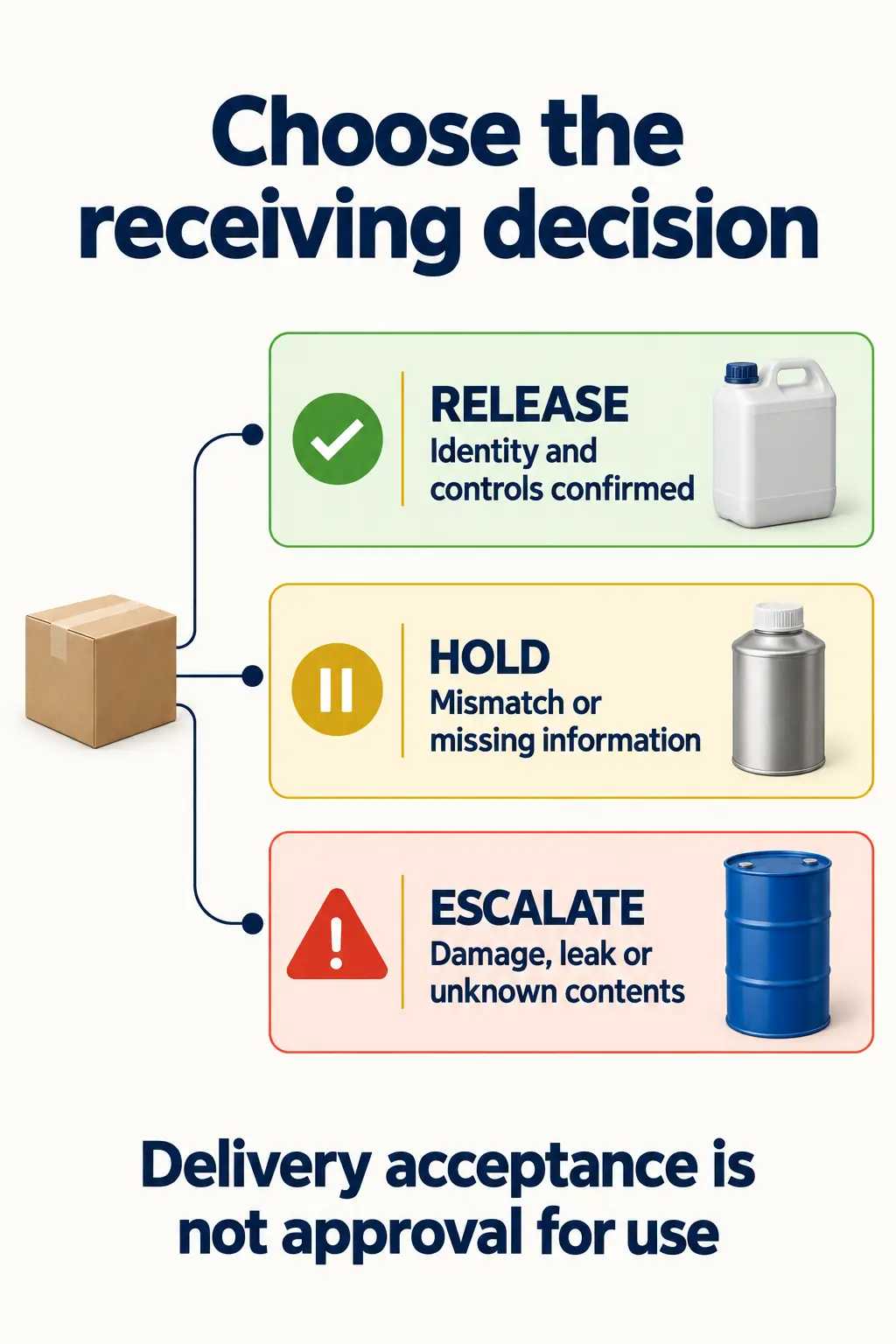
Define the receiving decision in terms of unresolved risk and missing evidence, rather than the visual size of a label change. A small instruction change may affect daily work, while a conspicuous redesign may leave the approved use unchanged. The proposed categories below give receivers a consistent escalation route. They are hotel operating rules to adapt with the safety lead, not statutory categories. Keep delivery acknowledgement and approval for use separate in the inventory process, so staff cannot interpret a signed delivery receipt or a counted carton as permission to issue the product.
| Finding | Suggested decision | Evidence needed to close it |
| Identity matches; applicable information and controls are ready | Release under the property’s procedure | Reviewer and decision recorded |
| Artwork or contact details changed; identity remains traceable | Review before release | Written explanation and corrected product record |
| Concentration, product identifier, use directions, or protective measures differ | Hold from use | Supplier clarification and operational approval |
| Required current SDS cannot be located, or a required label is unreadable | Hold from use | Correct accessible document or compliant label resolution |
| Leaking package, unsafe damage, or unknown contents | Escalate immediately | Site response procedure and trained personnel determine action |
Do not confuse a missing enclosure with a missing SDS
For repeat sales of the same hazardous product to the same customer, section 5.11 of the Hazardous Products Regulations permits reliance on the previously supplied SDS when it remains compliant. A fresh paper copy is therefore not necessarily required in every carton. The receiving question is whether the hotel has the correct current information available through its approved system.
Consider a hypothetical delivery with no paper sheet enclosed. The product matches the approved record, and the controlled file is confirmed as current. Record that verification. In a different delivery, the supplier’s portal offers only an unidentified file covering several products, and nobody can establish which version applies. Keep that product from issue until the ambiguity is resolved. The missing paper looks similar; the evidence available to make a decision is different.
Treat significant new data as information staff need now
Under section 5.12 of the regulations, the update periods begin when the supplier becomes aware of significant new data affecting hazard classification or protective measures: 90 days for the SDS and 180 days for the label. If relying on these periods to supply an existing SDS or label, the supplier must provide the required changes and the date the data became available in writing at sale. The periods do not justify withholding that information.
Build a place for that addendum into the receiving record. If the supplier identifies a new protective measure, the reviewer should consider it before release even if the final revised artwork is still pending. Keep the addendum linked to the affected product so it is not mistaken for an unrelated shipping note.
Verify disinfectant claims separately
An SDS addresses hazards; it does not establish authorization for a disinfectant claim. Health Canada’s biocides information explains the regulations in force since May 31, 2025 and the identification number used for authorized biocides. Legacy disinfectants and sanitizers have transition arrangements, so receiving should verify the applicable authorization route and approved directions for the exact product.
Health Canada’s transition guidance for authorized disinfectants and registered sanitizers explains how existing products move to the new framework. A changed regulatory number can have a legitimate transition explanation. Ask for the relevant authorization record before deciding what the change means.
For example, if a replacement label changes a contact time or the surfaces named in the directions, compare those instructions with the hotel’s intended task. Do not let an unchanged SDS close a separate question about how the product may be used.

Close the Change Before Housekeeping Uses It
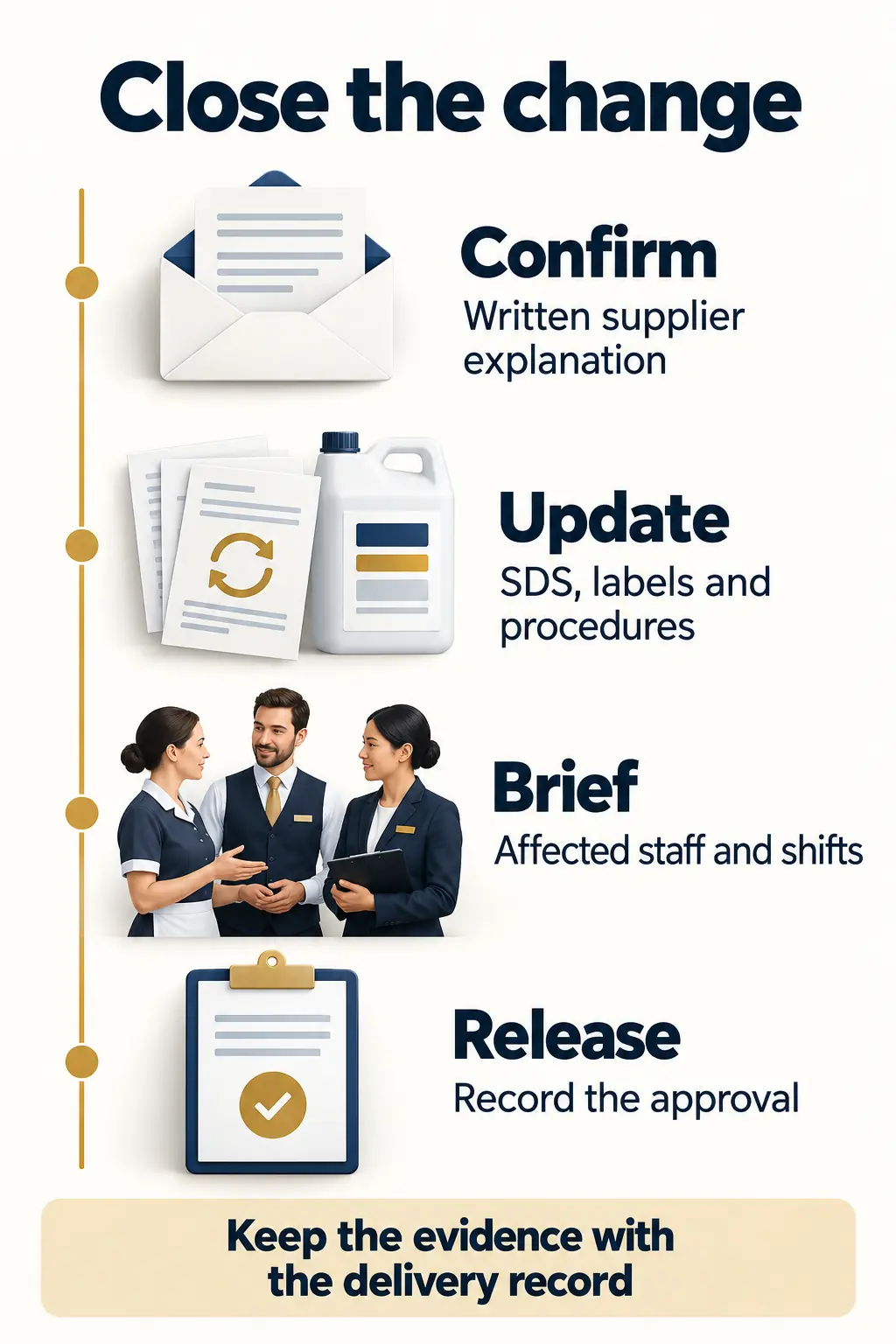
A hold is useful only when someone owns its resolution. Set a named reviewer, a supplier contact, and a follow-up date when the discrepancy is opened. The receiver records what arrived; purchasing obtains the missing evidence; the safety lead and affected department decide whether the proposed use remains appropriate. A small property may assign several roles to one person, but it should still record those decisions separately. Close the case by linking the supplier’s explanation to the delivery and documenting any changes needed before the product becomes available to housekeeping or another department.
Ask questions that produce a usable supplier response
Send the product code, concentration, lot, label photographs, and the versions being compared. Describe the specific discrepancy, such as a changed precaution or a different use dilution, rather than asking only whether the product is “the same.” Request confirmation of:
What changed: formulation, classification, use directions, supplier information, or presentation.
Which product codes and lots are affected, and when the change took effect.
Which SDS, label, and any addendum apply to the delivery.
Whether the new information changes the hotel’s proposed task or required controls.
How any incorrectly supplied product or label will be corrected.
A phone explanation may help resolve the question quickly, but capture the substantive answer in the delivery record. Avoid closing a case with “supplier contacted”; that records an activity without recording the answer.
Update the place where staff actually work
Once the safety review identifies an operational change, update the controlled SDS location, relevant workplace labels, task instructions, and staff briefing as applicable. Check the locations that can lag behind: a printed stockroom binder, a night-shift reference folder, a housekeeping cart, or an outsourced cleaning team’s instructions. The CCOHS WHMIS program emphasizes accessible information and training appropriate to actual work.
If a change affects a dispensing setup, route it to the person responsible for that equipment. Matching container size or connector shape does not establish that the approved concentration or directions still apply. This receiving review should identify that dependency; any setup verification belongs in the property’s separate equipment and chemical approval process.
Keep superseded records in the property’s controlled archive as required, clearly separated from the active version. Where old and new stock coexist, document which instructions apply to each. Use a physical and inventory hold that staff can recognize without obscuring the supplier’s information or moving incompatible products together.
Make the next purchase easier to receive
Include documentation expectations in the purchase specification: exact product identity, intended use, Canadian-market information, change notification contact, and approval requirements for substitutions. Ask for proposed changes before shipment when possible. This gives purchasing time to resolve questions while the hotel still has approved stock available.
For a housekeeping supply sourcing request, use KW Hospitality’s RFQ form to provide the product list, destination, quantities, required delivery date, and supporting specifications. Include the property’s documentation requirements and identify substitutions that need approval. The hotel retains responsibility for authorizing workplace use; the sourcing request should make the evidence needed for that decision clear.
Conclusion
A reliable receiving review ends with a traceable decision about the product that actually arrived. Match its identity, establish the applicable documentation requirements, explain meaningful changes, and confirm that the people and procedures using it are ready. Keep unresolved products from issue and route unsafe packages through the property’s response procedures. Over time, the most useful record is not a folder full of undifferentiated SDS downloads. It is the connection between an approved product, a particular delivery, the information reviewed, and the person who authorized its use. That connection makes routine replenishment easier to manage and unexpected changes easier to resolve.
Frequently Asked Questions
Can a US SDS be used for a Canadian hotel delivery?
A document can serve both markets if it meets the applicable Canadian requirements. A US origin alone does not disqualify it, but an OSHA reference or English-only file does not establish Canadian compliance. Have the supplier confirm the Canadian version and required language information. If the hotel imports a hazardous product directly, it can also have supplier obligations; a foreign supplier’s assurance alone does not resolve those duties.
Can a receiver put a hotel label over a damaged supplier label?
Do not improvise a replacement from memory or conceal the remaining information. Hold the product from use and have the responsible person arrange the applicable label correction under the property’s procedure and jurisdictional requirements.
Can the hotel release part of a mixed delivery?
Potentially, if the approved and held items can be clearly identified and controlled. Record the affected products, lots, and quantities separately. A discrepancy on one item should not silently become either blanket approval or an unexplained hold on every other item.
What should happen if the supplier has not answered before stock runs low?
Keep the unresolved item out of use. Escalate the supply problem to purchasing and the operating department, which can seek an already approved alternative or adjust the work plan. Urgency does not answer the identity or safety question that caused the hold.
References
1. Canadian Centre for Occupational Health and Safety — WHMIS – WHMIS Program
2. Health Canada — Guidance on the WHMIS supplier requirements
3. Canadian Centre for Occupational Health and Safety — Consumer Chemical Products in the Workplace
4. Health Canada — Amended Hazardous Products Regulations
5. Canadian Centre for Occupational Health and Safety — WHMIS – Safety Data Sheet (SDS)
6. Canadian Centre for Occupational Health and Safety — WHMIS – Labels
7. Department of Justice Canada — Hazardous Products Regulations (SOR/2015-17)
8. Health Canada — Biocides
9. Health Canada — Guidance on the transition of disinfectants and surface sanitizers to the Biocides Regulations: Transition of authorized disinfectants and registered sanitizers