Hotel janitorial tools for food-service areas should have a designated storage location outside food storage, with separate places for used equipment, drying tools, and clean replacements. Mops, floor brushes, buckets, and cleaning chemicals do not belong among ingredients, takeout containers, clean dishes, or service linens. The practical objective is to prevent contamination during storage and handling while making the correct return location easy for every shift to use.
The difficult moment is often the end of service. Breakfast closes while receiving staff bring in deliveries, a banquet team needs the corridor, and a wet mop is left beside the dry-store shelving because the utility room is full. A storage policy can look clear on paper and still fail if the hotel has no space for the equipment actually returning at that time. Buying more tools without planning their return can make the problem worse.
This guide helps hotel purchasing managers, food-and-beverage leaders, executive housekeepers, and engineering teams connect equipment selection to the building and its daily workflow. It covers storage boundaries, tool segregation, cleaning and drying, capacity planning, and a practical sample trial. It does not prescribe a universal color chart, chemical dilution, or cabinet size. Those decisions depend on the property, the product instructions, and the food operation being served.
For properties in the United States and Canada, confirm the requirements adopted by the authority responsible for the hotel’s food premises before approving a layout or plumbing change. National model guidance is not automatically the law in every location, and a food manufacturing rule should not be assumed to apply unchanged to a hotel restaurant. Treat the arrangements below as operational design recommendations to review against local requirements. The most useful purchasing question is simple: where will each tool go immediately after use, and what must happen before someone can take it out again?
Design a Storage Boundary That Works During Service
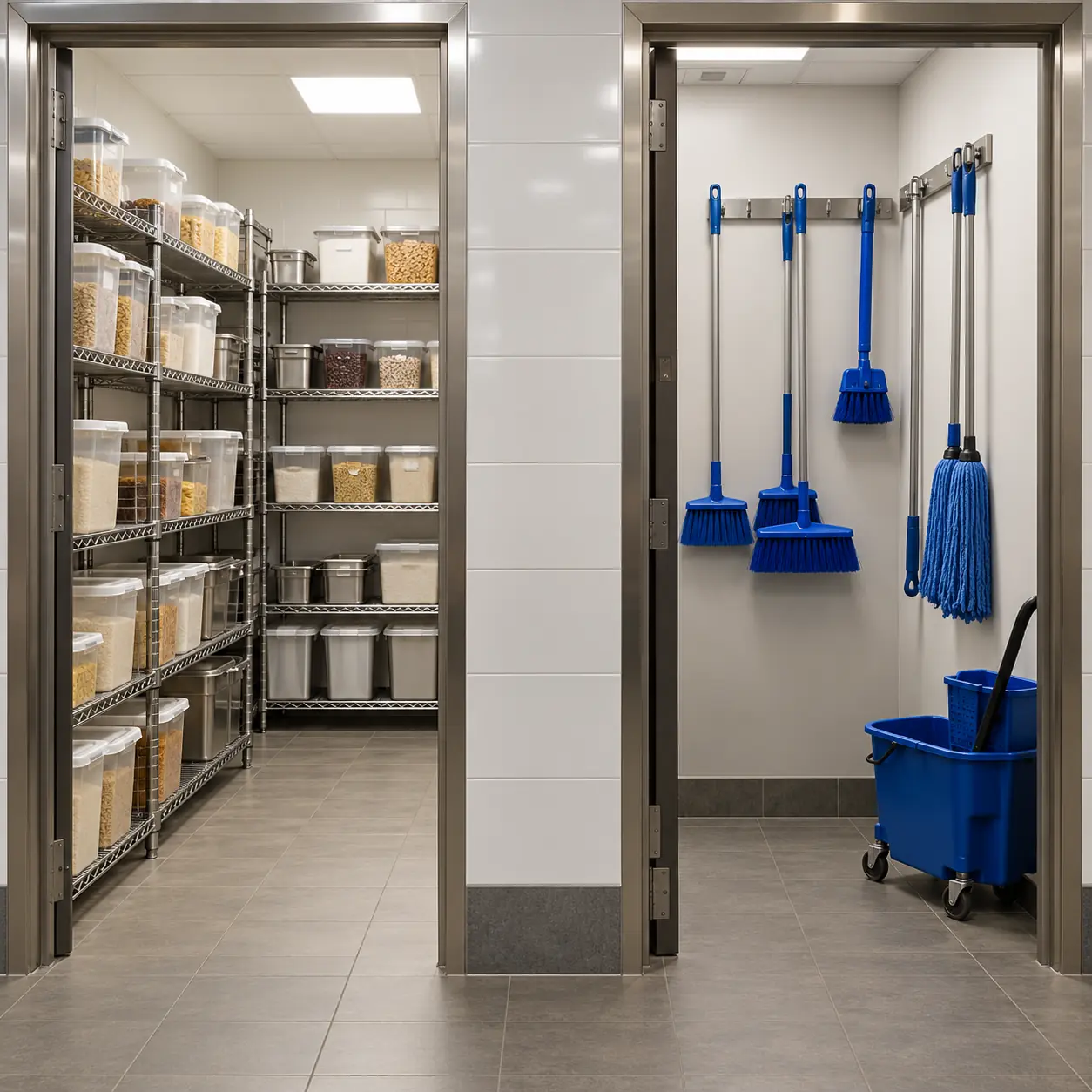
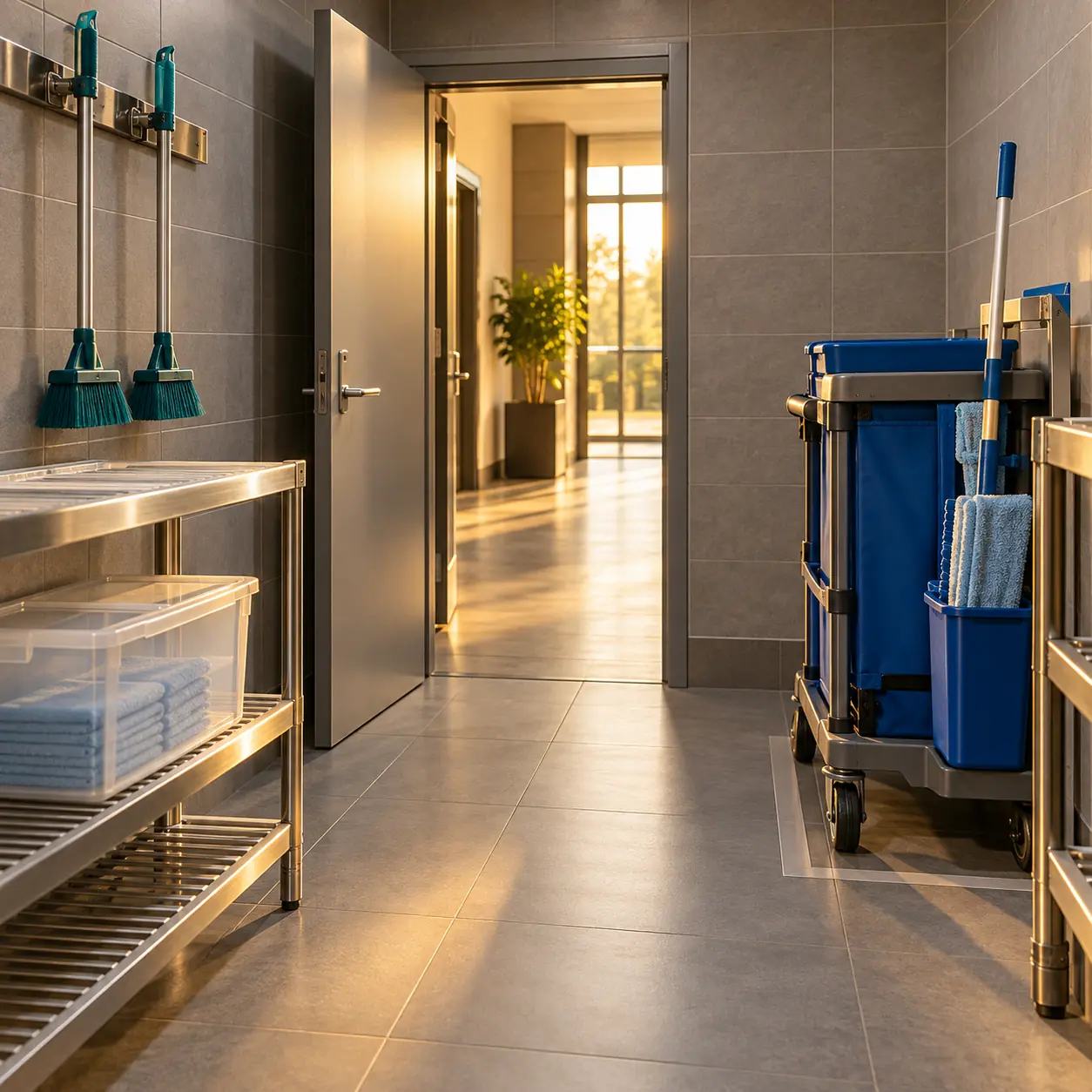
A dedicated janitorial room or properly designed cleaning-equipment area gives the hotel a clear boundary between food supplies and maintenance tools. The boundary must work when doors are open, carts are moving, and equipment is wet, not just when everything is arranged for inspection. Start with the return route from each food-service zone and identify where used tools are received, cleaned, dried, and stored. Then examine what is beside, below, and along that route. A mop rack may be tidy yet unsuitable if its drips reach clean supplies or staff must carry it past open food to reach the wash point.
Separate the tool room from the dry store
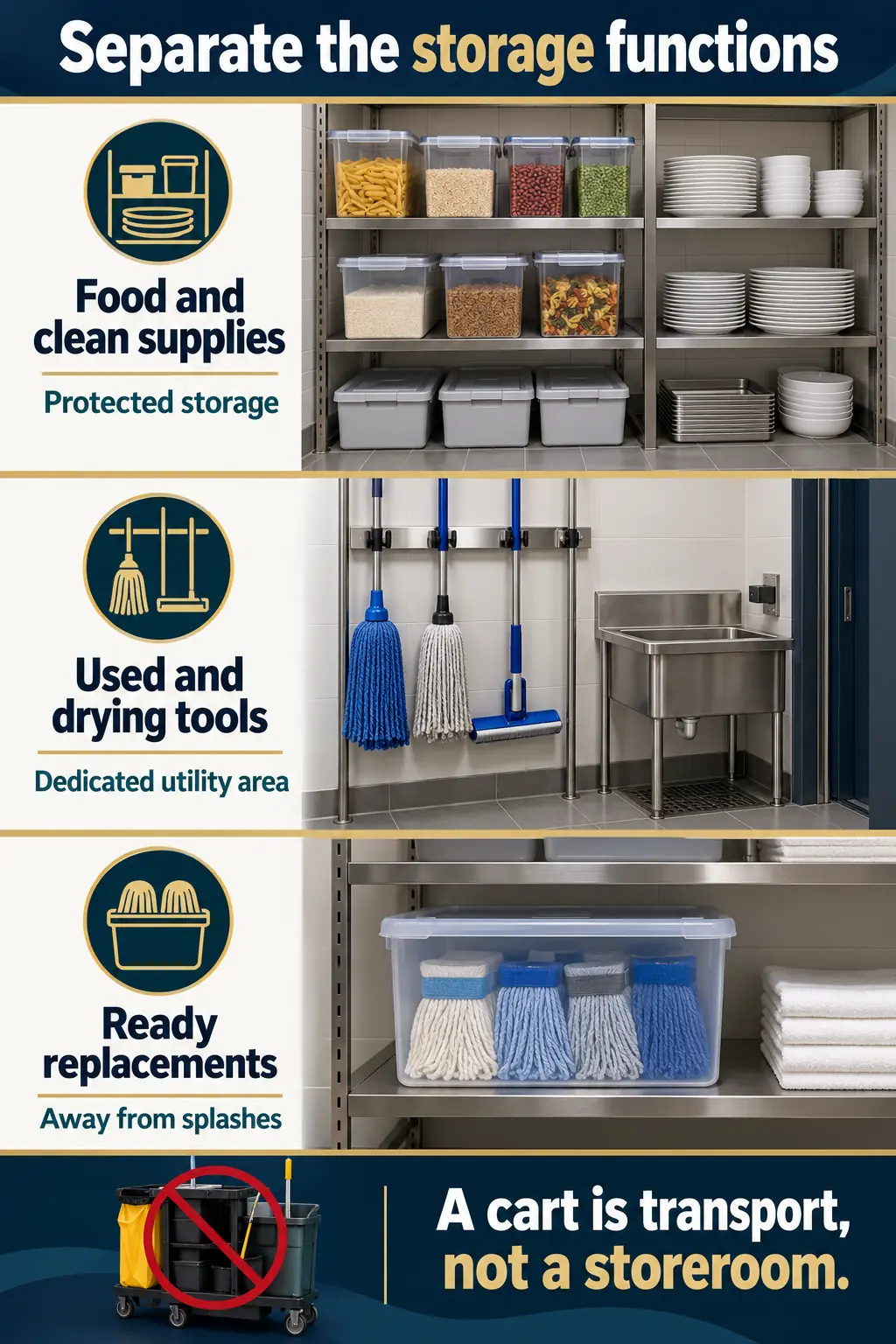
Plan food storage and janitorial storage as different functions. A broom hung above sacks of flour, a mop bucket under a food shelf, or a chemical caddy beside spare cups creates an avoidable contamination pathway. Sealed packaging does not make the outside of a container immune to dirt or spills. Keep cleaning equipment away from food-contact packaging and clean utensils as well as from the food itself. The FDA Food Code 2026, Section 6-501.113, supports this separation by specifying storage that prevents contamination and allows the storage area to be cleaned; it is a model for local adoption, not a universal requirement for a separate room.
A lockable chemical cabinet addresses access and spill containment; it does not automatically solve wet-tool storage. Conversely, a ventilated mop area does not establish that every chemical can be stored there. Assign compatible chemicals a suitable location based on their labels and safety data, with containers identified and closed. Do not put chemicals above food or clean food-service supplies. Keep chemical dispensing separate from tool drying where splashes could reach cleaned equipment.
Compare storage arrangements by their failure point
Use the following comparison when reviewing an existing room or a proposed retrofit. It describes design tradeoffs, not automatic regulatory approval. A small hotel may need a different arrangement from a property with several kitchens, but both need a controlled destination for returned tools.
| Arrangement | Useful role | Main limitation |
| Dedicated utility room | A defined home for receiving, washing, drying, and storing janitorial tools. | Fails if wet and clean items overlap or peak returns exceed the room’s capacity. |
| Segregated cabinet or alcove outside food storage | A possible retrofit for a compact operation, subject to local acceptance. | A cabinet alone may lack a suitable wash point, drainage, airflow, or space for wet returns. |
| Mobile cleaning cart | Moves the assigned tools to a task and back to their home location. | Does not replace a storage and cleaning area; parking it in the pantry recreates the problem. |
| Shared shelf in the food store | Convenient access to tools near the work area. | Food, packaging, and tools share handling and spill pathways; redesign the arrangement. |
Give water and traffic their own route
Locate the approved service sink or other approved mop-cleaning facility where staff can use it without carrying dripping tools through food handling. Do not wash floor-maintenance tools or dispose of mop water in a handwashing sink, food-preparation sink, or warewashing equipment. The required plumbing arrangement and any permitted alternatives need local confirmation. An ordinary floor drain should not be assumed to be an approved dump point. See FDA Food Code Sections 5-203.13 and 6-501.15 for the model provisions on service sinks and maintenance-tool cleaning.
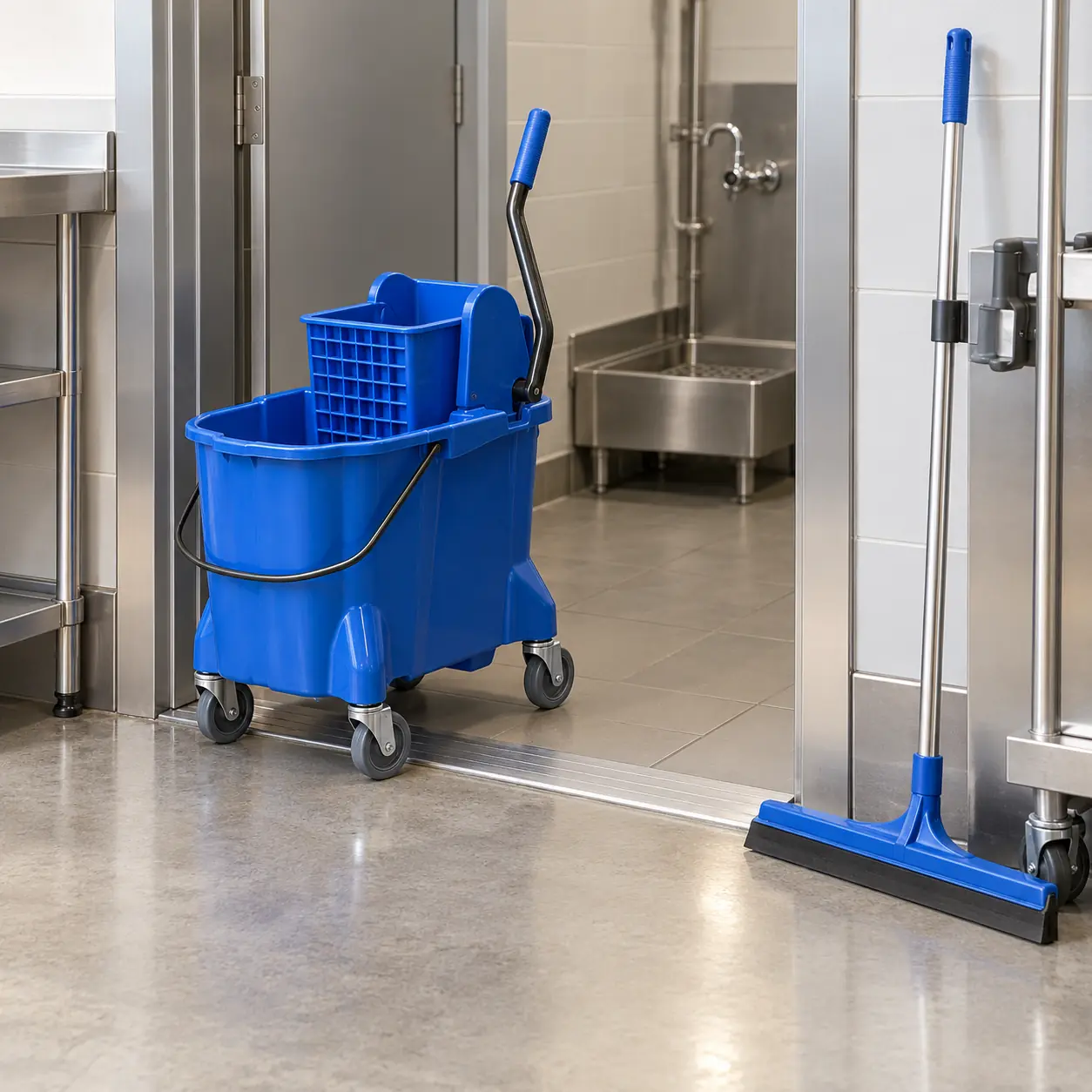
Inside the utility area, provide access to clean the floor and the space behind equipment. Hang appropriate tools so they can drain and dry without touching food-service supplies or soiling walls. Keep clean replacements outside the splash area. Test doors with the bucket and cart present: the route still needs to accommodate staff, deliveries, and required exit access. Tape on the floor can clarify a parking position, but it cannot contain a splash or replace a physical separation where one is needed.
Control Tools from Issue to Cleaning, Drying, and Return
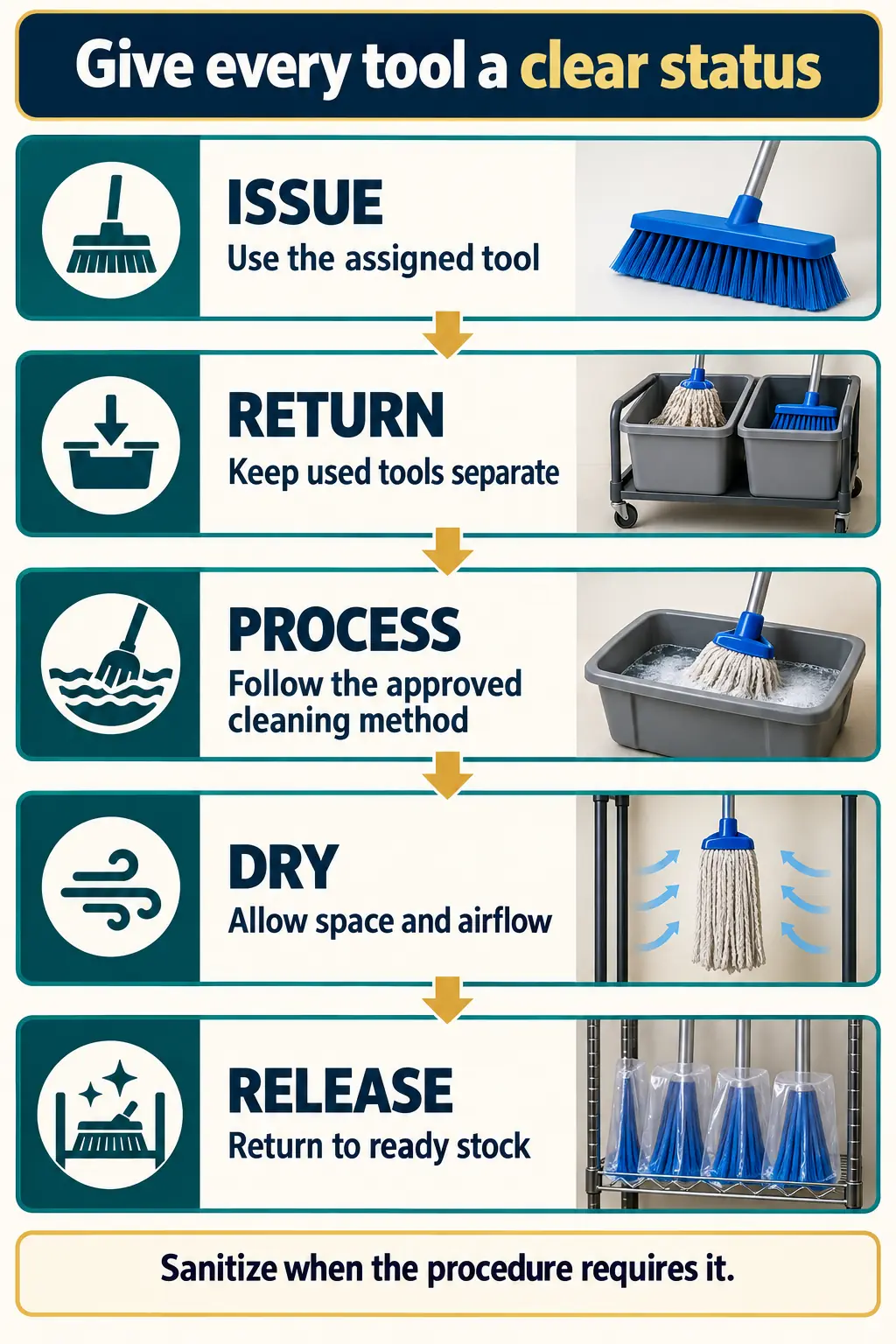
Each food-service cleaning tool needs an assigned job and a clearly understood condition: ready for use, used and awaiting cleaning, or cleaned and drying. Color can help staff recognize the assigned zone, but color alone says nothing about whether the tool has been processed correctly. Keep floor and drain equipment separate from tools intended for food-contact surfaces, and keep restroom equipment out of the food-service tool pool. Build the return process around the hotel’s actual sanitation program, using the CFIA cleaning and sanitation framework as a planning reference so the next employee can distinguish a ready item from one that has merely been put back on a hook.
Assign tools by task before selecting colors
Define the categories the operation needs: general kitchen floors, drains, food-contact equipment, and any other area requiring dedicated tools. Keep drain tools distinct even from general floor tools. Select colors that the supplier can maintain across handles, heads, buckets, and replacements, then display the hotel’s own legend in the relevant staff languages. Add words or clear symbols so the system does not depend entirely on color recognition. Do not present one supplier’s chart as a universal legal standard.
A tool used in a restroom should not return to a kitchen rack simply because it is the correct color. If an item crosses its assigned boundary, remove it from the ready stock and follow the property’s corrective procedure before reuse. For allergen-related tasks, the food-safety lead should decide whether dedicated tools are needed and how cleaning effectiveness will be verified. A colored brush is an identification aid, not evidence that allergen residue has been removed. The CFIA allergen-control guidance distinguishes equipment identification from effective cleaning and verification.
Return used equipment without contaminating ready stock
Bring only the equipment needed for the task into the food-service area. Remove or protect exposed food and clean supplies before cleaning nearby. Avoid methods that spread dust, droplets, or debris onto food and food-contact surfaces. After the task, take used tools to their assigned return location; do not rest a dirty mop head on a cart shelf intended for clean cloths. Keep the dirty return container and its handling surfaces within the cleaning schedule.
Clean the tool using the method approved for its material, construction, and contamination. Where the sanitation program requires sanitizing, use a product suitable for that application and follow its directions for concentration, contact time, temperature, and any rinsing. Cleaning removes soil; sanitizing is a separate control and cannot be assumed to compensate for visible residue. Product instructions also determine whether a particular cleaner is suitable for a food-contact surface. Never substitute a general-purpose disinfectant on that basis alone. In the United States, EPA guidance on sanitizer labeling confirms that a shorter Food Code exposure time does not override the contact time on the registered product label.
Match reusable pads and cloths to the laundry process as well as the cleaning task. Ask for documented washing and drying instructions rather than guessing a universal temperature or chemical combination. Use the established soiled-textile collection route, and keep clean stock protected until issue. The hotel’s cleaning chemical selection should be coordinated with its tool materials and approved procedures so a replacement product does not quietly invalidate the process.
Make drying a real stage
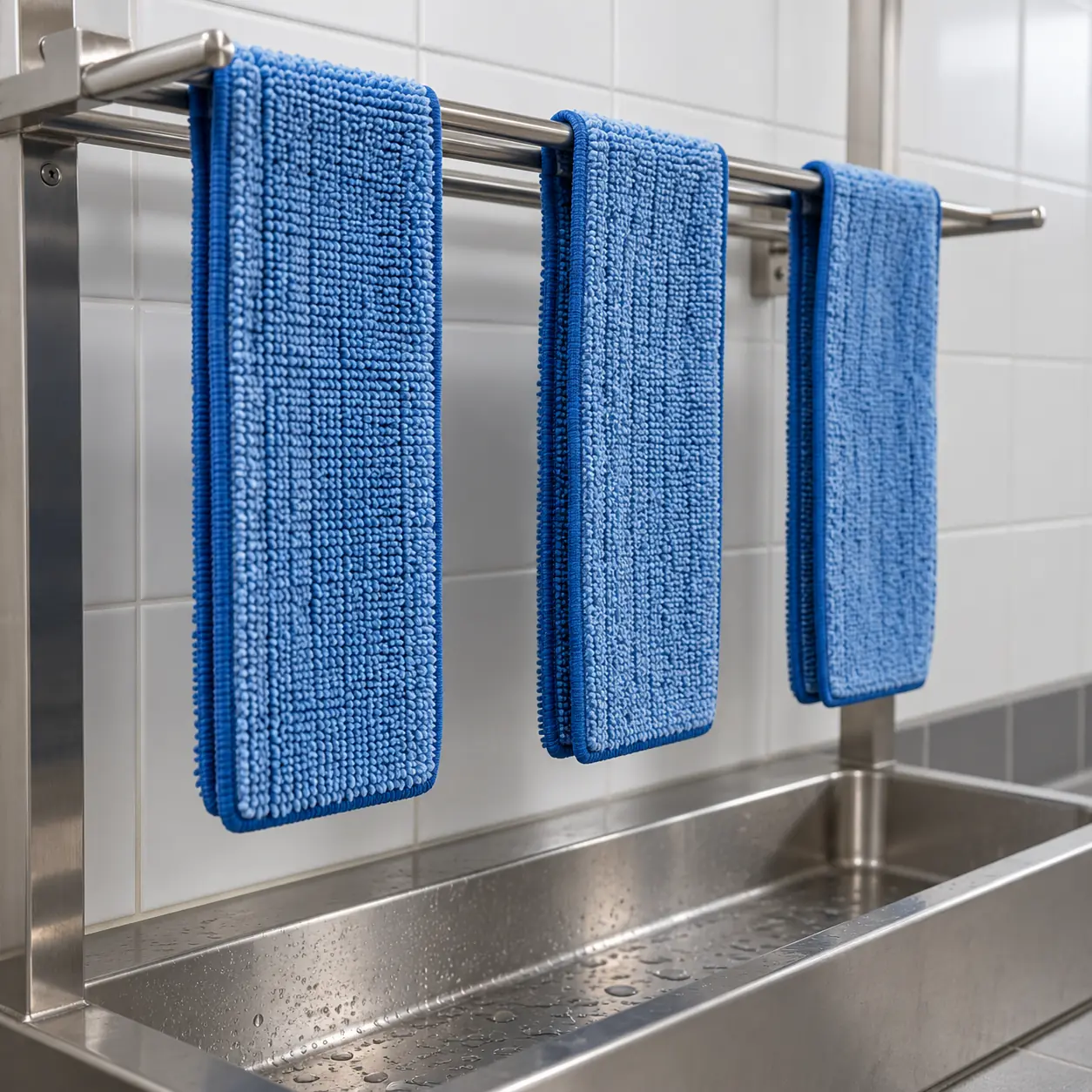
After cleaning, position mops to air-dry without soiling nearby surfaces or supplies. Avoid leaving wet heads standing in dirty water or sealing damp equipment into an unventilated container for storage. Separate drying items from tools already released for use. A rack is useful only if the actual head can hang freely, adjacent items do not press together, and the installation allows the surrounding area to be cleaned.
Assign a person on each shift to release cleaned tools back to ready stock after the required process is complete and the item is in acceptable condition. For a small team, the same employee may perform several steps; the distinction between used, drying, and ready must still be visible. Before returning to food handling, employees must complete the hand hygiene and clothing or glove changes required by their task and the property’s procedure.
A housekeeping cart restocking routine can help organize issue and replenishment, but the food-service team should set its own tool assignments and return rules. Guestroom, restroom, and kitchen carts should not become an informal shared inventory whenever a shift runs short.
Buy for the Return Route and Test the Complete Setup
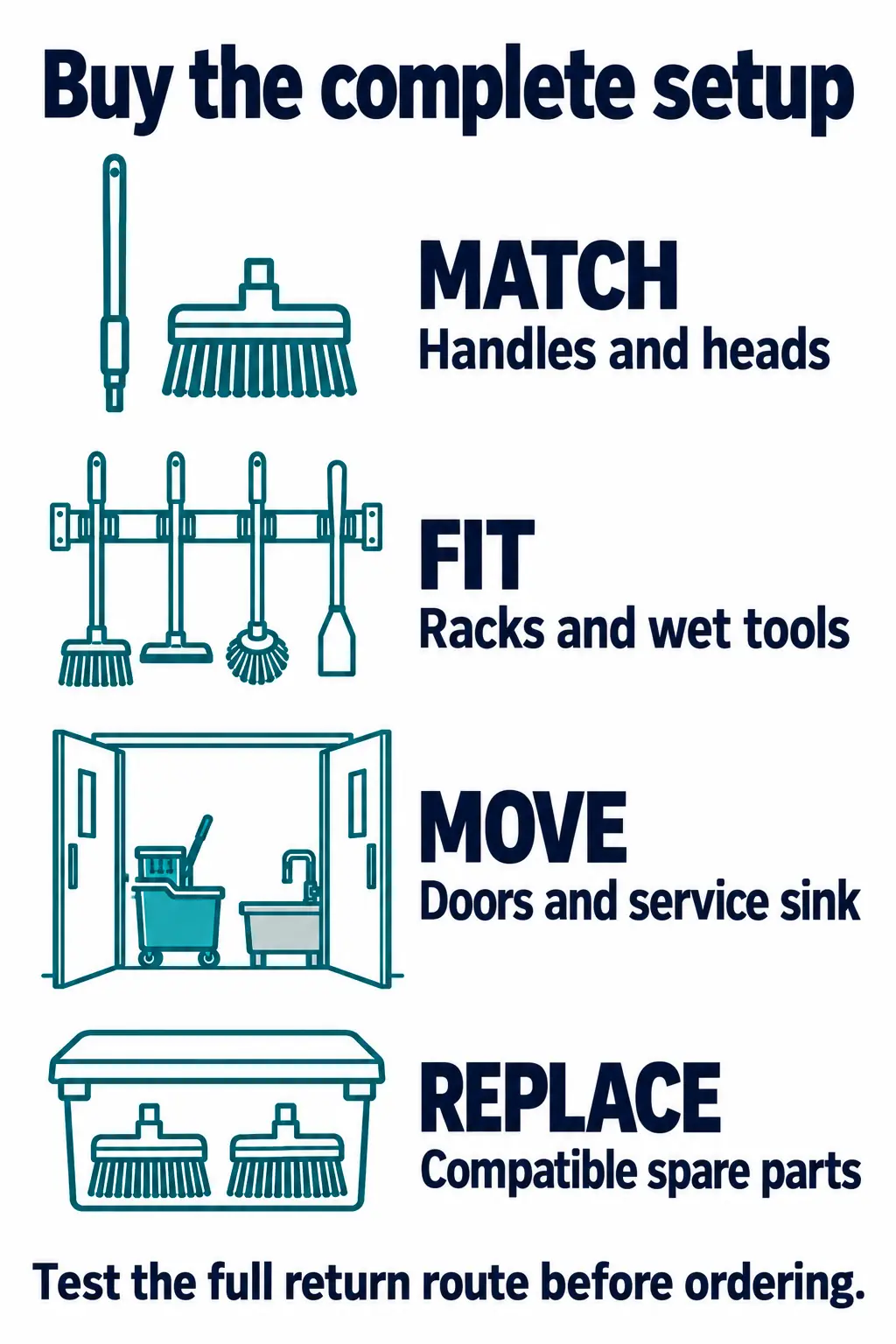
Specify the storage and return arrangement before ordering a large batch of janitorial tools. A low unit price has limited value if the handle will not fit the rack, the bucket cannot be emptied safely at the service sink, or replacement heads arrive in a different connection system. Purchasing, food service, housekeeping, and engineering should review one complete sample set together. The useful trial starts with taking a tool from storage and ends with its return to ready stock. This exposes practical mismatches that a catalog photograph or an empty-room measurement will miss.
Compare complete systems, including replacements
Give potential suppliers the intended task, floor or equipment surface, cleaning method, chemical exposure, storage dimensions, and expected replacement pattern. Ask for exact model identifiers and written compatibility information. Descriptions such as heavy-duty, commercial, or food-grade do not establish that a tool fits a particular task or sanitation process. For food-contact equipment, Québec’s equipment guidance reinforces the need for cleanable surfaces, sound condition, and use according to purpose.
| Purchase decision | Information to compare | Operational consequence |
| Handle and head connection | Connection type, dimensions, compatible model numbers, and replaceable parts. | A similar-looking replacement may not connect securely. |
| Tool construction | Cleanable joints, bristle retention, drainage, material compatibility, and care instructions. | Cracks, trapped soil, or shedding parts can make continued use unsuitable. |
| Rack and mounting | Grip range, tool spacing, load rating, wall substrate, and mounting instructions. | A rack must hold the actual wet tool securely while allowing cleaning and drying. |
| Bucket and cart | Loaded size, turning space, wheel suitability, lifting method, and sink access. | Fit should be tested through the real doorway and at the disposal point. |
| Replacement supply | Lead time, minimum order, recurring color availability, and change notification. | A stockout should not force borrowing from another cleaning zone. |
The housekeeping and janitorial supply range can be used to define product families for an inquiry. Keep the project specification more detailed than the category name: include the matching rack, spare heads, approved textile process, and any required documentation. Do not assume that equipment sourcing includes approval of the site’s food-safety layout.
Size drying capacity for the busiest return period
Count how many tools may occupy the drying area at the same time. Daily averages can hide the busiest period after breakfast or banquet close. As an illustrative capacity example, suppose six cleaned mop heads are still drying when four more heads return and become ready for drying. The rack needs ten separate positions at that moment, before any additional operating reserve. These are assumed quantities, not a prescribed par level or a measured drying time.
Measure the time each tool actually occupies a drying position under the proposed conditions, including airflow and spacing. Then observe overlapping returns across the busiest shifts. Use the highest simultaneous occupancy as the starting capacity, and choose any reserve from the hotel’s service pattern. Maintain sufficient ready replacements for the drying interval. Buying twelve heads for a rack with four usable positions can simply move the excess onto the floor or into a bucket.
Run a sample trial before approving the order
Use the proposed equipment during a representative service close, under the property’s approved cleaning procedure. Record where staff stop, where wet tools wait, which doors or carts obstruct movement, and whether drying items encroach on clean stock. Observe receiving and replenishment at the same time if those activities normally overlap. Do not introduce contamination to test the system; ordinary workflow observation is sufficient for finding layout and handling problems.
Set practical acceptance criteria before the trial: no tools parked in food storage, no contact between used and ready items, adequate drying positions at peak return, secure rack retention, and a usable route to the approved wash point. These are operating acceptance criteria, not microbiological proof. If the food-safety program calls for additional verification, use the appropriate method and qualified interpretation; a visually tidy room does not prove that sanitation was effective.
When the trial fails, correct the cause before adding inventory. An overcrowded drying rack may need more positions or a different return schedule. Repeated borrowing may indicate too little ready stock, slow laundry turnaround, or unreliable replacement supply. A bucket left in the dry store may reveal an inaccessible utility room. Give the responsible department a specific corrective action and repeat the affected part of the trial.
After approval, retain the sample identifiers and the accepted configuration with the purchasing record. Review the arrangement when a tool, chemical, menu process, laundry service, or room layout changes. Remove damaged tools from service promptly and hold them apart from usable stock so they cannot be taken out accidentally.
Conclusion
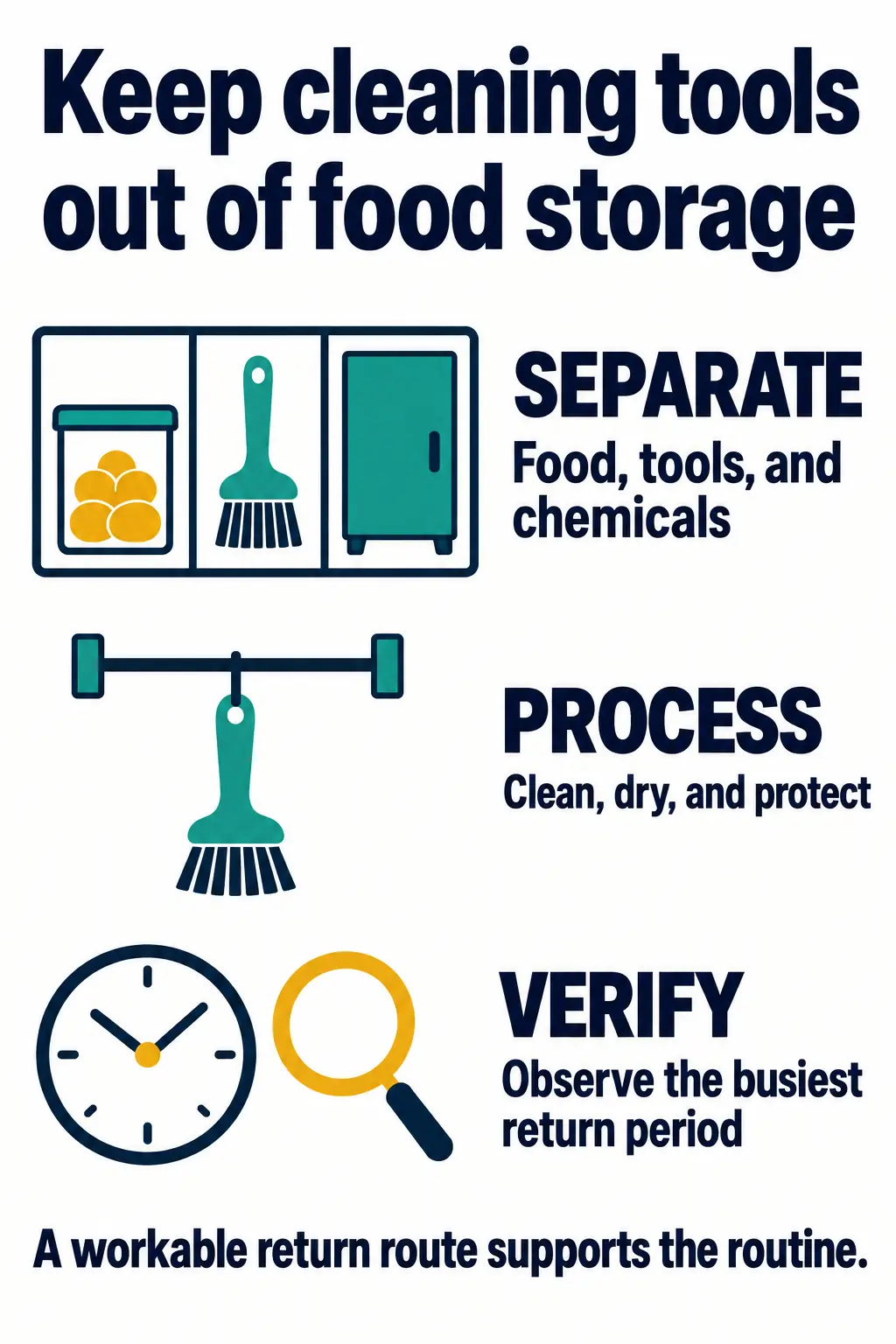
Keeping hotel cleaning equipment out of food storage depends on a workable destination for every tool. Define the storage boundary, distinguish used and drying equipment from ready stock, and size the arrangement for the busiest return period. Buy tools, racks, buckets, and replacements as a compatible set, then observe the complete route during a normal service close. The result should be a process staff can follow without borrowing from another zone or parking equipment beside ingredients. Local requirements and product instructions remain the basis for approval; an attractive rack or a matching color scheme cannot replace them.
For a new opening or a storage retrofit, prepare the tool list, proposed quantities, room and doorway measurements, cleaning method, replacement needs, project location, and target delivery date. You can send KW Hospitality a janitorial equipment inquiry with that information to discuss sourcing options. Keep final sanitation procedures and layout approval with the hotel’s responsible team and the relevant local authority.
Frequently Asked Questions
Can a pantry keep a new, unused broom on its food-storage shelf?
A new broom still needs a designated storage location. Keeping it among food or food-contact packaging makes its handling and future return ambiguous. Place unused replacement tools in the assigned clean tool storage area, protected until issue, rather than making the pantry shelf an exception that later accepts used equipment.
What can a small hotel do if it has no separate janitorial room?
Review a designated cabinet, alcove, or other separated arrangement with the authority responsible for the food premises. It must address used returns, cleaning, drying, chemicals, and access to the approved wash facility. A lockable cabinet may be useful for some functions but will not necessarily accommodate a wet mop safely. Avoid treating a nearby food shelf as temporary overflow while the layout is being resolved.
Can kitchen and restroom tools use the same utility room?
A shared utility room may be workable where local requirements permit it, but the tools should remain in distinct, identified groups. Evaluate the wash process, splash exposure, drying positions, and handling sequence so restroom equipment cannot contaminate food-service tools. Separate rooms may be preferable when the shared arrangement cannot maintain those controls during normal use.
Does a closed food container make nearby chemical storage acceptable?
A lid does not remove the need for appropriate chemical separation. A leak or handling error can contaminate the container’s outside, nearby packaging, or equipment. Store chemicals in their assigned location with suitable containment, identification, and compatibility controls. Do not rely on closed food packaging as the main barrier.
What should staff do if a chemical spills near food or clean utensils?
Stop the affected activity, isolate potentially exposed food and equipment, and notify the responsible manager. Follow the spill procedure and the product’s safety instructions. Do not serve food or return utensils to use until the manager has determined the appropriate disposal or cleaning action. Moving the chemical container alone does not resolve possible exposure.
Should tools be replaced on a fixed monthly schedule?
Use the manufacturer’s guidance, observed condition, task, and sanitation performance to set replacement rules. Inspect for loose bristles, cracks, damaged grips, trapped residue, and parts that no longer clean or dry adequately. A purchasing schedule can support replenishment, but it should never require staff to continue using a damaged tool until the next order date.
References
- U.S. Food and Drug Administration — FDA Food Code 2026
- Canadian Food Inspection Agency — Cleaning and sanitation program
- Canadian Food Inspection Agency — Preventive controls for food allergens, gluten and added sulphites
- U.S. Environmental Protection Agency — Pesticide Labeling Questions & Answers
- Gouvernement du Québec — Matériel (5 M)