
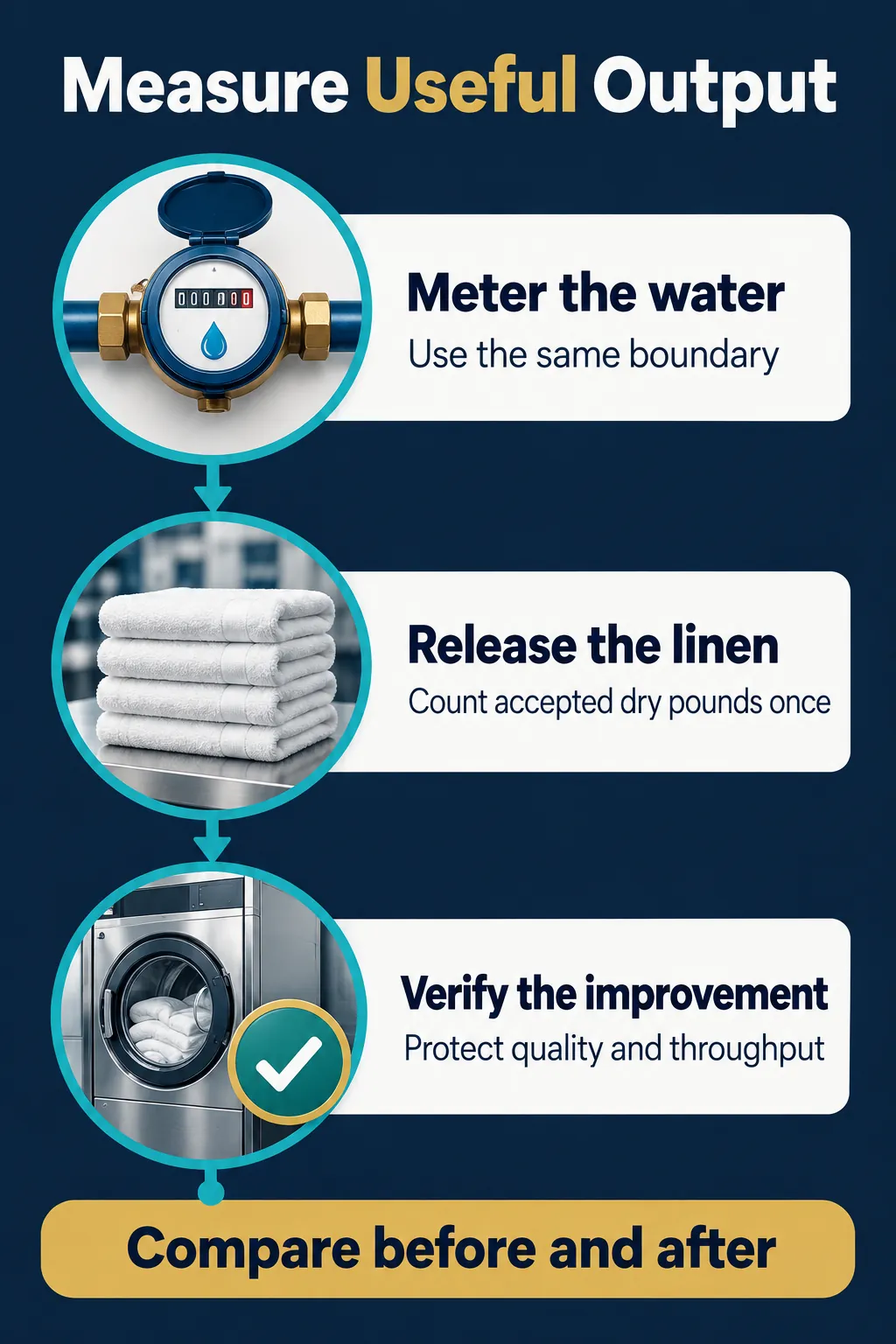
A hotel should evaluate laundry equipment replacement by measuring the water required to deliver usable linen, not simply the water consumed during a selected wash cycle. The practical calculation is straightforward: divide the measured water entering a clearly defined laundry boundary by the dry-equivalent weight of linen accepted for return to service. Include the water used for repeat washes and extra rinses. Count each accepted item only once for that laundering episode.
That distinction matters when a replacement washer appears efficient on a specification sheet but operates differently in the hotel. An economical program may require additional rinsing, create more stain rework, or take longer to produce the day’s linen requirement. Conversely, a well-controlled replacement may reduce consumption while maintaining the same release standard. Total utility bills cannot reliably separate these outcomes from changes in occupancy, restaurant activity, leaks, or laundry sent off site.
The EPA’s laundry equipment guidance discusses water use per pound and the importance of equipment, loading, and wash settings. This article extends that measurement into an explicit hotel operating method: water per accepted dry pound. It is a proposed decision metric, not an EPA certification requirement or a universal industry acceptance standard. The hotel’s laundry, housekeeping, engineering, and procurement teams must agree on what qualifies as accepted output.
The following method focuses on on-premises hotel laundries evaluating washer-extractors or a broader laundry-system replacement. It explains the denominator, meter placement, baseline records, fair comparison, and purchasing decision. All numerical examples are hypothetical. They show how to calculate and challenge a result, not the savings any particular machine will deliver. Keep water, linen quality, production capacity, and drying performance visible together so a lower water figure represents a useful operating improvement.
Define Accepted Dry Pounds and the Water Boundary
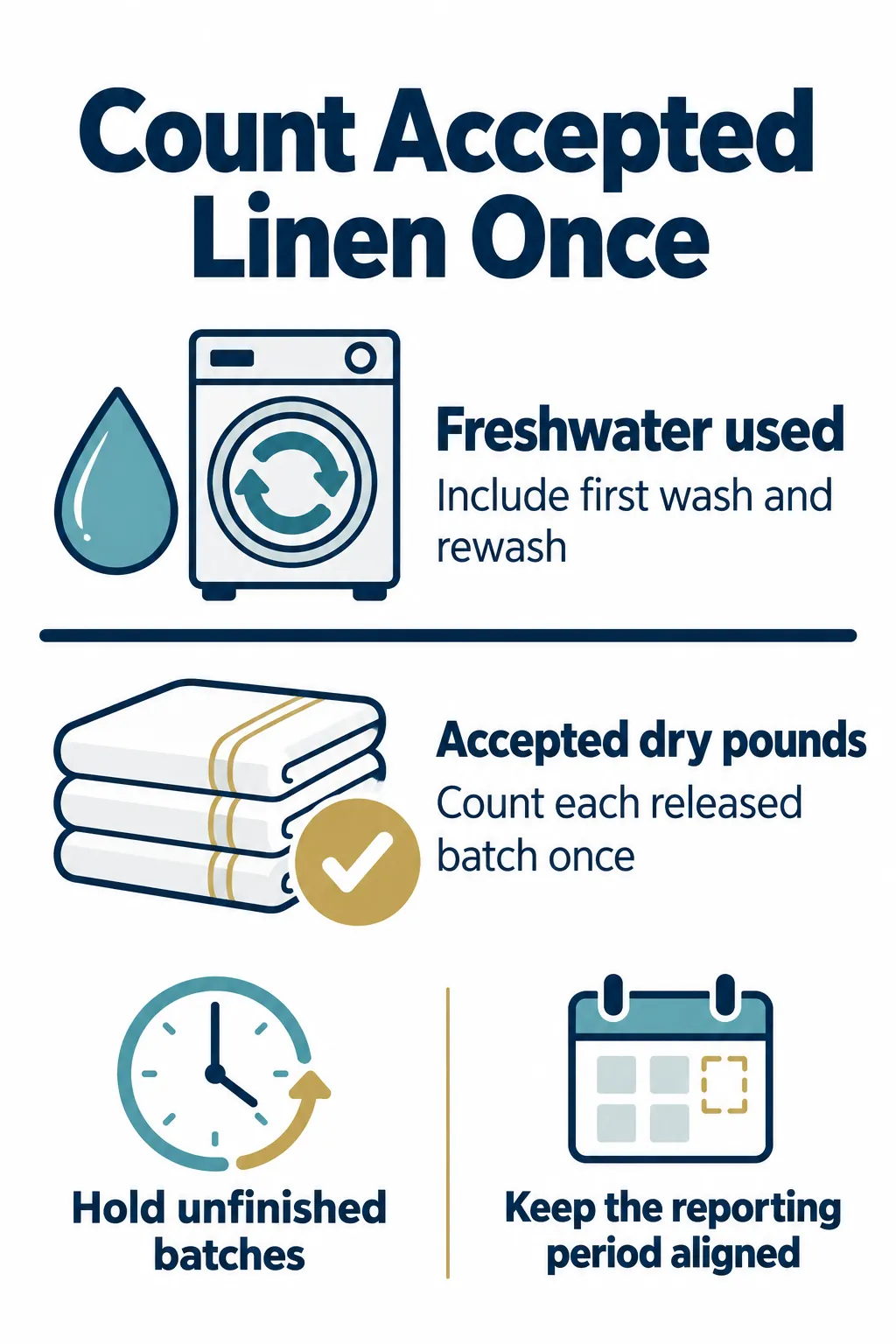
The numerator and denominator must describe the same work. For the main comparison, use freshwater measured at the selected boundary and the dry-equivalent weight of linen released from the corresponding laundering episodes. Do not substitute rated washer capacity, wet discharge weight, or the sum of every wash pass for accepted output. A consistent definition prevents the same linen from earning production credit each time it is rewashed. It also prevents a change in metering scope from appearing to be equipment savings. Agree on these definitions before collecting a baseline or asking suppliers to demonstrate performance.
Calculate the primary metric
Water intensity = total measured freshwater used ÷ accepted dry-equivalent linen weight.
Report the result as US gallons per accepted pound, written as US gal/accepted lb. A metric alternative is liters per accepted kilogram. Identify which gallon is used; US and Imperial gallons are different. To convert US gal/lb to L/kg, multiply by approximately 8.3454. Keep the same units throughout the comparison and show the denominator definition beside the result.
The EPA’s benchmarking guidance recognizes that activity-based measures, including water per pound of laundry, can describe performance and that the basis of a denominator needs to be documented. Here, “accepted” adds a quality condition: the linen must meet the hotel’s agreed release criteria.
Count release, rewash, and rejection consistently
| Linen event | Treatment in the calculation |
| Accepted after the first wash | Include its associated water; count its accepted dry weight once. |
| Rewashed and then accepted | Include all associated wash and rinse water; count accepted weight once, after release. |
| Permanently rejected after washing | Include its consumed water; add no accepted weight. Record the rejection reason separately. |
| Still awaiting inspection or rewash | Keep it as work in process; reconcile it before closing the comparison. |
| Previously released linen returns after another guest use | Treat this as a new laundering episode, eligible for a new accepted-output count. |
For example, 3,000 US gallons used to produce 1,000 accepted dry pounds equals 3.00 US gal/accepted lb. If those linens also generate 100 pounds of repeat wash passes, dividing by 1,100 gives 2.73 US gal/pass-lb. Both ratios can be calculated, but they answer different questions. The lower pass-based figure does not mean that less water was required to provide usable linen.
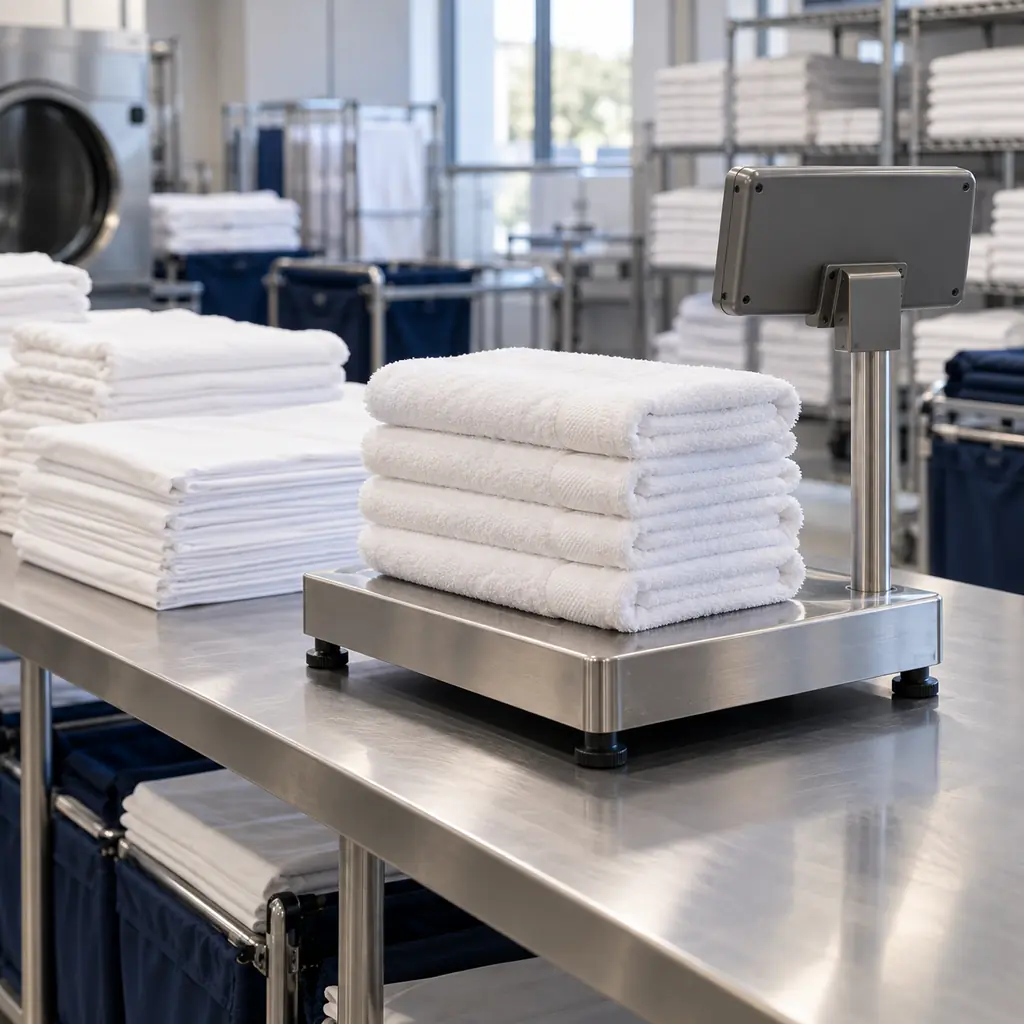
Weigh finished dry linen under consistent conditions, subtracting carts, bags, and containers. Zero and tare the scale as appropriate, and check its accuracy with a suitable known weight under the manufacturer’s procedure. Alternatively, multiply accepted item counts by representative dry item weights verified for each textile type. Recheck those weights when specifications change or wear materially changes mass. Neither approach means oven-drying every towel; it means using a stable, documented dry-equivalent basis. Soiled or freshly extracted wet weight cannot be treated as dry output without a defensible conversion.
Select a boundary that matches the purchase
A washer-only boundary measures the new hot and cold water supplied to the machines under comparison. A laundry-system boundary can also include attributable freshwater used for treatment, regeneration, chemical flushing, cleaning, and other support operations. The broader boundary is useful when a proposal changes these supporting systems. Name every inclusion and exclusion, and preserve them before and after replacement.
Do not add a water-heater cold-feed reading to downstream hot-water consumption if both represent the same water. Likewise, circulating hot water is not automatically new consumption. Where a common pipe serves other hotel operations, add suitable submeters or establish an independently supported allocation; do not call the whole branch a laundry measurement.
With internal water recovery, count new makeup water entering the chosen boundary once. Monitor recycled flow separately rather than counting every circulation as new water. Include freshwater used for backwash or cleaning when it falls inside that boundary. If an external reclaimed-water supply is used, report potable freshwater and total external water supply separately: replacing potable water with another supply is different from reducing total supply volume. Align recovery-tank levels at the start and end of short comparisons, or account for the inventory change.
Build a Metered Baseline You Can Reproduce
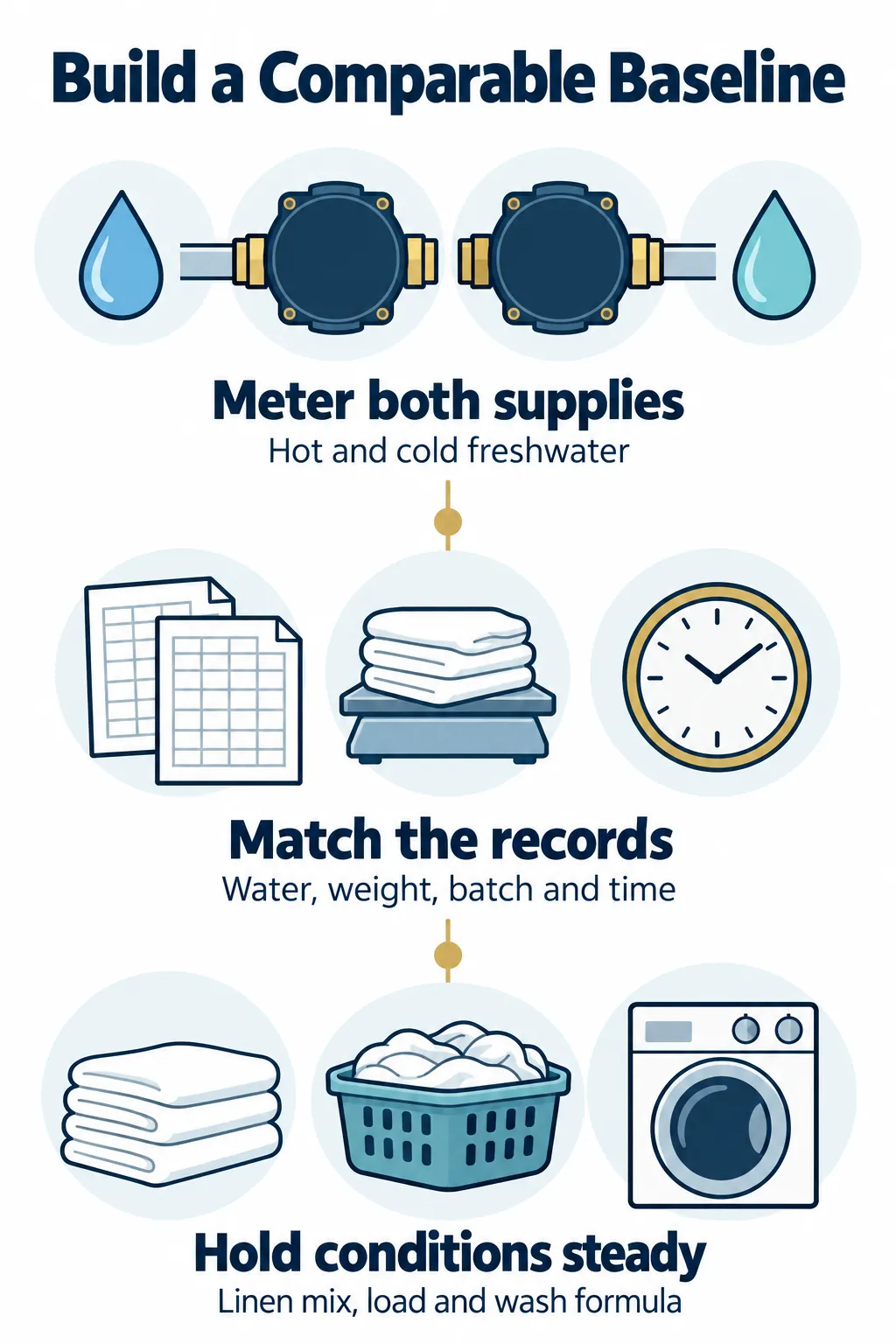
A credible baseline links meter readings to actual laundry work and final release decisions. Engineering should confirm where water crosses the boundary; laundry supervisors should record loads and formula versions; housekeeping should apply the agreed acceptance rules. Use synchronized timestamps so water consumption and accepted output belong to the same trial. Collect enough repeated, representative operating periods to observe the hotel’s normal variation rather than selecting one unusually favorable day. The objective is a record that another reviewer can reconstruct, including missing data, unusual batches, and changes made during the measurement period.
Make the meters fit the measurement
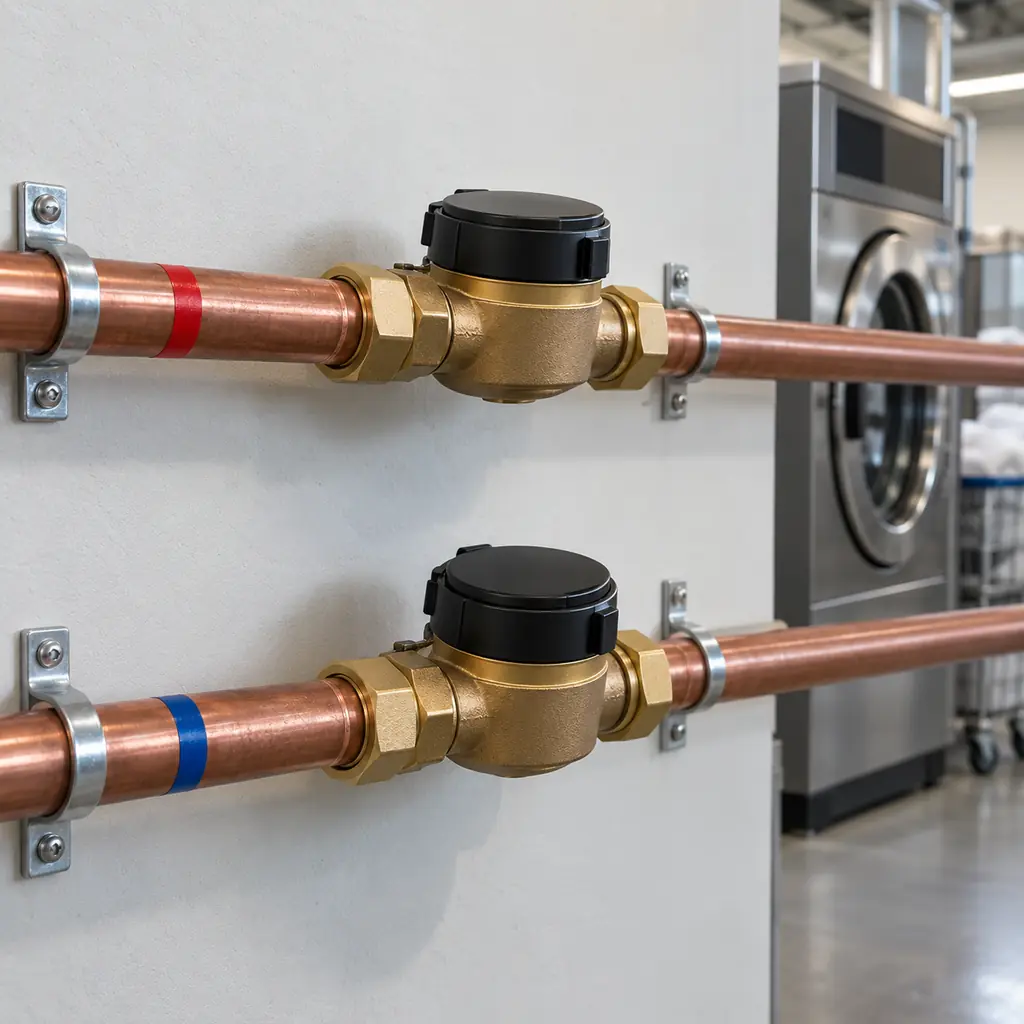
The EPA’s metering and submetering guidance supports using submeters to understand specific uses, select suitable meters, and maintain reliable readings. Have a qualified installer select devices for the actual flow range, fluid temperature, pressure, pipe arrangement, and manufacturer’s installation requirements. Hot and cold supplies may need separate instruments. A pipe’s diameter alone is not enough to establish the appropriate meter.
Verify the meter register’s unit, multiplier, rollover behavior, and any pulse-to-volume conversion in the logger. Compare logger increments with the physical register over a known operating interval. Record instrument identity and the date and basis of its accuracy check. The PNNL water-metering guide explains why flow range, installation, testing, and data quality matter. An automated dashboard does not remove these measurement responsibilities.
Choose a logging interval fine enough to distinguish the events that matter, such as overlapping machine cycles or idle-period flow. If only opening and closing totalizer readings are available, restrict conclusions to that aggregate boundary and period. Do not assign water to individual machines or textile classes that the measurements cannot separate.
Keep a linked operating record
| Record group | Minimum information to retain | What it resolves |
| Water | Meter IDs, boundary, starting and ending readings, unit, times, gaps | Reconstructs the numerator and reveals double counting. |
| Batch | Batch ID, machine, linen category, soil class, actual load weight, wash formula version | Shows what work was performed and under which settings. |
| Rework | Original batch link, extra rinses, repeat passes, reason | Keeps additional consumption attached to the original service episode. |
| Release | Accepted item count or net dry weight, release time, held and rejected quantities | Reconstructs useful output and open work in process. |
| Conditions | Supply conditions, dosing changes, maintenance events, staffing and downtime | Identifies competing explanations for a result. |
Retain the underlying batch-level records even when reporting a weekly result. Calculate the weekly intensity by dividing the week’s total matched water by its total matched accepted weight. Do not take a simple average of batch ratios: a small load would receive the same statistical weight as a large one.
Close the period without hiding unfinished work
For a controlled comparison, follow a defined group of batches through final acceptance and capture all associated water, including later rewash. This is a closed-cohort trial. If a shared meter also captures unrelated batches during that interval, separately measure their water or use a documented allocation; retain attributable idle and support-water use consistently. If the operating period begins or ends with unfinished linen, either reconcile those batches using linked records or extend the measurement until their disposition is known. Avoid dividing today’s water by today’s releases when substantial linen was washed yesterday or will be accepted tomorrow.
Flag missing readings and their estimated contribution rather than silently replacing them with zero. Where gaps, unmetered bypasses, or changing inventories can materially alter the result, repeat the affected part of the trial. There is no universal trial length that makes poor records reliable. Duration should reflect the main linen categories, operating shifts, peak conditions, and observed variability; continue until the comparison is representative enough for the decision being made.
Separate maintenance improvement from replacement benefit
Record an as-found baseline, then document any leak repairs, loading corrections, or approved formula changes. If the old machine can remain in service, a second, maintained baseline can reveal what replacement adds beyond routine operational improvement. The DOE’s guidance for water-intensive processes includes laundry leak repair, appropriate loading, and soil-dependent programming. Do not attribute those improvements automatically to the purchase of a new machine, or overload equipment merely to improve the ratio.
Compare Replacement Equipment at Equal Quality and Output
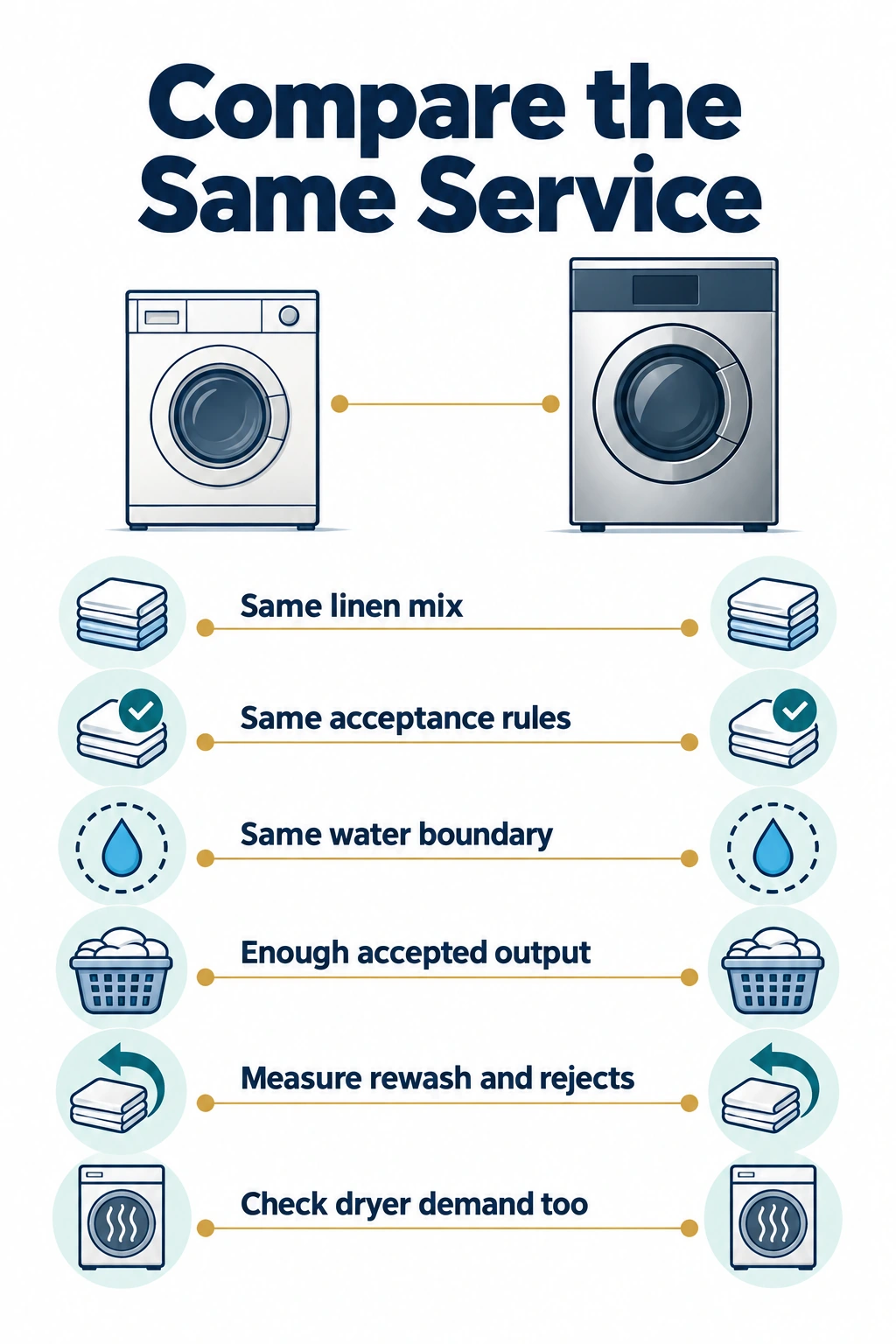
A fair trial asks whether the candidate system uses less water to deliver the same required service. Match linen categories, soil conditions, load weights, release criteria, and the water boundary before interpreting a difference. A comparison can include a new machine, different dosing, or water recovery, but the result then belongs to that combined operating package. Record each change so the hotel knows what must remain in place to reproduce the result. Water intensity should be assessed alongside accepted output per hour, rewash, rejection, and drying performance, with acceptance criteria agreed before testing.
Use a transparent worked example
The following figures describe two hypothetical closed-cohort trials with no unresolved work in process. Assume that the linen mix, water boundary, and acceptance method are comparable. The extra passes are already included in the measured water; their water must not be added a second time.
| Measurement | Existing system | Candidate system |
| Fresh hot-water input, US gal | 4,200 | 3,600 |
| Fresh cold-water input, US gal | 8,400 | 7,200 |
| Total freshwater, US gal | 12,600 | 10,800 |
| First-pass dry-equivalent input, lb | 6,100 | 6,120 |
| Additional repeat-pass weight, lb | 300 | 480 |
| Accepted dry-equivalent output, lb | 6,000 | 6,000 |
| Final rejected dry-equivalent weight, lb | 100 | 120 |
| Water per accepted lb, US gal | 2.10 | 1.80 |
| Water per process-pass lb, US gal | 1.97 | 1.64 |
Accepted-output intensity falls by (2.10 − 1.80) ÷ 2.10 × 100 = 14.3%. The candidate still requires more repeat-pass weight and has more final rejection in this example. Those changes require explanation and comparison with the pre-agreed quality limits; they cannot be dismissed because the water result improved. The table alone does not establish that the candidate passes the hotel’s acceptance test.
Here, process-pass weight is first-pass input plus additional repeat passes: 6,400 lb for the existing system and 6,600 lb for the candidate. For a mass-based rework indicator, divide additional repeat-pass pounds by first-pass pounds: about 4.9% versus 7.8%. This describes repeat processing, not the percentage of unique items rewashed; multiple repeats can be counted more than once. State the denominator whenever reporting a “rewash rate.”
Normalize changes in the linen mix
A hotel washing more lightly soiled sheets and fewer heavily soiled food-service textiles may show lower aggregate water intensity even if machine performance is unchanged. First compare equivalent categories. Where category water is separately measured or allocated by a defensible method, multiply each category’s intensity by its share of an agreed reference mix, then add the results.
For illustration, a reference mix consisting of 70% sheets and 30% towels by accepted dry-equivalent weight, with measured intensities of 1.6 and 2.4 US gal/accepted lb, produces 0.70 × 1.6 + 0.30 × 2.4 = 1.84 US gal/accepted lb. Apply the same shares to both systems. This is an analytical example, not a benchmark. Without defensible category data, run matched trials and disclose the remaining mix difference instead of inventing an adjustment.
The DOE’s measurement and verification options distinguish system-level measurement from whole-building verification. This hotel approach adapts that measurement principle; it does not claim compliance with a federal contracting protocol. Occupancy-adjusted hotel bills can help track the property, but they do not by themselves isolate the performance of one replacement washer.
Protect the service conditions behind the number
Document appearance, residual staining, odor, damage, and any other agreed release requirements. Apply the same inspection method and sampling intensity before and after. Hygiene or infection-control requirements, where applicable, must be addressed through the relevant validated process and qualified advice; visual acceptance alone cannot demonstrate microbiological safety. Do not reduce required rinsing, time, temperature, or dosing just to meet a water target.
Measure accepted pounds per scheduled production hour, including the agreed treatment of handling, waiting, rework, and downtime. A slower cycle may save water per pound yet fail the peak shift requirement. Also track extraction outcome and dryer time or energy under comparable conditions. Lower hot-water use is not proof of lower total water use, and lower washer water use is not proof of lower drying energy.
Repeat the comparison across representative runs and show their spread. If the claimed reduction is small compared with meter and scale uncertainty or normal operational variation, describe it as inconclusive until better measurement resolves the difference. Avoid reporting a precise savings percentage unsupported by the quality of the inputs.
Distinguish a label metric from the site result
ENERGY STAR’s clothes-washer product criteria define integrated water factor using weighted per-cycle water consumption and drum capacity. That is not the same denominator as accepted dry linen weight. Where a product is within the applicable certification category, use its certification for what it actually establishes; verify the exact model and program scope. Do not substitute an IWF figure directly into a US gal/accepted lb comparison.
Use the accompanying workbook to reproduce the aggregate example and substitute your own matched trial data. Its inputs and outputs do not validate the water boundary, quality criteria, or comparability of the trial; those remain documented operational decisions.

Turn the Result into a Purchase and Commissioning Decision
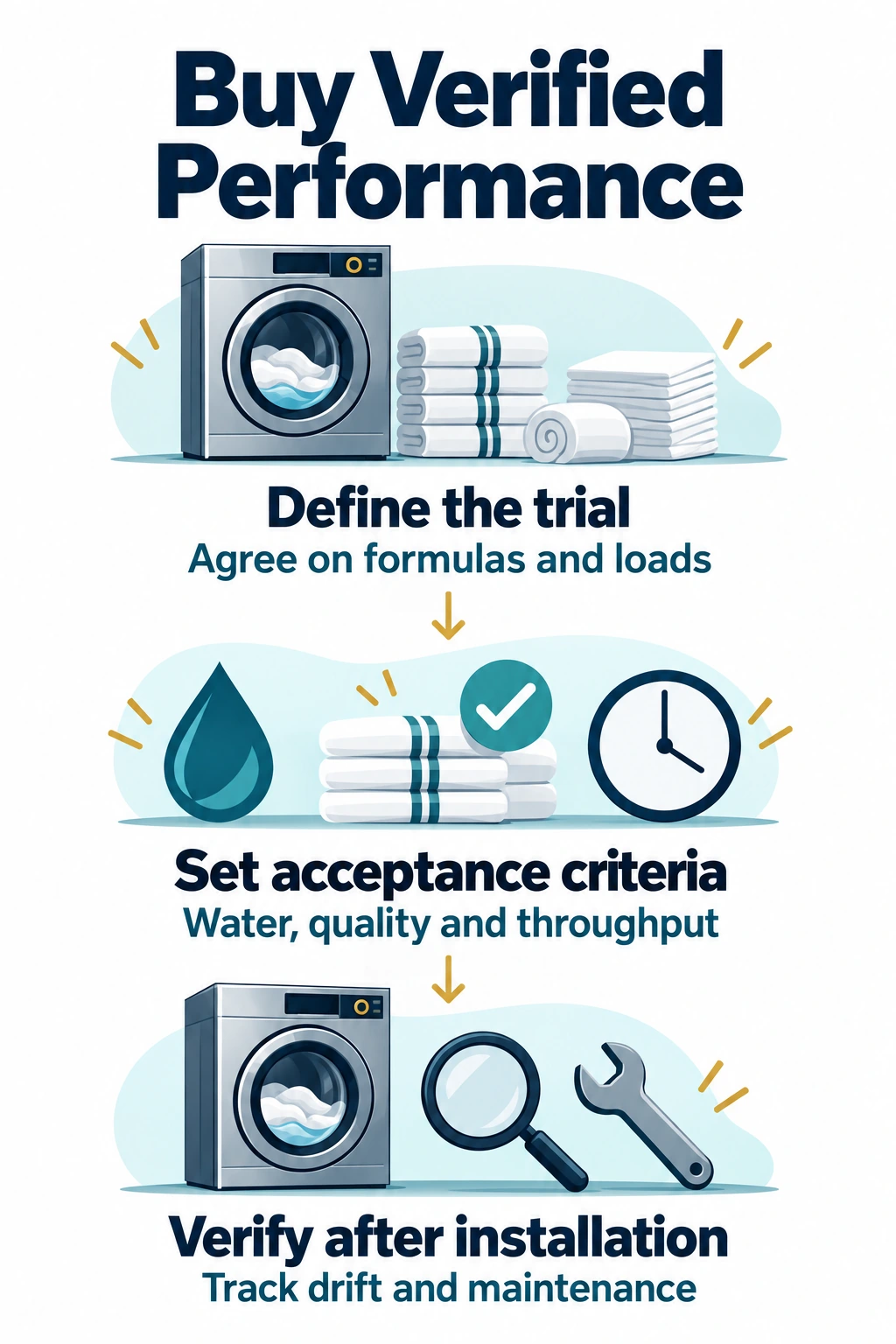
The purchase decision should connect the measured result to a written performance scope. Ask each supplier to identify the exact configuration, wash formulas, test loads, supporting equipment, and exclusions behind its proposed water performance. Then define how the hotel will test the installed system and what evidence will establish acceptance. This prevents a demonstration under favorable conditions from becoming an unsupported operating promise. A complete comparison also considers installation, maintenance, service coverage, production disruption, and the cost of keeping linen available while the old equipment is removed and the new system is commissioned.
Specify a trial the hotel can repeat
The performance schedule should identify the metered boundary, US gal/accepted lb calculation, dry-weight method, representative linen and soil categories, loading range, supply conditions, formula versions, and treatment of rewash and final rejects. Attach the baseline records and state whether the comparison is against as-found or maintained existing equipment. Require access to raw meter and batch records rather than only a supplier’s summary percentage.
Set project-specific limits for water intensity, accepted output per hour, rework, rejection, and release quality. Agree on how a failed run, missing data, changed formula, or meter fault triggers investigation and retesting. Identify who witnesses the trial, who approves linen quality, and who can authorize operating changes. Neither a universal gallons-per-pound target nor a universal number of test days can replace those site decisions.
Use the hotel supplies RFQ guide to organize responsibilities and comparable quotations. For a laundry replacement, the technical schedule should also establish utilities, drainage, floor and access requirements, commissioning, operator training, spare parts, service response, and responsibility for old-equipment removal. Confirm these details for the exact proposed configuration.
Convert measured intensity into a conditional cost estimate
For the hypothetical comparison above, the difference is 0.30 US gal/accepted lb. At an assumed annual workload of 600,000 accepted lb with comparable conditions, estimated avoided freshwater is 0.30 × 600,000 = 180,000 US gal per year. At an illustrative marginal combined water and sewer cost of USD 0.012 per gallon, the water-related benefit is USD 2,160 per year. These are example inputs, not a utility tariff, quotation, or forecast for a real hotel.
Use the avoidable marginal charges applicable to the property. Fixed charges may not fall, sewer billing may not track every gallon, and tiered tariffs may change the value of the saved volume. Keep all currencies and tax treatments consistent. Analyze verified changes in heating, drying, chemicals, labor, linen replacement, maintenance, and treatment consumables separately; a water-only calculation does not establish total operating savings.
Simple payback, when useful, is the incremental installed investment divided by positive annual net savings. Define the alternative: repairing and retaining an existing machine is different from replacing a failed machine that cannot continue operating. Include metering, enabling works, removal, downtime, and commissioning in the appropriate option costs. If net savings are zero or negative, do not display a positive payback. Evaluate more than one workload and tariff scenario before relying on a long-term estimate.
Verify performance after installation
At commissioning, verify the meter identities and scaling, retain the approved formula versions, and repeat the acceptance trial on the installed system. Confirm that bypasses, recovery settings, and support-water uses match the agreed boundary. Archive the raw results, release decisions, maintenance instructions, and operator training record with the purchase documentation.
Continue tracking both aggregate and category results where measurement supports them. Investigate rising water per accepted pound against possible changes in loading, rework, inlet valves, leaks, treatment operation, and linen mix. Resetting the target to match deteriorating performance hides the problem. Conversely, a changed textile specification or service requirement may justify a documented new baseline. Establish an owner and a review frequency appropriate to the operation so the measurement remains useful after the supplier’s demonstration ends.
Conclusion
Water per accepted dry pound gives hotel buyers a practical way to connect consumption with useful linen output. Its value depends on disciplined definitions: measure the same supply boundary, include repeat processing, count accepted linen once per service episode, and reconcile unfinished work. Compare representative operations under unchanged quality requirements, then examine throughput and drying alongside the water result. A replacement is ready for approval when the installed system meets the hotel’s agreed service and performance criteria and the commercial case remains credible under realistic operating assumptions. The calculation supports that decision; it does not replace the acceptance trial.
For a replacement project, send KW Hospitality your laundry equipment RFQ with the equipment schedule, metered baseline, peak accepted-linen requirement, utility details, destination, and required delivery date. Include the trial and acceptance requirements so the sourcing discussion starts from a measurable scope.
Frequently Asked Questions
Can we estimate accepted pounds from occupied rooms?
Room occupancy can help explain demand, but it does not measure accepted linen weight. Stayover policies, towel reuse, food-service work, outside laundry, and textile specifications change the relationship. Use weighed dry output or accepted item counts multiplied by verified dry item weights for the equipment comparison. Keep occupancy as contextual data.
What if the hotel has no laundry submeter?
Start by mapping the water connections and planning temporary or permanent metering suitable for them. Controller estimates or supplier cycle-volume figures can help screen options, but label them as estimates until independently checked. A whole-hotel meter generally includes too many other uses to establish one washer’s performance without additional measurement and analysis.
Does a lower ratio mean the machine is ready to buy?
No. Confirm comparable work, adequate data quality, acceptable linen, sufficient production capacity, and the complete cost and installation scope. A result accompanied by unacceptable rejection, unresolved rewash, or slower-than-required output has not demonstrated the required service, even when its water ratio is lower.
How should outsourced loads be handled?
Exclude off-site production from an on-site equipment denominator unless its corresponding water is measured within the same declared scope. Record outsourced quantities separately so sending difficult loads away cannot make the on-site system appear better without explanation. A combined service comparison needs separate, compatible evidence for each provider.
What happens when accepted output is zero?
Report the water consumed and the reason for zero release, but leave water per accepted pound undefined. Do not enter zero for the ratio or remove the incident without explanation. Hold the associated work open until its final disposition is known, or report it as a failed or nonproductive period within the agreed trial method.
Is a universal water-per-pound target suitable for every hotel?
No. Equipment type, linen and soil mix, recovery arrangement, support-water scope, and acceptance rules affect the result. A published or quoted figure is useful only after those definitions are understood. Establish a project target using comparable measured performance and the hotel’s required service rather than treating an unmatched number as a guarantee.
References
1. U.S. Environmental Protection Agency — WaterSense at Work Section 3.5: Laundry Equipment
2. U.S. Environmental Protection Agency — WaterSense at Work Section 2.3: Benchmarking
3. U.S. Environmental Protection Agency — WaterSense at Work Section 2.1: Metering and Submetering
4. Pacific Northwest National Laboratory — Water Metering Best Practices
5. U.S. Department of Energy — Best Management Practice #13: Other Water-Intensive Processes
6. U.S. Department of Energy — Measurement and Verification Options for Federal Energy- and Water-Saving Projects
7. ENERGY STAR — Clothes Washers Key Product Criteria