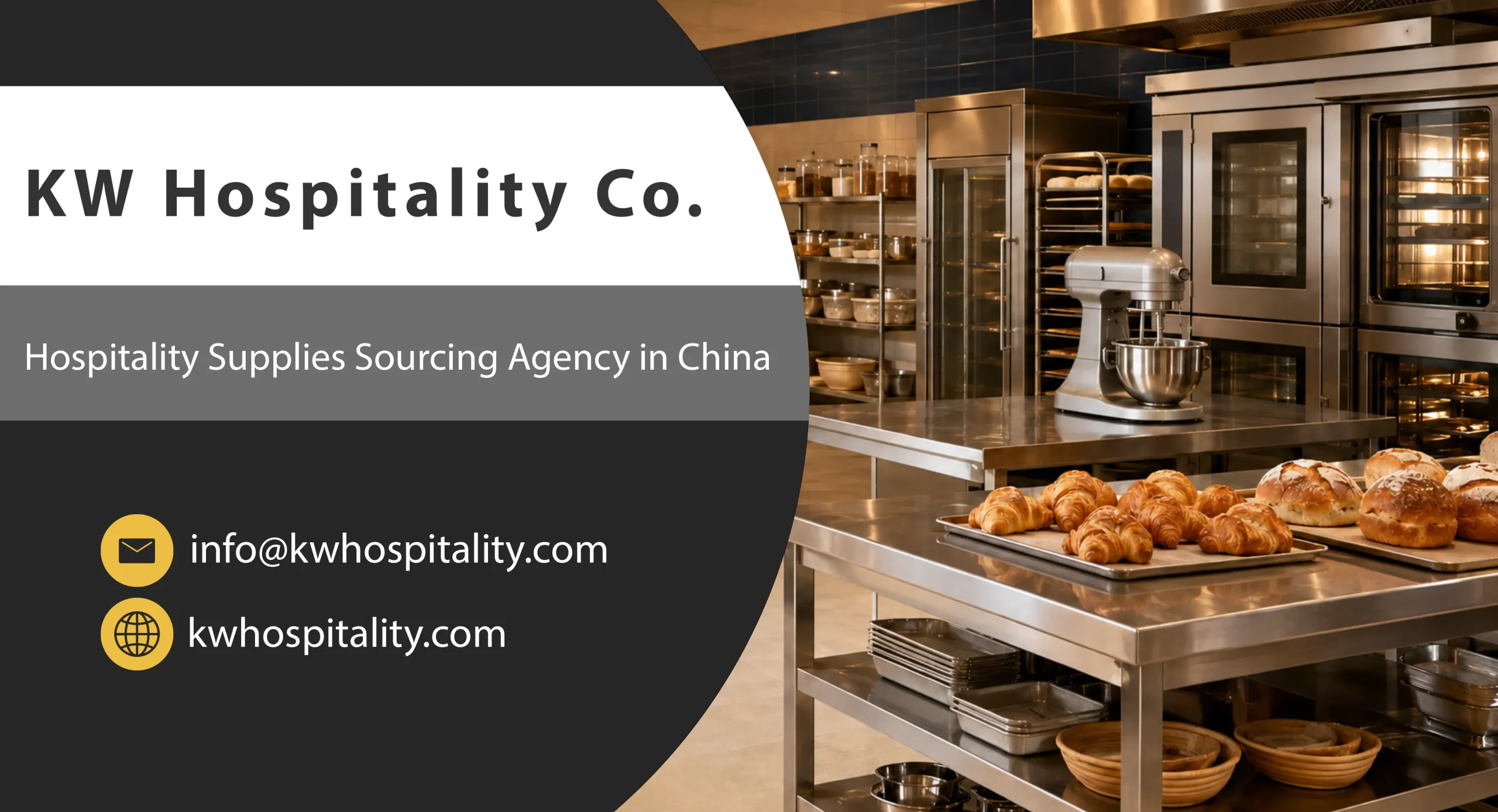
A hotel bakery equipment package should be designed around the property’s menu, peak production periods, outlet delivery schedule, tray standard, labor model, utilities and available installation space. A limited-service hotel may require a compact pastry and bake-off setup, while a resort or convention hotel may need separate bread, pastry, proofing, baking, cooling, finishing and internal distribution systems.
This guide helps hotel owners, executive chefs, pastry chefs, kitchen consultants and procurement teams identify the equipment, OS&E, smallwares, utility connections, documentation and commissioning requirements needed before opening.
Get a Property-Specific Hotel Bakery Equipment Schedule
Planning a new hotel, resort, restaurant bakery or production upgrade?
Send your bakery menu, estimated peak covers, outlet list, project location, tray standard, available utilities, target installation date and any available layouts or technical drawings. KW Hospitality can review the information and help structure a categorized equipment and OS&E schedule for supplier quotation.
Request a Bakery Equipment Package
Download the 163-Item Master Checklist
Prepared for Commercial Hospitality Projects
Hotels and resorts
Pre-opening and renovation projects
Restaurants, cafés and banquet operations
Central production and multi-outlet bakeries
Equipment, OS&E and bakery smallwares
Supplier quotation and specification coordination
Consolidated project documentation
Custom labeling and project-specific packaging, where available
Download the Hotel Bakery Equipment Master Checklist
Use the editable checklist to organize equipment requirements, capacities, utility connections, quantities, proposed suppliers and approval status.
The downloadable package includes:
A 163-item master equipment checklist
Essential and optional equipment classifications
Capacity and sizing criteria
Utility and MEP requirements
Quantity and supplier fields
Technical approval status
Project-input worksheet
Utilities and MEP register
Supplier-comparison worksheet
Technical-submittal approval log
PDF and Word versions for review and printing
Download Checklist:
Technical note: The checklist is a procurement and coordination framework. Final equipment models, capacities, certifications, utility loads, ventilation, installation and commissioning requirements must be approved for the specific property and destination.
Which Hotel Bakery Production Model Are You Planning?
| Hotel bakery model | Typical production scope | Common equipment approach |
|---|---|---|
| Limited-service hotel | Breakfast pastries, reheating, frozen or ready-to-bake products | Convection oven, planetary mixer, refrigeration, worktables, racks and core smallwares |
| Full-service hotel | Breakfast, breads, desserts, restaurant and room-service support | Planetary and spiral mixers, proofer, sheeter, convection or deck oven, blast chiller and finishing stations |
| Resort bakery | Multiple outlets, artisan bread, pastries, cakes, desserts and retail production | Multiple mixers, retarder-proofer, deck or rack ovens, expanded refrigeration, blast chilling and internal transport |
| Convention hotel | High-volume breakfast and overlapping banquet production | High-capacity mixers, divider-rounder, roll-in proofers, rack ovens, large cooling capacity and transport racks |
| Central production bakery | Production for several outlets or properties | High-capacity and automated equipment, blast freezing, storage, dispatch systems and structured logistics |
The selected model should be confirmed before equipment capacities and quantities are finalized.
Build the Production Plan Before Choosing Equipment
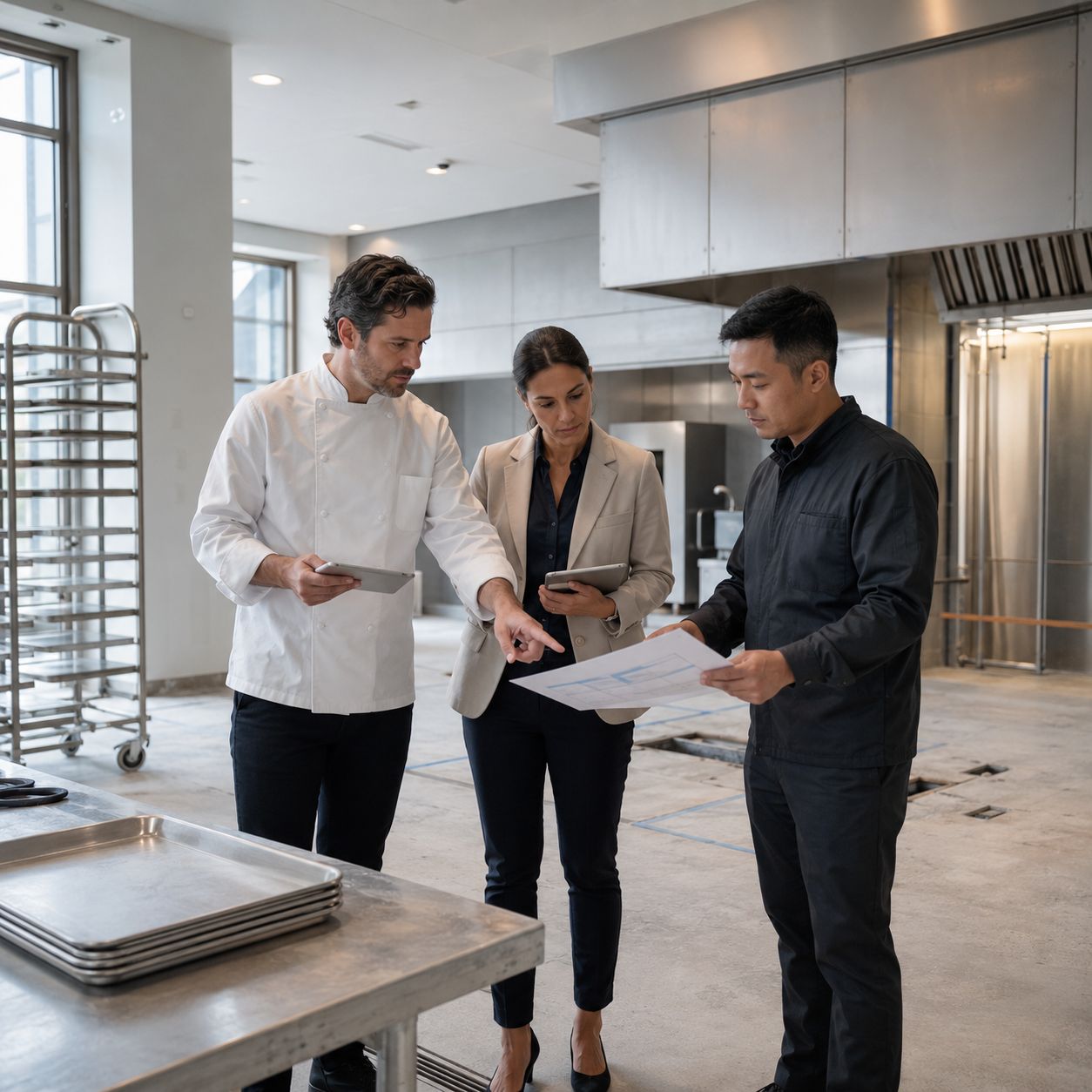
The first procurement document should be a production brief. It defines the hotel bakery’s operating scope and prevents an attractive but mismatched equipment package from driving the concept. Begin with the approved menus for every consuming outlet: breakfast buffet, all-day dining, banquets, room service, executive lounge, coffee shop, pool or beach service, minibars, welcome amenities, staff dining, and any retail counter. Record whether each item will be made from scratch, assembled from purchased components, baked from frozen, finished on site, or bought ready to serve.
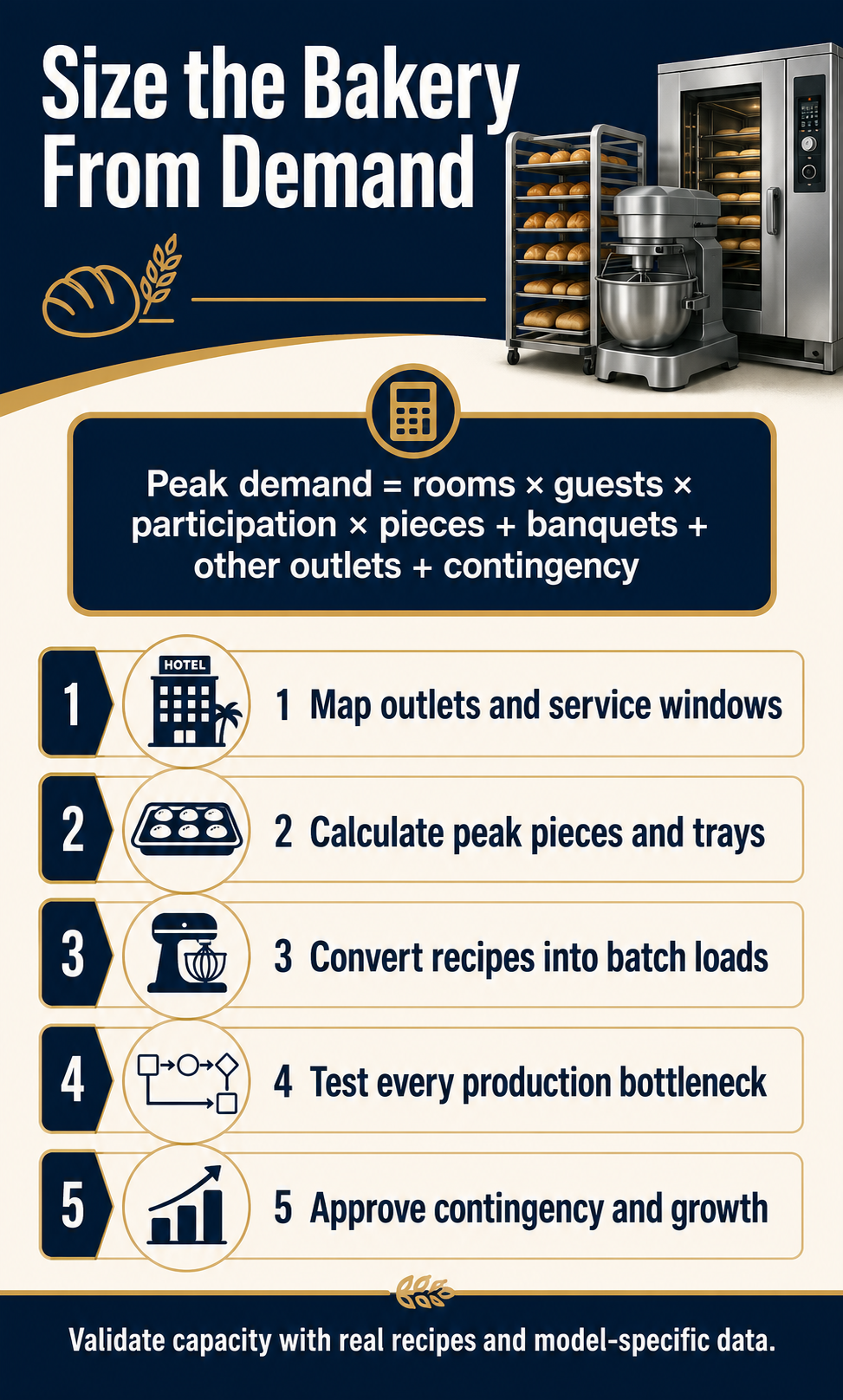
Map demand by outlet and time window
Daily totals alone are not enough. A hotel may need most breakfast pastries within a ninety-minute service window, bread for lunch before the morning shift ends, and banquet desserts several hours later. Create a demand table showing the product, outlet, service time, peak quantity, batch size, pan or tray type, process steps, storage state, holding limit, and delivery method.
A useful planning formula is:
Peak bakery demand = occupied rooms × average guests per occupied room × outlet participation × pieces per participating guest + banquet demand + other outlet demand + approved contingency.
Use property-specific operating assumptions rather than generic industry percentages. Model a normal day, a forecast peak day, and a credible opening-period surge. Banquet demand should be calculated from confirmed function capacity and service style, not absorbed into a broad buffer.
Convert demand into equipment capacity
For each product family, work backward from the service deadline. Estimate mixing time, rest time, forming time, fermentation, baking, cooling, finishing, packing, and transport. Then test the bottleneck in the chain. A larger oven does not solve a sheeter constraint; a fast divider does not help if proofing capacity is too small; more mixer volume can create queues at the bench.
Use throughput calculations that procurement and culinary teams can verify:
Required mixer batches = required dough or batter weight ÷ usable batch size for the selected recipe.
Oven output per hour = trays per load × product yield per tray × completed loads per hour × realistic utilization factor.
Proofer positions required = trays entering during the longest proofing cycle + separation allowance for incompatible products.
Cold-storage requirement = average daily use × delivery interval + approved safety stock + work-in-process capacity.
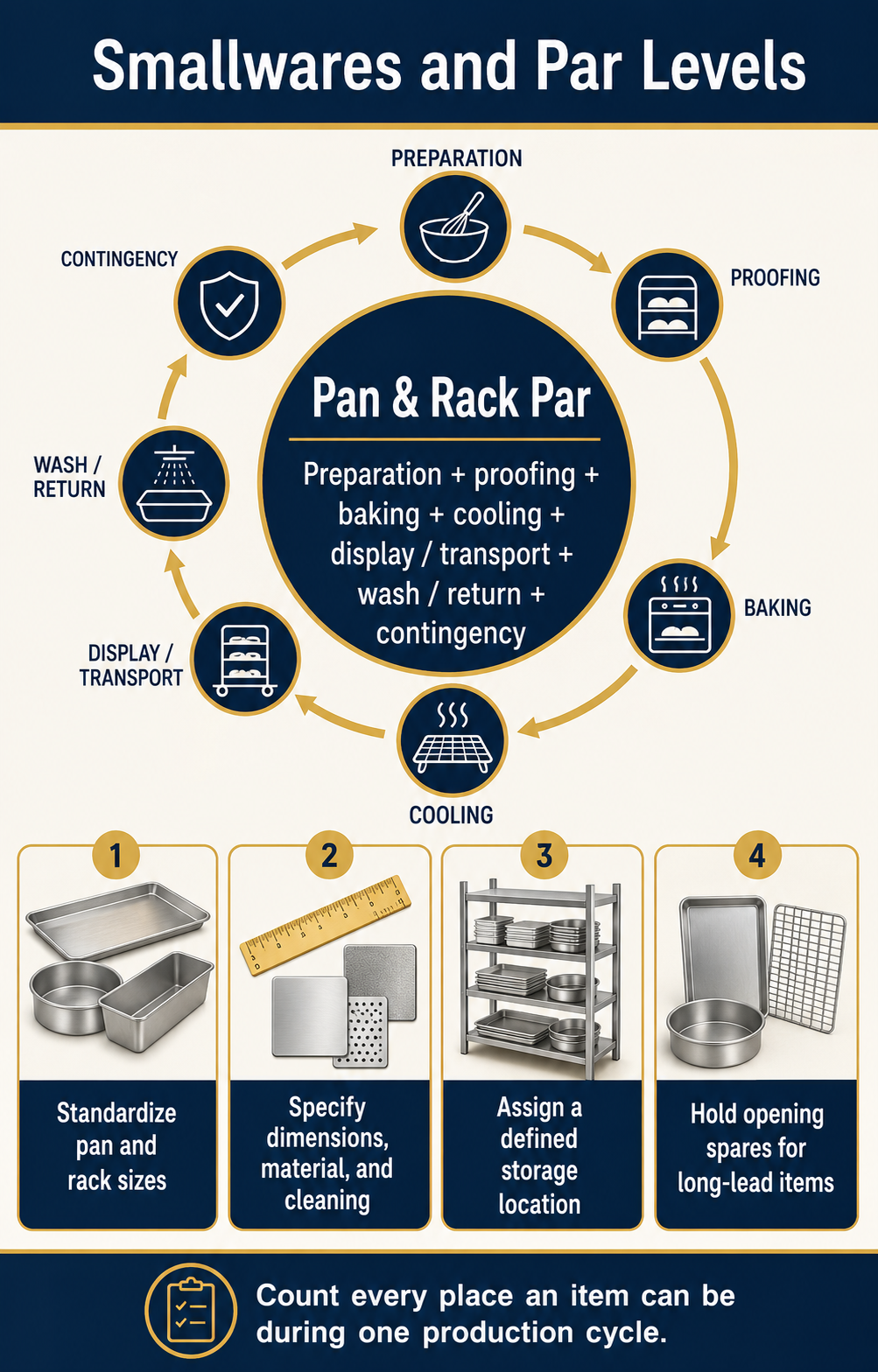
Pan and rack par = items in preparation + baking + cooling + display or transport + washing and return + contingency.
Test the calculation with the actual manufacturer’s stated capacities and the hotel’s recipes during acceptance trials. Nominal bowl volume, deck count, or rack count is not the same as usable production capacity.
Define the operating model and growth boundary
Document shift hours, skill levels, cleaning windows, delivery frequency, menu-change expectations, redundancy requirements, and the number of outlets that may call for urgent orders. Decide which failure would stop service and whether the answer is a backup machine, shared capacity elsewhere in the hotel, a spare-parts kit, or an emergency supply agreement.
Finally, define the expansion boundary. Allow reasonable electrical, ventilation, refrigeration, drainage, and floor-space capacity for approved future products, but do not buy every specialized machine on the possibility that it may someday be useful. Modular benches, mobile racks, interchangeable pan systems, and utility connection points often preserve flexibility better than premature automation.
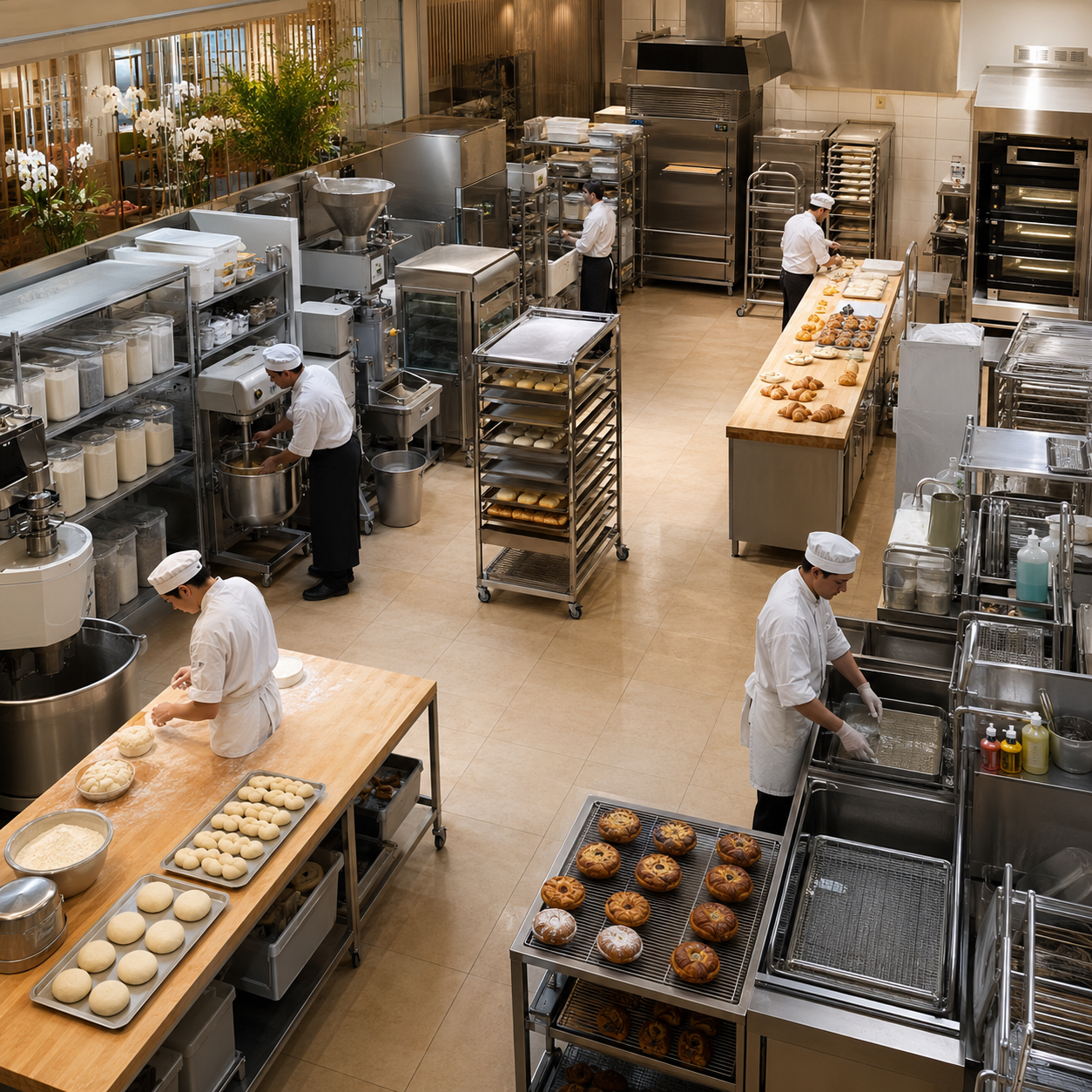
Use a Zone-by-Zone Hotel Bakery Equipment Checklist
Organizing the schedule by workflow exposes missing handoffs and prevents equipment from being duplicated under different departmental lists. The typical sequence is receiving, storage, scaling, preparation, mixing, make-up, fermentation, baking, cooling, finishing, display or dispatch, warewashing, and waste removal. Raw ingredients, finished food, dirty utensils, waste, and employees should not be forced through conflicting paths.
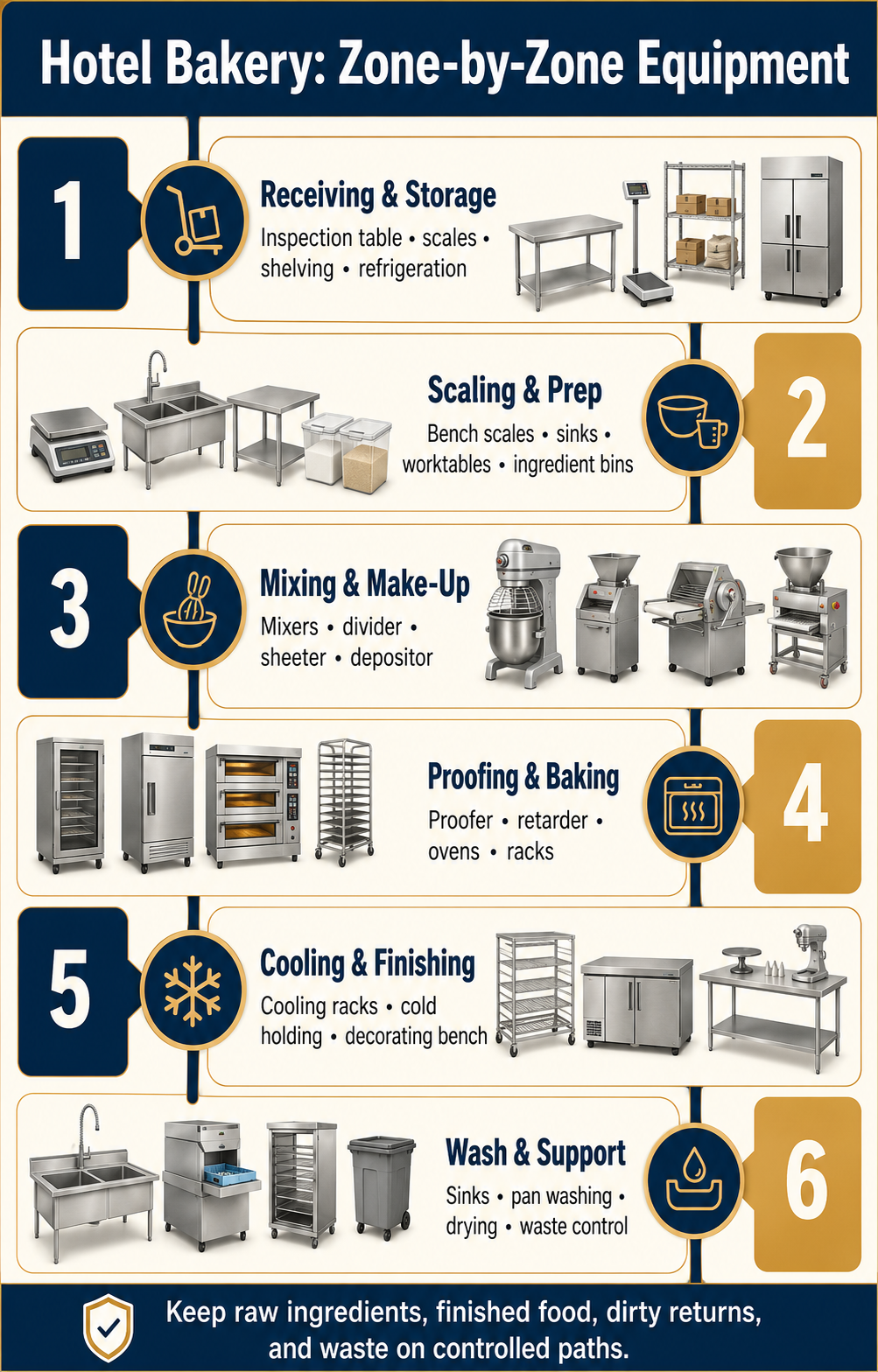
Receiving and storage
Include the following where required by the approved menu and delivery model:
Receiving table or inspection surface, platform scale, probe thermometers, label printer, and mobile receiving cart.
Dunnage racks, adjustable dry-storage shelving, ingredient bins with fitted lids, mobile flour or sugar bins, and dedicated allergen storage.
Reach-in, roll-in, undercounter, or walk-in refrigerators and freezers; sheet-pan or bakery-rack compatibility should be specified where needed.
Lockable storage for high-value ingredients, chemicals, blades, and controlled smallwares.
Date-labeling supplies, stock-rotation labels, and protected storage for packaging materials.
Dry storage must account for bag dimensions, safe lifting, shelf loading, pest-control access, and flour-dust control. Cold storage must include both unopened stock and work in process: butter blocks, dairy, eggs, fillings, creams, fruit preparations, shaped dough, frozen products, and finished desserts may have very different temperature and segregation needs.
Scaling and ingredient preparation
Plan precision scales for small ingredients, bench scales for recipe batches, and a floor or platform scale where bulk handling justifies it. Specify graduation, maximum capacity, cleanability, calibration method, battery or mains power, and whether print or data output is needed. Provide stainless worktables, sinks as required by the local authority, mobile ingredient bins, scoops, sieves, containers, and space for recipe staging.
Additional preparation equipment may include a food processor, fruit preparation tools, chocolate melter, induction units, cooktops, saucepans, water-dosing or temperature-control equipment, and an ice machine. Each item should have a defined recipe function. Avoid turning the bakery into an overflow kitchen with unplanned heat, grease, ventilation, or sanitation loads.
Mixing, make-up, and fermentation
The core list may include planetary and spiral mixers, mixer bowls, bowl trucks, dough troughs, dough dividers, rounders, moulders, sheeters, reversible sheeters, croissant cutters, depositors, extruders, bread slicers, proofing cabinets, retarder-proofers, and temperature-controlled work surfaces. Buy only the automation supported by repeatable volume, stable recipes, trained labor, cleaning capacity, and maintainable local service.
Baking, cooling, and finishing
Depending on the product mix, evaluate convection, deck, rack, combination, or specialized ovens. Include hoods or other approved ventilation solutions when required, oven loading tools, peel storage, heat-resistant gloves, sheet-pan racks, cooling racks, cooling or freezing equipment, finishing benches, glazing and decorating tools, display refrigeration, and transport carts.
Warewashing and support equipment
Provide the locally required sink arrangement, pre-rinse equipment, commercial warewashing or pan-washing capacity, drainboards, drying racks, chemical storage, cleaning-tool storage, handwashing facilities, waste containers, and floor-cleaning equipment. Confirm that the largest bowl, pan, tray, rack component, and removable machine part can be safely cleaned. A warewasher selected around plates may be useless for bakery production equipment.
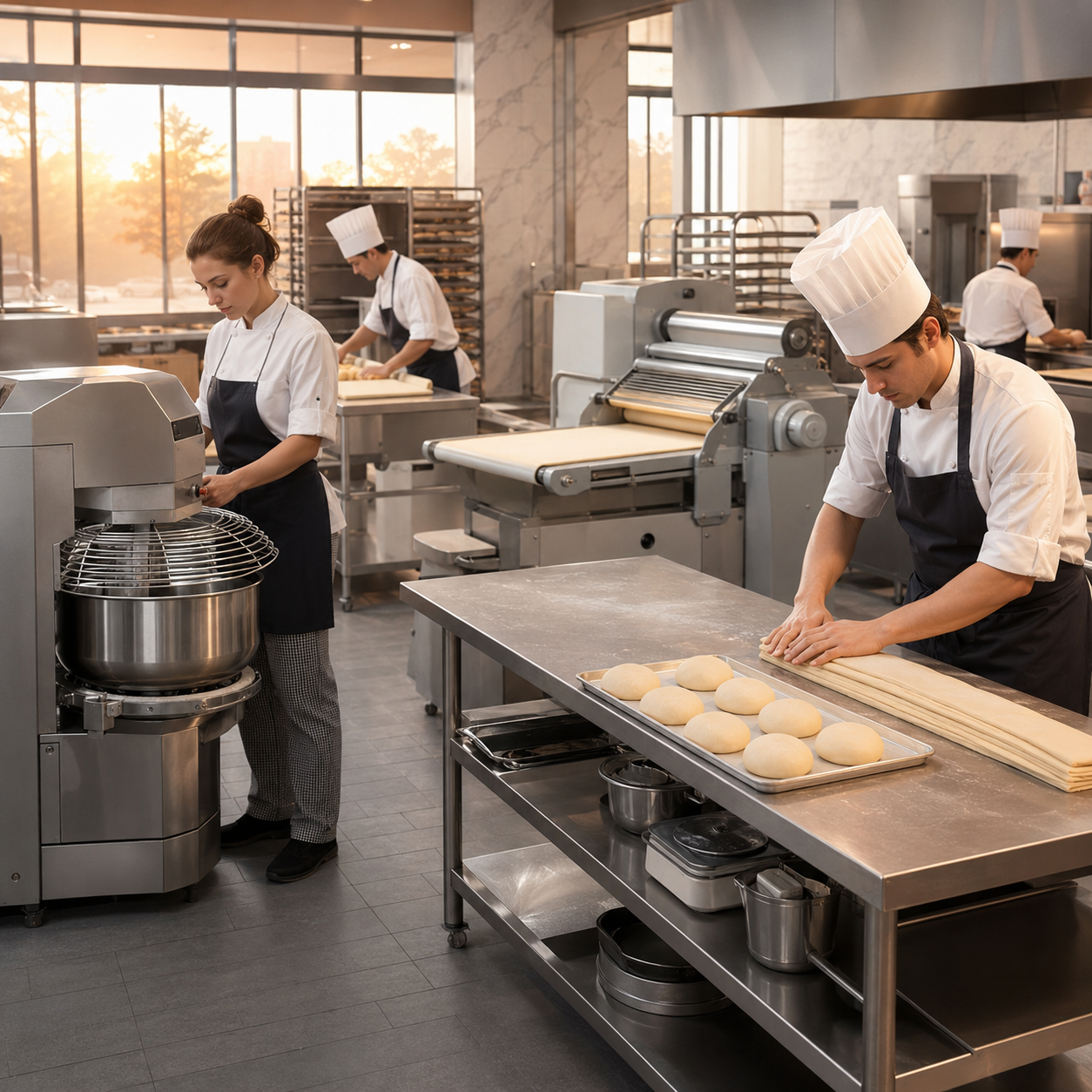
Specify Preparation, Mixing, and Dough Make-Up Equipment
Mixers and dough-processing machines should be selected by recipe behavior and usable batch range, not purchase price or headline capacity. Ask the pastry chef to identify the lightest and heaviest regular batches, the most demanding dough, the aerated products that need controlled mixing, and any recipe that requires a second bowl or rapid changeover.
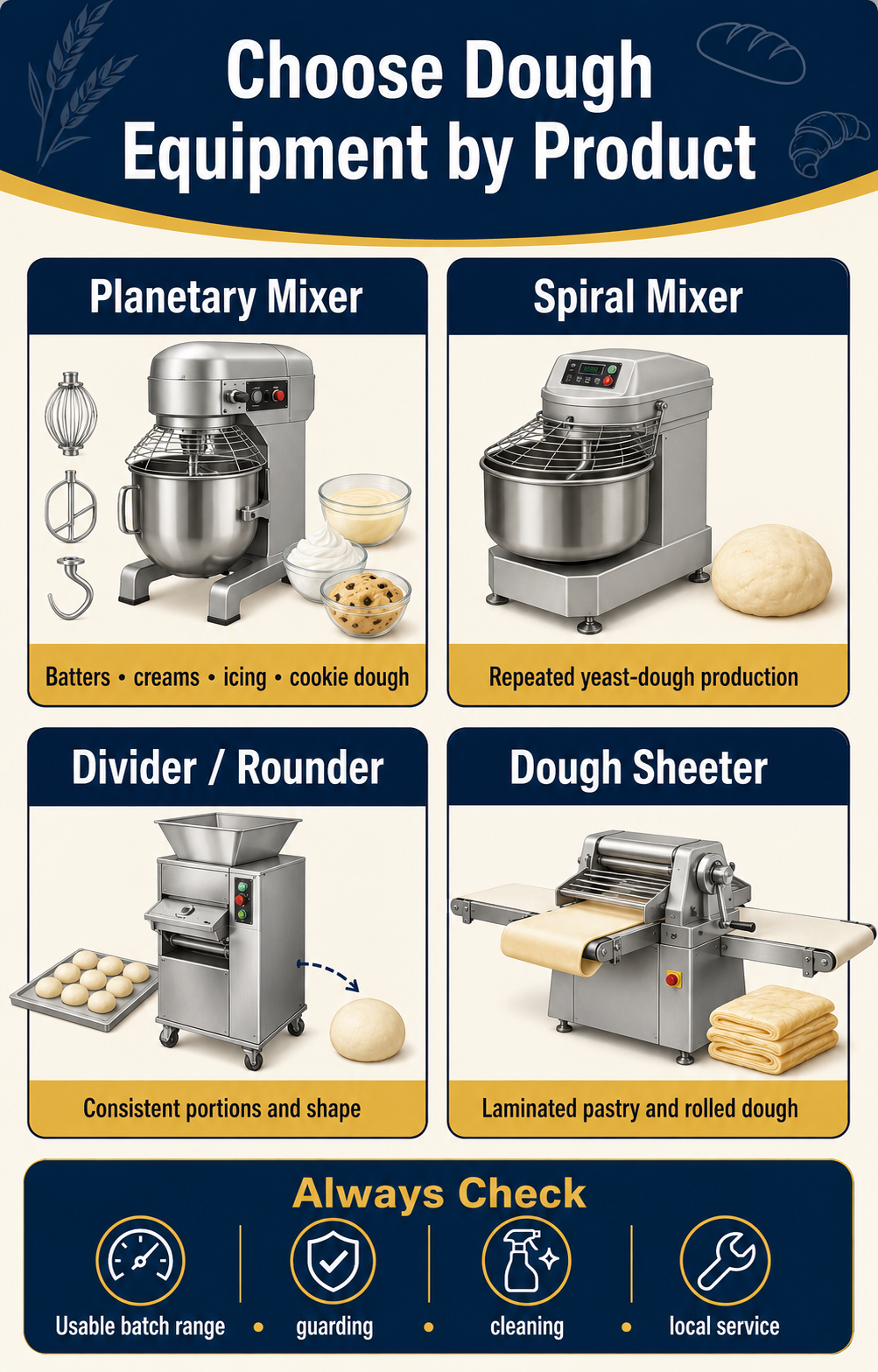
Planetary versus spiral mixers
A planetary mixer is the more versatile choice for cake batters, creams, icings, cookie dough, fillings, meringues, and smaller bread batches. The specification should identify required agitators, attachment hub needs, bowl count, bowl handling, speed control, timer functions, guard arrangement, bowl lift, washdown limitations, and the manufacturer’s permitted capacity for each product type.
A spiral mixer is commonly preferred for repeated yeast-dough production because its bowl-and-hook action is designed around dough development. Evaluate fixed versus removable bowl, reversing bowl direction, variable speed, dough temperature control, batch range, discharge height, and compatibility with dividers or bowl lifters. For large or dense batches, include the handling solution in the purchase: a mixer that exceeds comfortable manual handling without a bowl truck, lift, or safe discharge plan is an incomplete specification.
Do not treat horsepower, bowl liters, or kilograms as interchangeable measures. Flour capacity, total dough capacity, hydration, mixing intensity, and duty cycle all affect suitability. Obtain written capacity data for the hotel’s heaviest recipe and require a product trial when the decision is material.
Dividing, rounding, moulding, and depositing
Manual bench work preserves flexibility at low volume. Semi-automatic or automatic equipment becomes valuable when a stable product family creates repetitive labor, inconsistent weights, or a proven bottleneck. Evaluate:
Portion-weight range and accuracy across the intended doughs or batters.
Changeover time, removable parts, cleaning access, and allergen implications.
Output rate at a sustainable operator pace rather than maximum advertised speed.
Reject handling and the effect of rework on product quality.
Guarding, emergency stops, interlocks, and safe jam-clearing procedures.
Availability of dies, nozzles, plates, blades, belts, and wear parts.
A divider-rounder can support rolls and buns; a moulder may improve loaf consistency; a depositor can standardize cookies, muffins, choux, fillings, or cake batter. None should be included without a quantified product family and an owner for setup, sanitation, and preventive maintenance.
Dough sheeters and laminated pastry stations
For croissants, Danish pastry, puff pastry, tart dough, and other rolled products, specify belt width and length, roller opening, thickness repeatability, reversible controls, flour collection, table folding, mobility, guard design, and cleaning access. Confirm the machine’s installed footprint with tables fully deployed and the operator clearance required at both ends.
Temperature control around lamination can matter as much as the sheeter. Plan refrigerated ingredient storage, resting space, sheet-pan racks, covers, chilled work surfaces or a temperature-controlled room where the concept and climate justify it. Map the movement of dough between mixing, resting, sheeting, cutting, forming, and retarding so racks do not block the line.
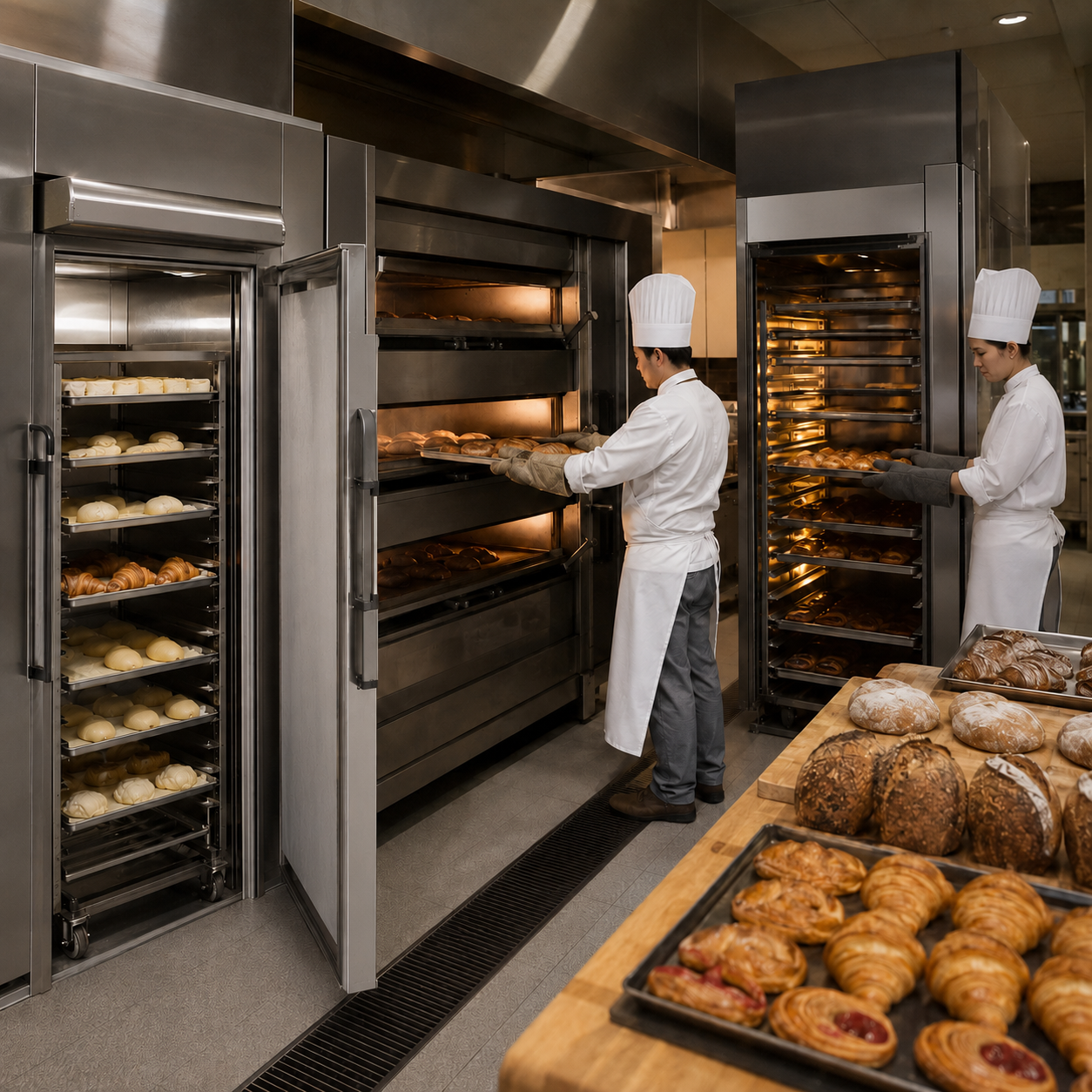
Match Proofing and Baking Equipment to the Menu
Proofing and baking are linked capacity decisions. The hotel needs enough controlled fermentation to feed the oven without creating over-proofed queues, and enough oven capacity to clear products before service while preserving the required bake profile.
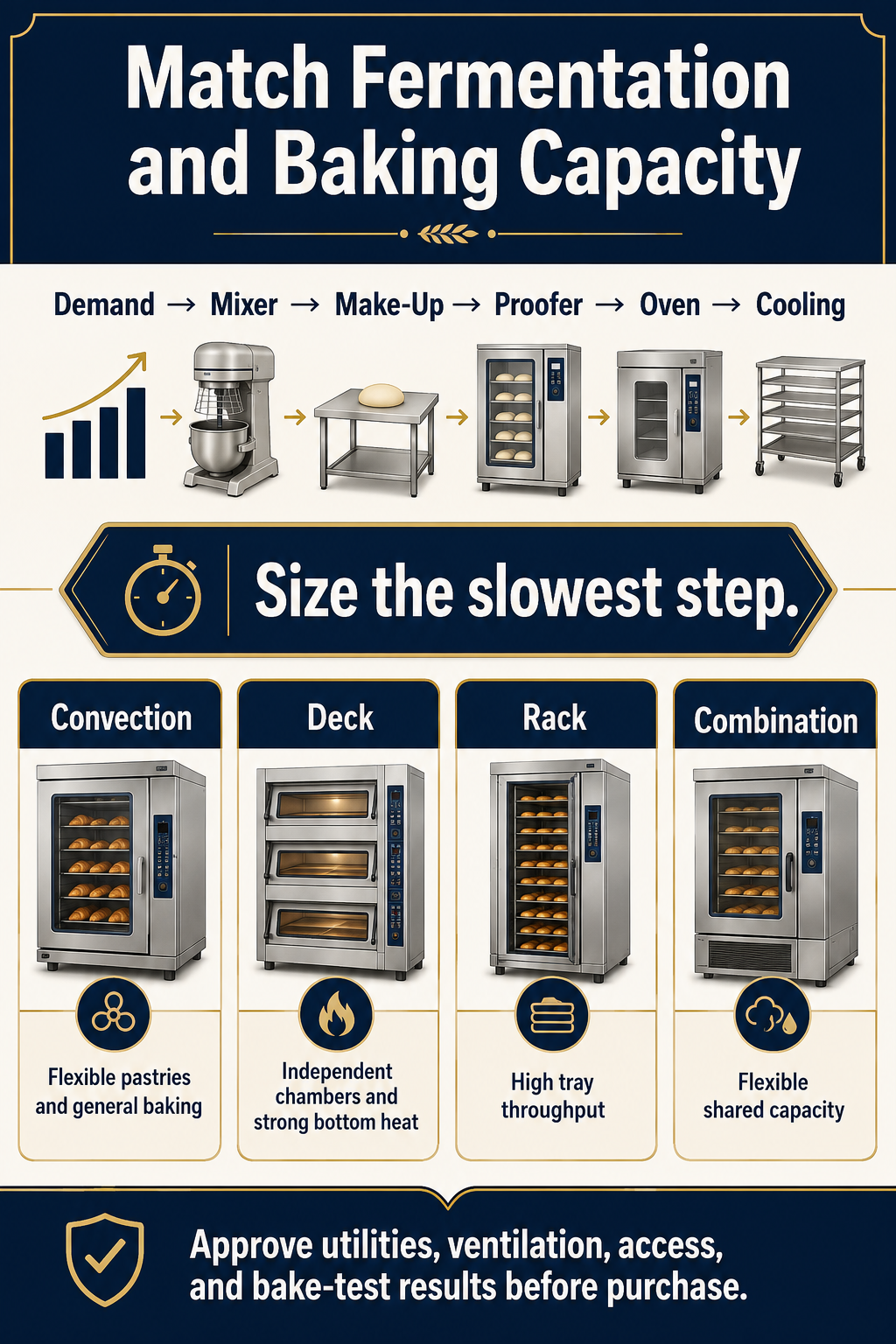
Proofers and retarder-proofers
A basic proofer provides controlled warmth and humidity for scheduled production. A retarder-proofer adds refrigerated holding and programmed transition, which can move part of the process into an overnight schedule and reduce early-morning handling. Evaluate usable rack or tray positions, recovery after door openings, temperature and humidity control, water treatment needs, drainage, refrigeration capacity, program storage, alarms, data logging, door access, internal release, and rack guidance.
Separate products when their fermentation conditions, timing, allergen profiles, or aromas conflict. Confirm rack dimensions, caster behavior, door swing, threshold detail, and aisle clearance with the actual rack system. For walk-in units, safety release and emergency procedures must be part of acceptance.
Select the oven type by product outcome
Convection ovens circulate heated air and suit cookies, pastries, muffins, cakes, and many general bakery products. Confirm fan control or reversal, humidity or steam options, tray spacing, recovery, and recipe programmability.
Deck ovens provide independently controlled baking chambers and are often selected when hearth-style bread, pizza, or products requiring strong bottom heat are important. Specify deck material, steam, loading height, chamber clearance, and peel or loader needs.
Rack ovens accept a loaded rack and can deliver high throughput with less manual pan handling. Check rack size, rotation system, floor flatness, hood requirements, door clearance, loading ergonomics, and the operational impact of a rack or rotation failure.
Combination ovens can add flexibility when the pastry kitchen shares capacity with other culinary functions, but the tray format, fan behavior, steam system, cleaning cycle, schedule conflicts, and recipe results must be validated.
Specialized ovens or fryers should be tied to approved products such as bagels, doughnuts, flatbreads, or wood-fired items. Their fire, ventilation, filtration, fuel, and cleaning implications require early authority review.
Ask for bake tests using representative products rather than relying on a generic demonstration. Record loading pattern, preheat time, bake time, recovery, color uniformity, moisture loss where important, energy input, and operator actions. A unit that produces excellent results only at half load is not correctly sized for peak service.
Verify utilities and building interfaces before purchase
The final model number must be coordinated with architectural, mechanical, electrical, plumbing, fire-protection, and structural drawings. Confirm voltage, phase, frequency, connected load, breaker and disconnect, gas type and pressure, combustion air, steam, potable water quality, water treatment, drainage, floor waste, exhaust volume, make-up air, heat rejection, clearances, access panels, floor loading, doorway dimensions, elevator capacity, and rigging route.
Hood requirements cannot be decided from the word “oven” alone. Appliance listing, food process, emissions, fuel, local mechanical and fire codes, and the authority having jurisdiction all matter. Obtain written approval for the proposed arrangement before fabrication or shipment. “Ventless” must be verified for the exact model, menu, installation, and jurisdiction.
Where eligible products are available, compare recognized energy-efficiency certifications, idle energy, preheat behavior, programmable shutdown, insulation, water consumption, and local utility incentives. Lifecycle evaluation should use the hotel’s operating schedule and utility rates, not a generic savings claim.
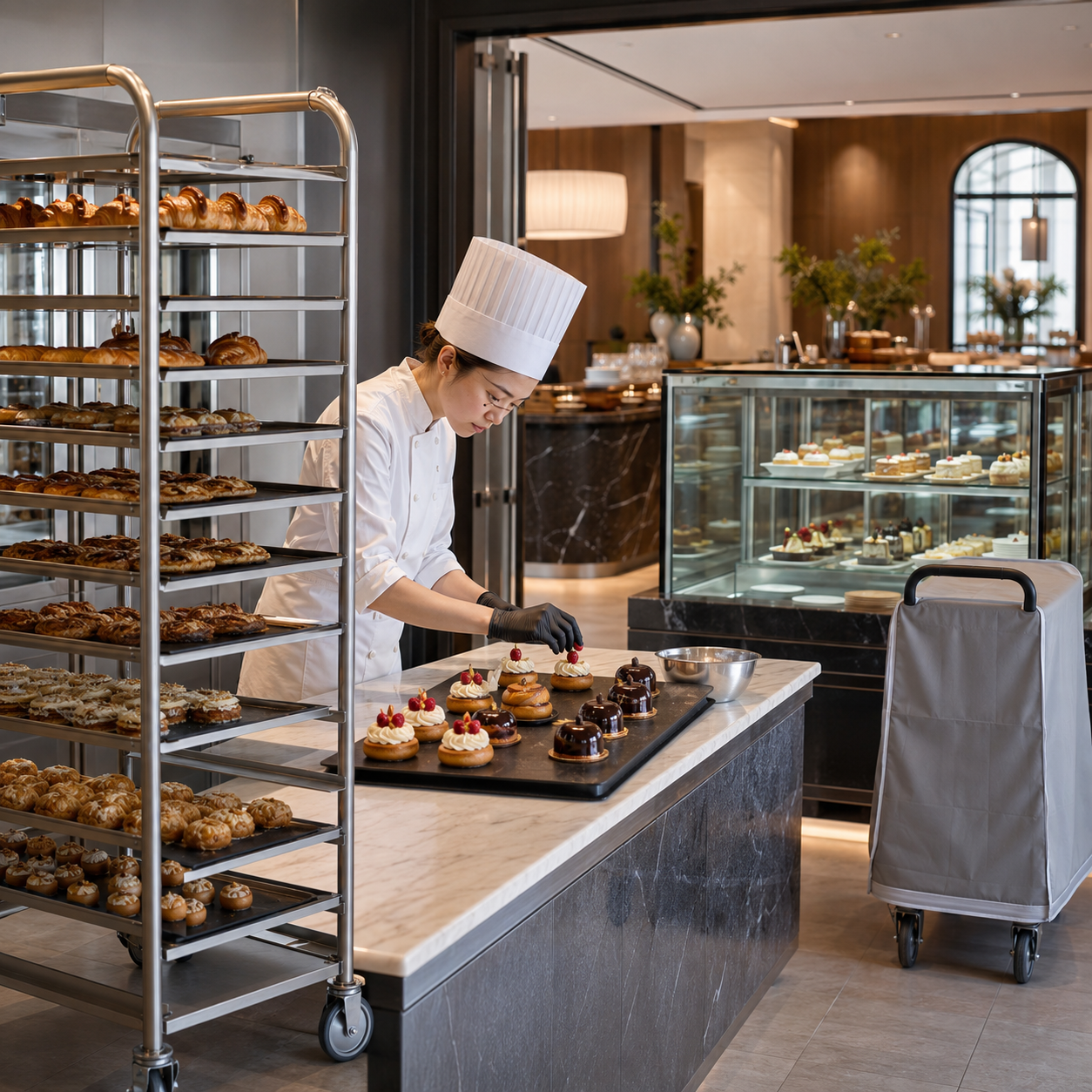
Plan Cooling, Finishing, Display, and Hotel-Wide Delivery
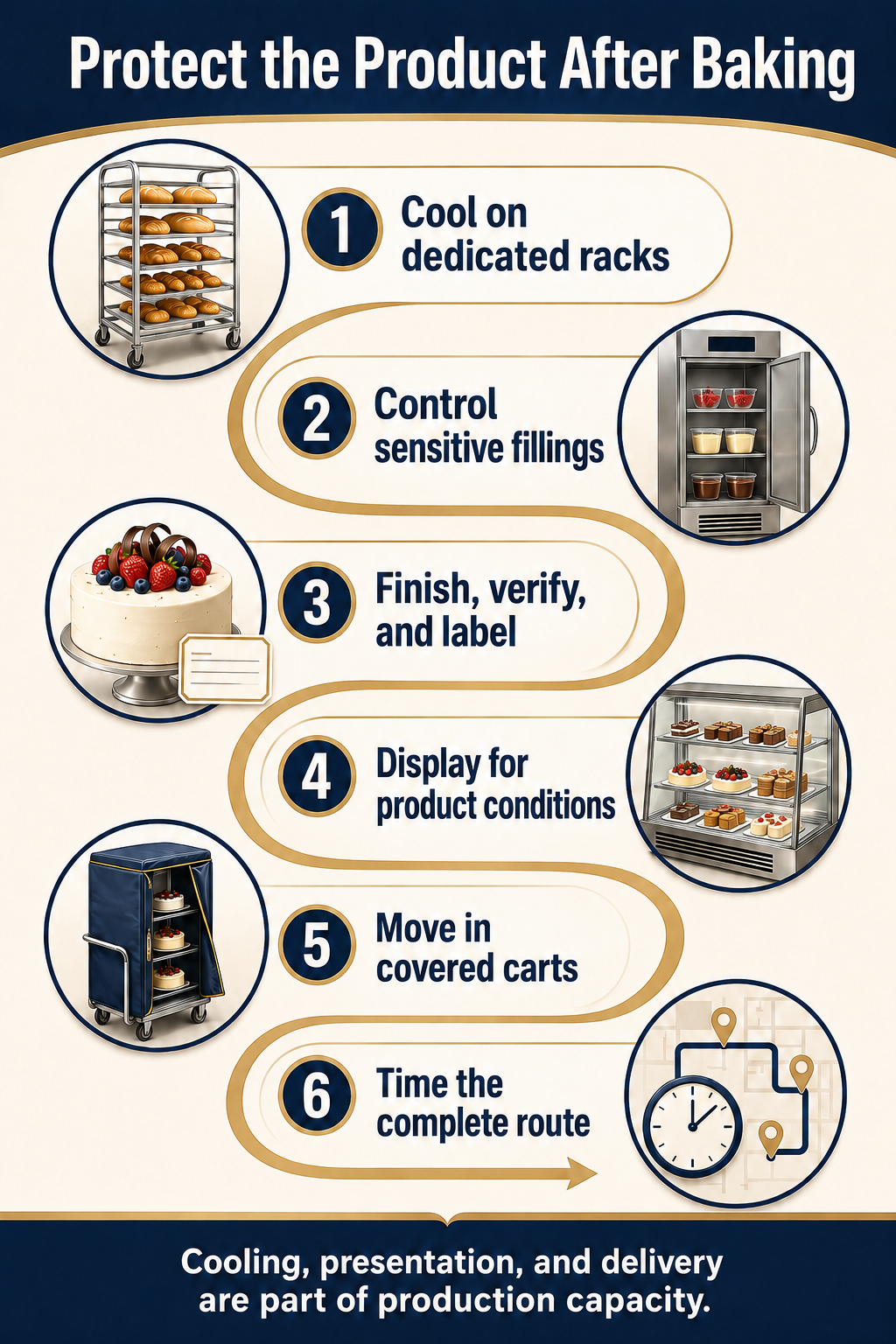
Production is not complete when a tray leaves the oven. Products need protected cooling, controlled finishing, temporary storage, presentation, and delivery to outlets that may be several floors or buildings away.
Cooling and temperature-controlled holding
Provide enough rack positions to cool peak output without placing hot pans on prep benches, floors, or service carts. Specify rack capacity, pan stops, handle position, caster type, brakes, bumpers, cleanability, covers, and nesting behavior if space is constrained. Separate cooling traffic from raw ingredient staging and dirty return paths.
Products containing cream, custard, cheese, egg, meat, or other time/temperature-control ingredients may require controlled cooling and cold holding under the rules adopted by the local jurisdiction. If ordinary refrigeration cannot accept hot production without affecting stored food, evaluate dedicated roll-in refrigeration, blast chilling, or another validated process. Cooling equipment must be sized from product mass, pan depth, loading temperature, target condition, loading frequency, and the manufacturer’s verified performance.
Finishing and decorating stations
A cake and pastry finishing zone may need stainless or stone work surfaces, refrigerated bases, ingredient rails, tempering or warming equipment, turntables, piping tools, airbrush equipment, chocolate tools, small induction units, scales, task lighting, splash protection, and mobile racks. Provide protected storage for fragile decorations, colors, molds, cutters, nozzles, and packaging.
Design the bench around the operator’s sequence: retrieve product, finish, verify, label, pack, and transfer. Locate handwashing, utensil changeover, waste, and refrigeration so they are convenient without contaminating the product zone. If guests can see the workspace, visual presentation should not compromise cleanability, extraction, cable management, or safe working clearances.
Display, buffet, retail, and dispatch equipment
Match display equipment to product condition and replenishment method. The list may include ambient display cases, refrigerated showcases, bakery baskets, covered stands, tiered risers, trays, platters, crumb-control accessories, tongs, label holders, sneeze protection, lighting, and undercounter storage. Verify temperature performance, glass defogging, lighting heat, rear access, cleaning access, shelf adjustment, drainage, lockability, and accessible service-counter provisions.
For breakfast and banquet service, standardize tray footprints and replenishment carts so a full tray can move from bakery rack to staging area to display with minimal transfer. Confirm that decorative platters are approved for the intended temperature and cleaning process; a material suitable for ambient pastries may not be suitable for an oven, heat lamp, or dishwasher.
Room service, lounges, villas, conference areas, and remote outlets require covered transport. Specify insulated or ambient cabinets as appropriate, tray slides, door latches, bumpers, quiet casters, turning radius, elevator fit, thresholds, loading height, and return flow. Time a fully loaded route during commissioning. The product should arrive in the intended condition without creating unsafe cart handling or congesting guest circulation.
Quantify Smallwares, Bakeware, Racks, and Storage
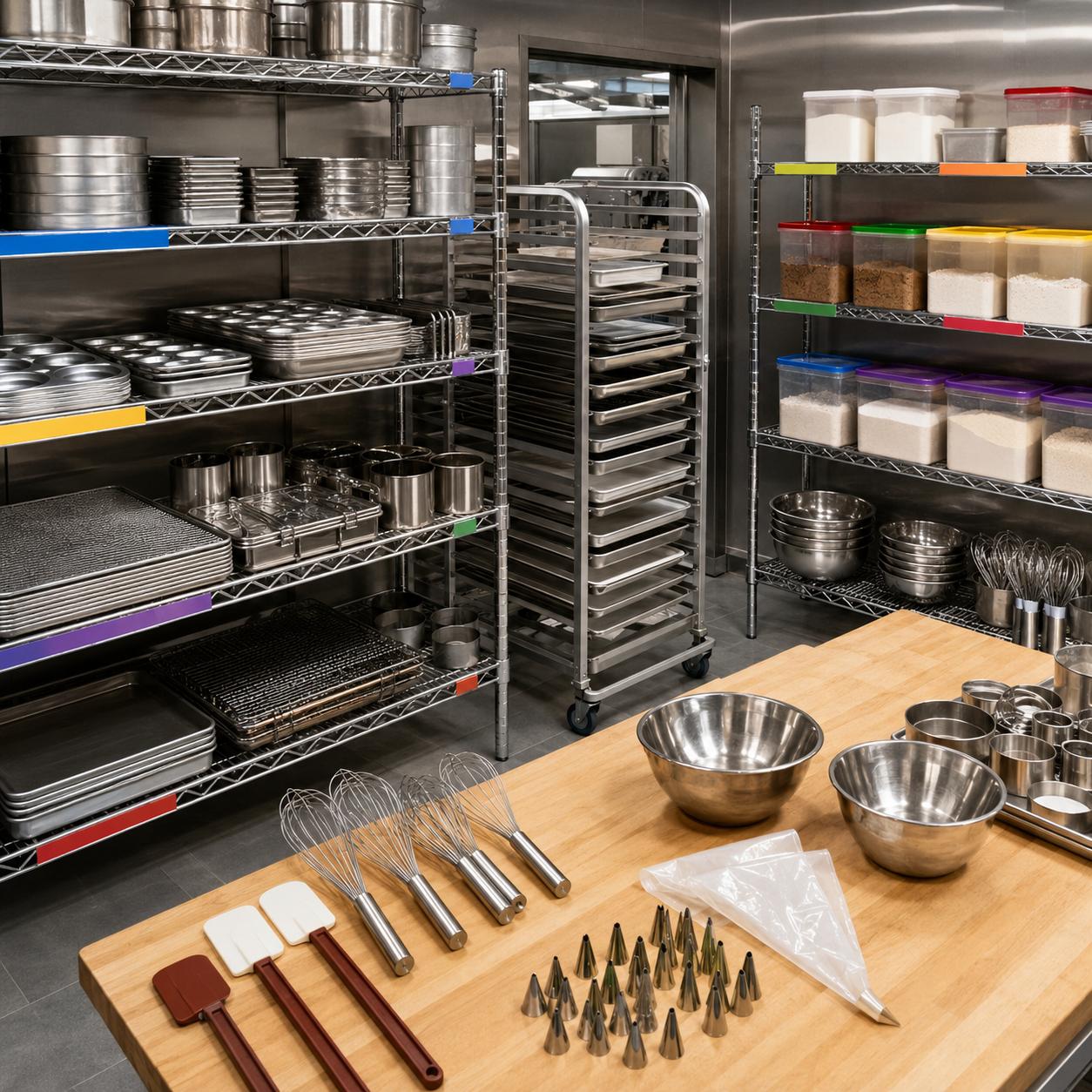
Opening delays are often caused by inexpensive missing items rather than major machines. Build the smallwares list recipe by recipe, then add shared production, sanitation, storage, transport, calibration, and replacement needs.
Bakeware and pan systems
Standardize the bakery around a limited number of pan and rack formats where possible. The schedule may include sheet pans, perforated pans, baguette trays, loaf pans, muffin pans, cake pans and rings, tart rings, molds, silicone mats, baking paper, cooling grids, proofing boards, couche cloths, and pan covers.
For each item, specify dimensions, material, gauge or construction, coating, edge detail, temperature limit, dishwasher or cleaning limitations, rack compatibility, and replacement source. Do not assume “full size” or “standard tray” means the same thing across suppliers and regions. Write dimensions in both metric and U.S. units when the project involves mixed standards.
Calculate par by process occupancy. If a pan can be in forming, proofing, baking, cooling, display, transport, washing, and storage during one production cycle, one set is not enough. Include a controlled opening spare, especially for proprietary rack components or pans with long replacement lead times.
Hand tools and measurement equipment
Typical categories include:
Mixing bowls, whisks, paddles, spatulas, scrapers, spoons, brushes, and ladles.
Bench knives, chef’s knives, serrated knives, paring knives, cake knives, and a controlled sharpening system.
Rolling pins, docker tools, pastry wheels, cutters, stamps, molds, piping bags, tips, and deposit funnels.
Measuring jugs, thermometers, timers, refractometers or other product-specific instruments, and calibration references.
Cake boards, cooling grids, turntables, acetate, storage containers, ingredient scoops, and color-coded allergen tools.
Heat-resistant gloves, aprons, sleeve protection, cut-resistant protection where the risk assessment requires it, and slip-resistant footwear policies.
Use durable identification that survives the actual wash process. Color coding can support segregation, but it should reinforce written procedures rather than replace labels, training, cleaning verification, or supervisory checks.
Mobile racks and storage fixtures
Specify racks as equipment, not incidental accessories. Confirm overall dimensions, tray pitch, load rating, welded or knock-down construction, pan stops, handles that keep hands within the frame, caster diameter and material, brakes, swivel pattern, temperature exposure, floor transitions, rack covers, and compatibility with proofers, ovens, coolers, elevators, and wash areas.
Shelving needs documented load ratings, corrosion resistance, shelf spacing, wall clearance, seismic restraint where applicable, and access for cleaning and pest inspection. Provide shadow boards, drawer organizers, labeled bins, or closed cabinets for high-count tools. A defined home for every item reduces opening loss, cross-use, and time spent searching.
Design Sanitation, Allergen, Safety, and Utility Controls Into the Package
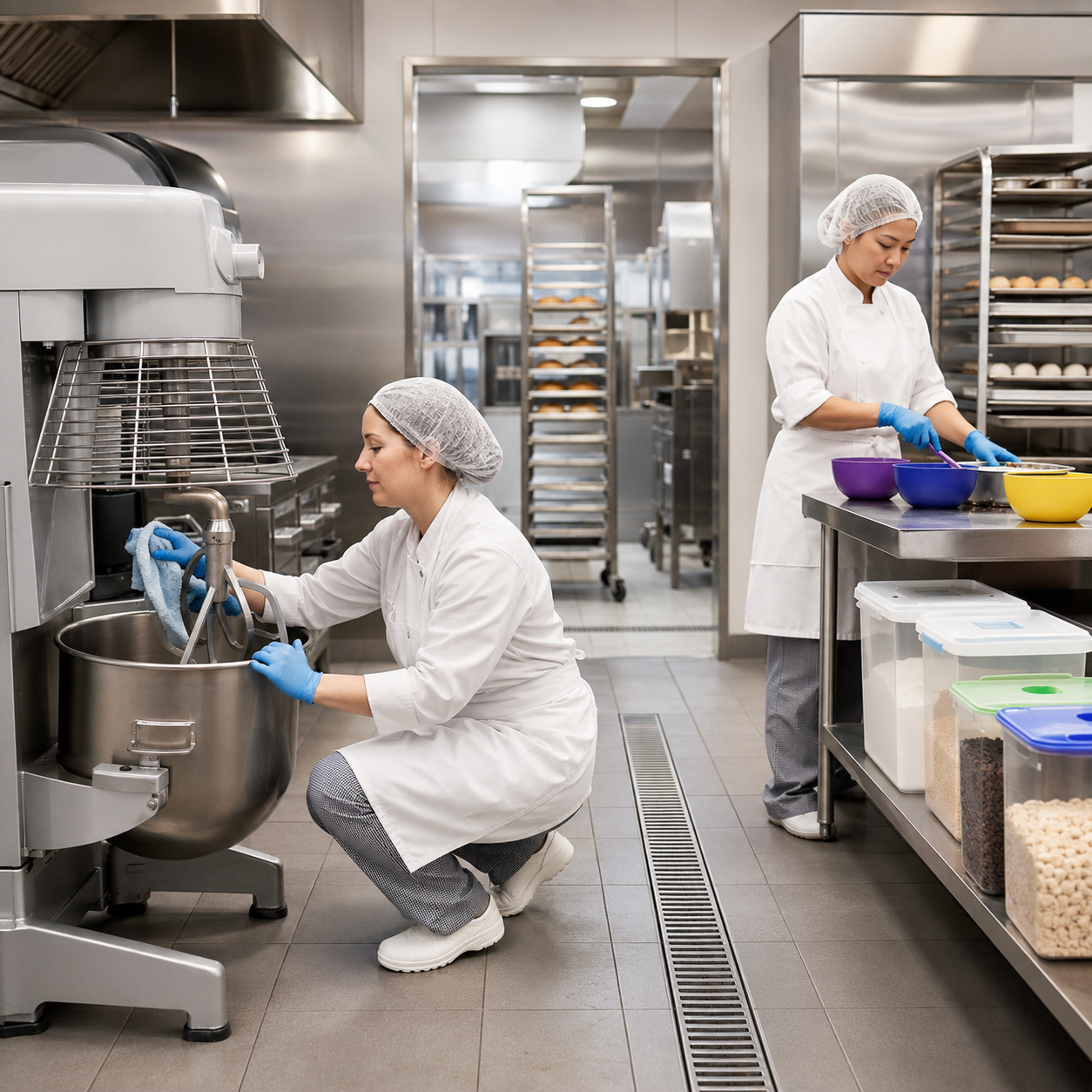
Compliance cannot be added after equipment arrives. In the United States, the FDA Food Code is a model used by jurisdictions rather than a single automatically applicable national operating code. The adopted state and local requirements, plan-review comments, fire and building codes, occupational-safety rules, hotel brand standards, and insurer requirements must be confirmed for the project location.
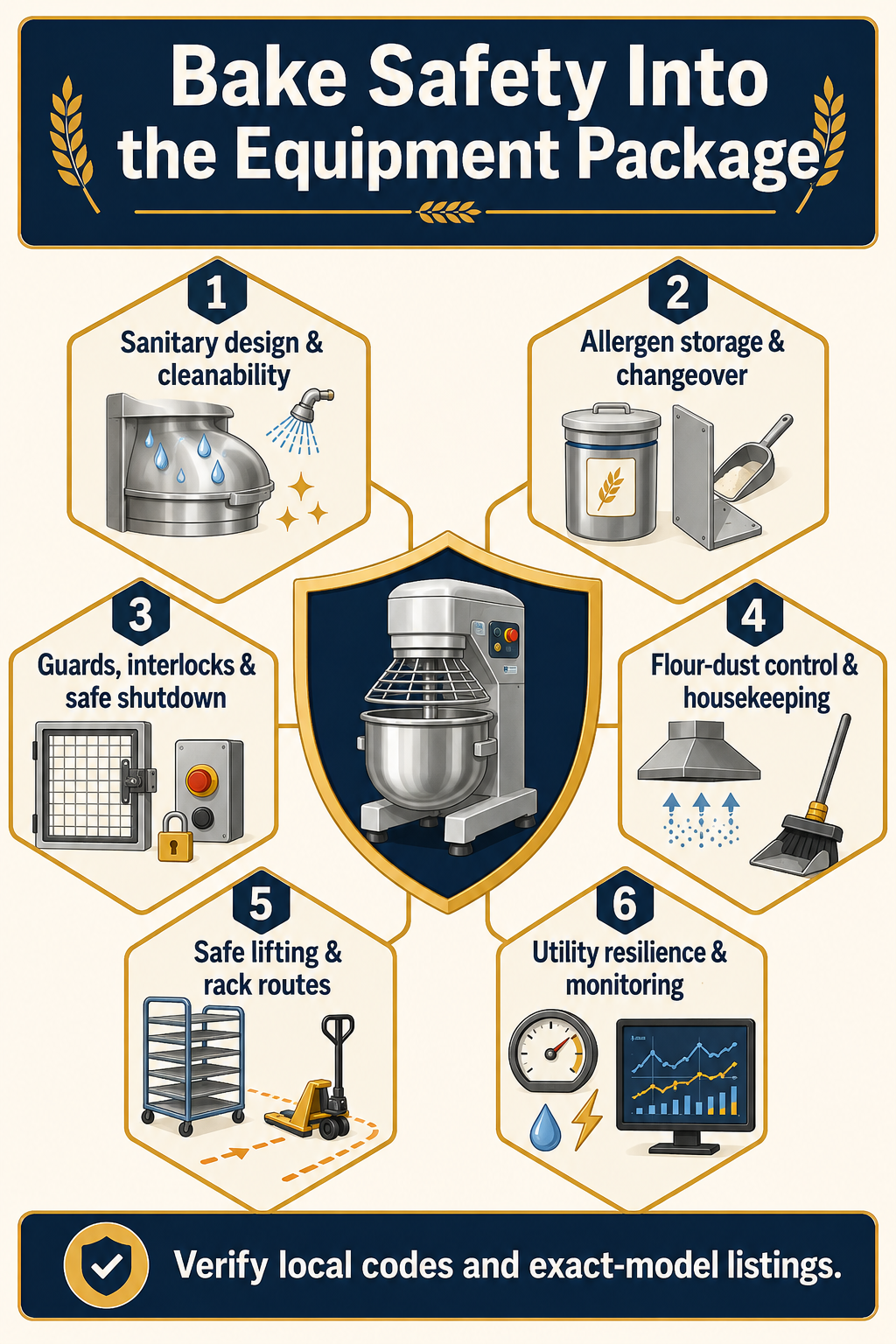
Sanitary design and cleanability
Procurement should request equipment certified or otherwise accepted for the intended commercial-foodservice use by the local authority. Relevant sanitation standards cover food-handling fixtures, commercial warewashing, cooking and proofing equipment, refrigeration, and powered food-preparation equipment. Confirm the listing for the exact model and configuration rather than accepting a generic brand statement.
Evaluate food-contact materials, smoothness, seams, fasteners, drainage, removable parts, tool-free access, hollow sections, exposed threads, splash zones, caster mounts, control panels, and clearance for cleaning. Ask the supplier to demonstrate daily cleaning, allergen changeover, periodic deep cleaning, and safe access to hidden product zones. Record chemicals, concentrations, temperatures, contact times, tools, disassembly limits, and parts that cannot enter the warewasher.
Size the cleaning system around the production equipment. Include handwashing stations, the locally required warewashing sinks, commercial dish or pan washing, pre-rinse, drainboards, drying racks, chemical dispensing, test devices, cleaning-tool segregation, floor drainage, and protected waste movement. Confirm hot-water demand and simultaneous peak use with the plumbing engineer.
Allergen control in a bakery environment
The nine major allergens recognized in the United States are milk, eggs, fish, Crustacean shellfish, tree nuts, peanuts, wheat, soybeans, and sesame. A hotel bakery commonly handles several of them every day, and additional ingredients may be important to individual guests. Equipment planning must support the property’s documented allergen program and truthful guest communication; a separate tool color does not make a shared kitchen allergen-free.
Map allergen receipt, storage, weighing, production sequence, rework, cooling, finishing, display, labeling, and cleaning. Depending on the risk assessment, controls may include closed and labeled storage, lower-shelf placement, dedicated containers and utensils, separate small equipment, controlled scheduling, protected work-in-process racks, verified cleaning, label reconciliation, and restricted movement during sensitive production. Shared mixers, sheeters, depositors, brushes, cloth belts, and hard-to-clean joints deserve particular scrutiny.
Machine, thermal, dust, and handling safety
Commercial bakery machinery introduces nip points, rotating tools, sharp blades, stored energy, hot surfaces, steam, heavy bowls, loaded racks, and slippery contaminants. In the United States, OSHA’s bakery-equipment rules address equipment such as mixers, dividers, moulders, proof boxes, racks, conveyors, and ovens; general requirements such as hazardous-energy control may also apply.
Require appropriate guards, interlocks, emergency stops, safe controls, accessible disconnects, warning labels, and written lockout or tagout procedures for servicing when applicable. Verify that guards work with the real bowl, attachment, and workflow. Employees must not defeat an interlock to add ingredients, scrape a bowl, clear a jam, or clean moving parts. Include manufacturer training for operation, cleaning, blade changes, jam clearing, and maintenance.
Flour, sugar, and certain other fine organic powders can create combustible-dust hazards under some conditions. Bulk handling, dumping, conveying, grinding, dust collection, and housekeeping therefore need a project-specific assessment. Avoid specifications that permit uncontrolled dust escape or create inaccessible ledges. Coordinate dust collection, electrical classification where applicable, ignition-source control, housekeeping methods, and fire protection with qualified professionals and the authority having jurisdiction.
Complete an ergonomic review with realistic loads. Check ingredient-bag handling, bowl movement, rack push force, pan reach, oven loading height, repetitive piping, storage height, floor transitions, drain grates, and delivery routes. Select carts, lifters, smaller containers, or revised shelf heights where they reduce risk without disrupting sanitation.
Utility resilience and monitoring
List every utility dependency on the equipment schedule. Add water filtration cartridges, treatment consumables, drain tempering if required, spare hoses, plugs or connectors where permitted, ventilation controls, gas detection where specified, temperature monitoring, and power-loss procedures. Determine what happens to dough in a proofer, product in an oven, and temperature-controlled food during an outage.
Metering or equipment-level energy data can help the hotel verify performance, identify abnormal consumption, and schedule maintenance. At minimum, record commissioning baselines for preheat time, operating temperature, refrigeration recovery, water use where measurable, and key production outputs.
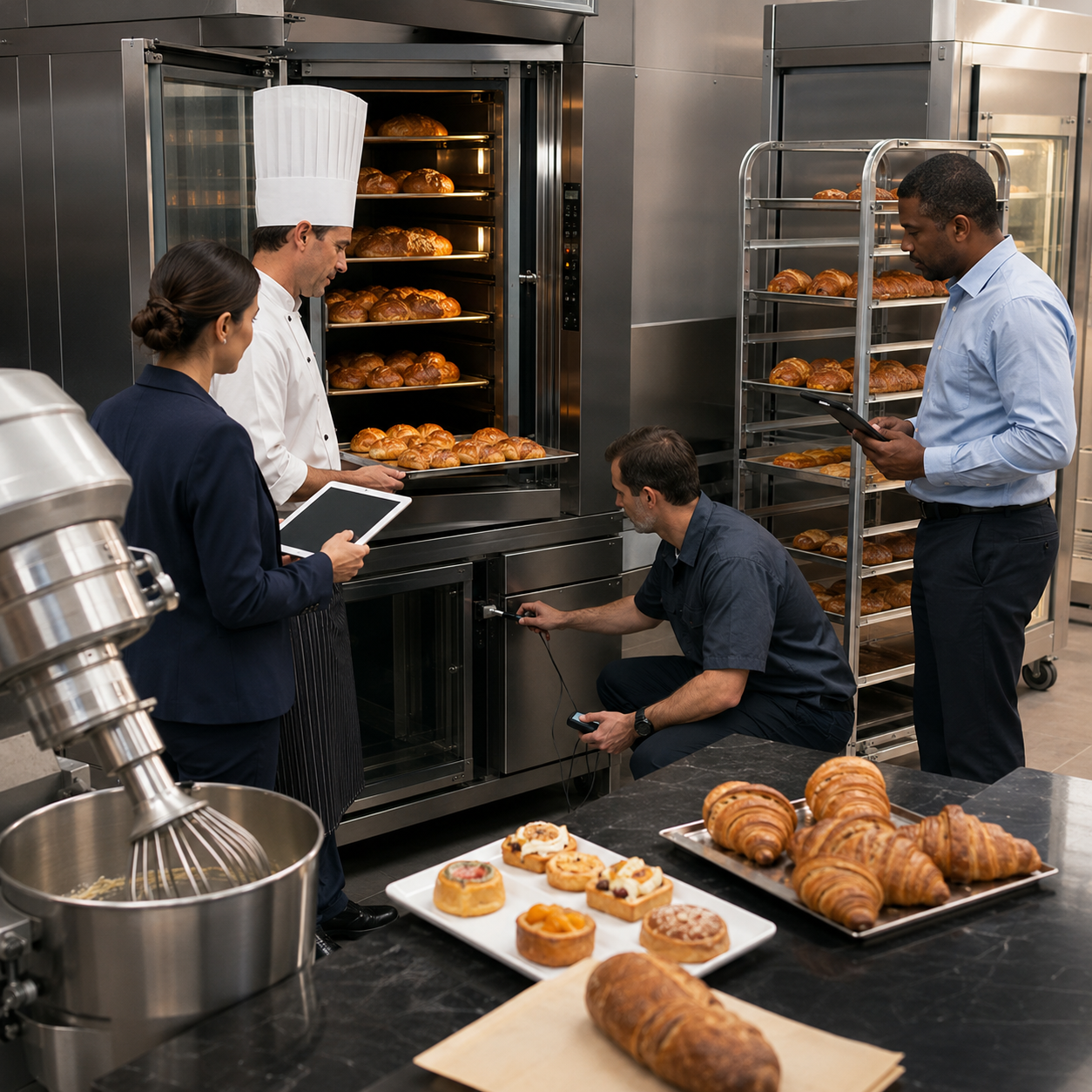
Procure, Install, and Commission the Bakery as One System
A supplier quote is only comparable when the specification defines the same scope. Create a controlled equipment schedule with one line per asset and a unique tag that appears on drawings, utility schedules, quotes, packing lists, commissioning records, and the asset register.
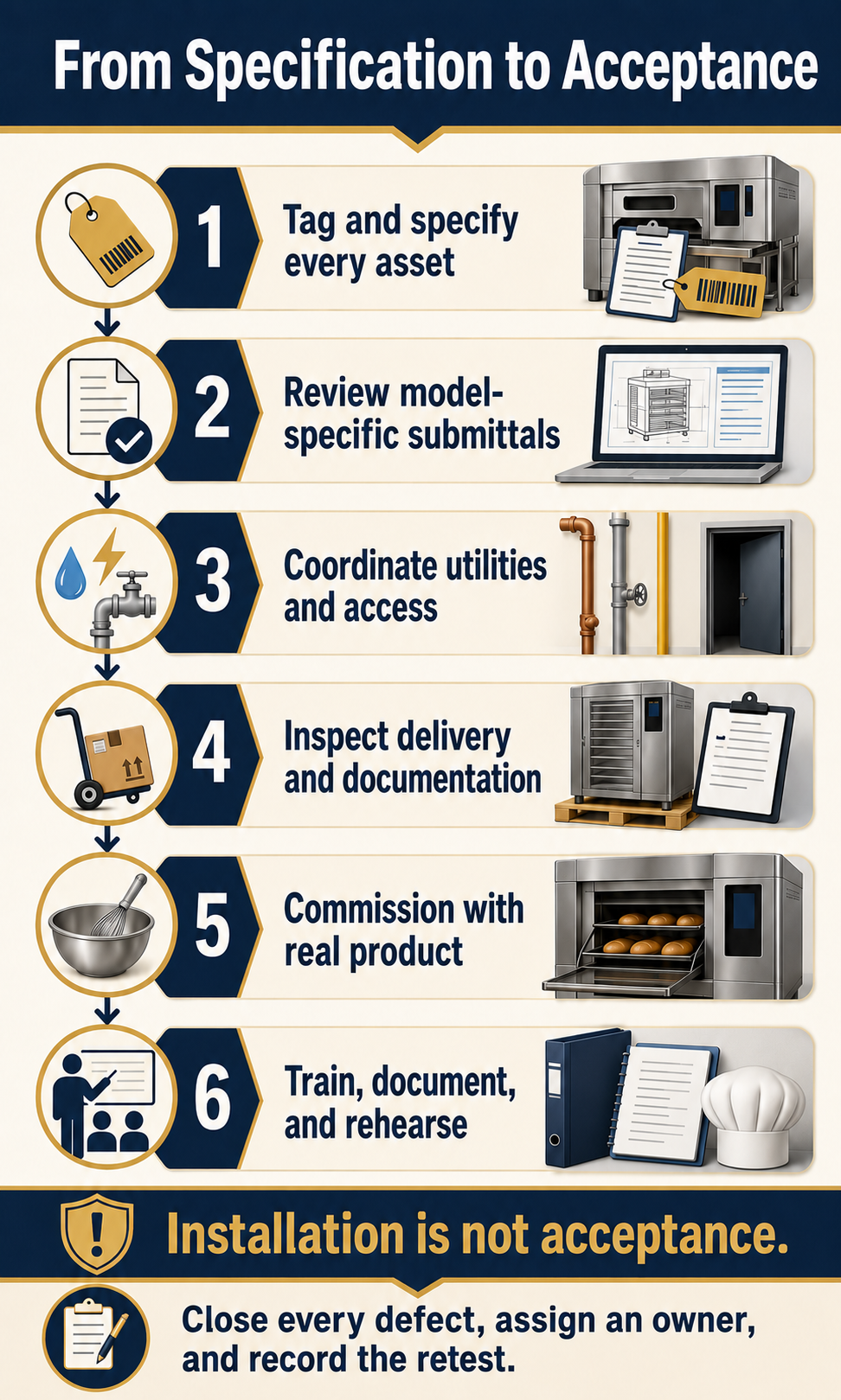
Write supplier-ready equipment specifications
Each major-equipment line should state:
Equipment tag, intended function, approved product families, and required peak output.
Physical dimensions, installed and service clearances, orientation, door swing, and access route limits.
Capacity expressed in the unit that matters: dough weight, trays per load, rack positions, cooling load, or pieces per hour.
Tray, pan, rack, bowl, attachment, and accessory compatibility.
Materials, finish, sanitation certification or local acceptance, and cleanability requirements.
Voltage, phase, frequency, connected load, plug or hardwire, fuel, water, drainage, exhaust, heat rejection, and treatment needs.
Controls, programs, alarms, connectivity, language, data export, and password ownership.
Guards, interlocks, emergency stops, accessibility, and operator-safety features.
Included accessories, starter consumables, spare parts, special tools, manuals, drawings, and certificates.
Warranty start point, labor and travel coverage, response expectations, commissioning, and training.
Packaging, shipping terms, delivery point, rigging responsibility, installation exclusions, and acceptance criteria.
State the approved equivalent process. Suppliers should identify every deviation in a compliance table rather than silently substituting a different capacity, voltage, tray standard, finish, or accessory set.
If your project needs a coordinated bakery package, KW Hospitality can help convert the menu, outlet plan, service deadlines, utilities, and logistics constraints into a supplier-ready equipment and OS&E schedule. Use the project’s equipment tags and capacity assumptions when requesting quotations so alternatives can be evaluated on the same basis.
Compare total cost and operational risk
Evaluate acquisition price together with freight, duties, storage, rigging, utility work, hood and fire-system changes, water treatment, installation, commissioning, training, consumables, cleaning labor, energy, water, preventive maintenance, spare parts, downtime exposure, expected service life, and disposal. An inexpensive oven that requires an unplanned electrical upgrade or has no local service coverage may be the highest-cost option.
Request the nearest authorized service provider, standard and emergency response process, parts location, recommended opening spares, preventive-maintenance schedule, software or subscription terms, and end-of-life support. Identify proprietary pans, racks, filters, chemicals, or accessories and price the initial par plus replacements.
Control submittals and site readiness
Do not release equipment on a brochure alone. Require model-specific data sheets, shop drawings, utility schedules, certifications, installation instructions, foundation or restraint details, and coordinated elevations. Culinary, procurement, design, engineering, operations, IT, safety, and the installer should review the same submittal revision.
Before shipping, verify finished openings, thresholds, corridors, loading dock, elevator, turning radius, ceiling height, floor strength, service clearances, utilities, ventilation, drainage, and storage for packaging. Decide whether equipment ships assembled, knocked down, or requires special lifting. Record who removes and disposes of crates and protective film.
Receive and inspect every item
At delivery, match the purchase order, packing list, equipment tag, model, serial number, voltage, phase, gas type, accessories, and quantities. Photograph packaging before opening and record visible damage on the carrier documentation. Quarantine damaged or noncompliant items; do not install them merely to preserve the program.
Inspect food-contact surfaces, welds, doors, seals, glass, controls, cords, casters, guards, labels, manuals, certificates, and accessory kits. Update the asset register and warranty record immediately. Preserve crates or evidence until claims are resolved.
Commission with product, not only an empty machine
Installation completion is not acceptance. Verify level, restraint, utilities, polarity or rotation where relevant, gas and water connections, drainage, ventilation interlocks, safety devices, clearances, firmware, programs, and calibration. Then run a documented product test at representative load.
The acceptance record should include:
- Preheat or pull-down time and stable operating condition.
- Temperature uniformity, recovery, humidity or steam performance, and alarm operation.
- Mixer function with the intended attachments and a demanding approved batch.
- Proofer or retarder program through its full cycle.
- Oven output, bake uniformity, loading ergonomics, and exhaust performance.
- Refrigeration recovery and monitoring after realistic door openings.
- Warewashing of the largest intended parts and verification of the sanitizing process.
- Cart and rack travel through doors, turns, thresholds, elevators, and outlets.
- Guard, interlock, emergency stop, and safe-shutdown tests.
- Cleaning demonstration, allergen-changeover procedure, and reassembly check.
List every defect, owner, due date, retest, and sign-off. Warranty should not begin months before the hotel can use the equipment unless the commercial terms explicitly compensate for that gap.
Train, stock, and rehearse before opening
Schedule separate operator, cleaning, and maintenance training. Use the installed machines, approved recipes, cleaning chemicals, PPE, and actual forms. Record attendance and keep quick-reference procedures near the point of use without blocking labels or ventilation.
Stock filters, gaskets, fuses where authorized, lamps, probes, belts or wear parts recommended for opening, food-safe lubricant, specialty tools, calibration supplies, approved chemicals, and replacement smallwares. Load recipe programs and control access. File manuals, drawings, certificates, passwords, parts lists, service contacts, and warranty documents in a controlled digital location.
Run at least one full production rehearsal from receiving through outlet delivery. Include a peak breakfast, a banquet overlap, allergen-order communication, equipment fault, delayed delivery, and dirty-return flow. Measure actual batch times, rack positions, labor, waste, and dispatch timing. Adjust pars, schedules, recipes, and storage labels before guests arrive.
How KW Hospitality Can Support a Hotel Bakery Equipment Project
A hotel bakery quotation should be based on a controlled project schedule rather than a collection of unrelated product links or supplier brochures.
Depending on the project scope, the procurement package can be organized around the following stages:
1. Requirement Definition
The project menu, production method, peak service periods, outlet list, tray standard, available utilities, site access and target installation date are documented before equipment is shortlisted.
2. Equipment and OS&E Schedule
Required equipment, bakeware, smallwares, racks, transport equipment, sanitation items, utilities and opening spares are organized into a consistent item schedule.
3. Technical Specification Review
Capacity, dimensions, construction, tray compatibility, electrical supply, gas type, water, drainage, ventilation, clearances, certifications, accessories and warranty requirements are compared against the project criteria.
4. Supplier Quotation Coordination
Suppliers are requested to quote against the same item numbers, capacities, quantities and technical requirements so that proposed models can be compared on a consistent basis.
5. Submittal and Sample Approval
Technical data sheets, drawings, material samples, finishes, accessories and supplier deviations are recorded and reviewed before production or shipment.
6. Quality and Pre-Shipment Review
Where included in the agreed scope, product identification, quantity, workmanship, rating-plate information, accessories, documentation, packaging and visible condition can be checked before shipment.
7. Consolidation and Delivery Coordination
Equipment and OS&E from different eligible suppliers may be organized using consistent project labels, item references, packing lists and destination information.
8. Installation and Commissioning Documentation
The project document package should identify installation instructions, utility schedules, manuals, commissioning requirements, training, warranties, spare parts and service contacts.
Practical Procurement Documents
The following documents help buyers define and control the project:
Hotel Bakery Equipment Master Checklist
Hospitality Product RFQ Template
Product Specification Sheet
Supplier Comparison Register
Quality Inspection Checklist
Sample Approval Form
Procurement Timeline Template
Technical Submittal Approval Log
Commissioning and Opening Review
What to Submit for a More Accurate Bakery Equipment Review
Prepare the following information where available:
Hotel and project location
Property type and room count
Bakery menu
Breakfast and banquet capacity
Outlets served
Peak hourly and daily production
Production model
Tray standard
Equipment layout
Electrical voltage, phase and frequency
Gas type
Water and drainage information
Ventilation strategy
Preferred or approved manufacturers
Required certifications
Delivery destination
Installation date
Opening date
Drawings, reference images or existing specifications
Request a Technical Review and Quotation
Frequently Asked Questions About Hotel Bakery Equipment
The requirements for a hotel bakery vary according to the property type, production model, menu, project location and applicable regulations. References to FDA, OSHA, NSF or ENERGY STAR below are primarily relevant to projects in the United States. For international projects, the project consultant, local authority having jurisdiction and approved equipment specifications should determine the final compliance requirements.
These final questions address the decisions that most often remain unresolved after an initial equipment schedule is drafted. Use the answers together with the opening-readiness review to confirm that capacity, compliance, training, spares, documentation, and product testing have all been completed before the bakery is released to operations.
What information is required to prepare a hotel bakery equipment quotation?
A professional quotation requires more than a general list of equipment. The supplier should receive enough information to determine the correct equipment type, capacity, utilities, accessories, compliance requirements and delivery scope.
The required information normally includes:
Hotel name, project location and delivery destination
Property type and number of rooms
Bakery production model
Number and type of food-and-beverage outlets
Estimated breakfast covers
Banqueting and event capacity
Expected room-service demand
Proposed bakery menu or product list
Peak hourly and daily production volumes
Required tray, pan and rack standards
Available floor plan and equipment layout
Electrical voltage, phase and frequency
Gas type and operating pressure
Water, drainage and ventilation availability
Preferred manufacturers or approved brand list
Required certifications
Installation and commissioning scope
Target delivery and hotel opening dates
Shipping terms and destination access conditions
Required spare parts, warranties and training
A preliminary quotation can be prepared with limited information, but the final quotation should be based on an approved equipment schedule, menu, production assumptions, utility schedule and layout.
Can one bakery package support breakfast, banqueting and room service?
Yes. A central hotel bakery can support breakfast service, banqueting, restaurants, lounges, room service and retail outlets, provided the equipment package is designed around the combined peak demand.
The bakery should not be sized only according to total daily production. The production schedule must identify when each outlet requires its products. Breakfast pastries may need to be produced early in the morning, while banquet bread, desserts and room-service products may be required later in the day.
A shared production package may require:
Separate mixing capacity for doughs, batters and creams
Retarded proofing for overnight production
Sufficient oven capacity during overlapping demand periods
Adequate cooling and refrigerated holding space
Clearly separated finishing and decoration stations
Dedicated transport racks and insulated carts
Production scheduling by outlet and delivery time
Allergen-control procedures
Backup capacity for critical equipment
Some outlets may also require satellite finishing, reheating or holding equipment even when the main production is centralized.
How should bakery equipment be sized for peak hotel occupancy?
Equipment should be sized according to the highest realistic production period rather than average occupancy or total annual demand.
The calculation should consider:
Number of occupied rooms during peak periods
Average guests per occupied room
Breakfast participation rate
Products required per guest
Restaurant and lounge demand
Maximum banquet attendance
Room-service demand
Staff dining requirements
Retail or takeaway sales
Product waste and production losses
Batch preparation and changeover time
Equipment loading and unloading time
Demand should then be converted into peak hourly output, required batches and tray loads. Mixer, proofer, oven, cooling and storage capacities should be assessed as one connected production system.
Oversizing only the oven will not solve a bottleneck in mixing, proofing, cooling or finishing. Capacity should therefore be checked at every production stage.
Which tray standard should a hotel bakery use?
The project should select one primary bakery tray standard and use it consistently across ovens, proofers, racks, blast chillers, freezers, cooling areas and transport trolleys.
Common formats include:
400 × 600 mm bakery trays
600 × 800 mm bakery trays
Full-size U.S. sheet pans
Half-size U.S. sheet pans
Gastronorm pans for compatible processes
The correct format depends on the project location, available equipment, expected production volume and local availability of replacement trays.
The tray specification should state:
External dimensions
Material
Rim design
Perforated or solid construction
Coating or non-stick finish
Maximum operating temperature
Load capacity
Rack runner spacing
Oven loading orientation
Compatibility with proofing and cooling racks
Mixing several tray standards without a documented operational reason can create unnecessary equipment incompatibility, storage problems and replacement-purchasing difficulties.
Can bakery equipment be supplied for different voltage and frequency requirements?
Many commercial bakery-equipment manufacturers offer different electrical versions, but the required electrical configuration must be confirmed before the purchase order is issued.
The supplier should receive:
Nominal voltage
Single-phase or three-phase supply
Electrical frequency
Maximum connected load
Required breaker size
Plug type or hardwired connection
Neutral and grounding requirements
Local electrical certification requirements
For example, equipment manufactured for 400 V, three-phase, 50 Hz operation should not automatically be assumed suitable for a 208 V or 480 V, 60 Hz project.
Transformers can change voltage but do not necessarily resolve frequency, motor-speed, control-board or certification issues. Field conversion may also void the warranty or invalidate the equipment certification. The correct factory electrical configuration is normally the safest option.
What is the difference between equipment, OS&E and bakery smallwares?
Equipment generally refers to powered, fixed or semi-fixed capital items such as ovens, mixers, proofers, dough sheeters, refrigerators and dishwashing equipment.
OS&E, or Operating Supplies and Equipment, covers the items required to operate the hotel after construction. In a bakery, this may include trays, racks, storage containers, scales, utensils, thermometers, transport equipment and cleaning accessories.
Bakery smallwares are typically the hand tools, containers and lower-value operational items used by bakery staff. Examples include:
Mixing bowls
Whisks and spatulas
Dough scrapers
Pastry brushes
Rolling pins
Piping bags and nozzles
Measuring tools
Bread knives
Proofing baskets
Baking molds
Cooling grids
Ingredient containers
The exact classification varies between projects. The procurement schedule should clearly identify whether each item belongs to the kitchen-equipment contractor, OS&E supplier, operating team or another package.
Which bakery equipment requires water, drainage or ventilation?
Equipment that may require a water connection includes:
Steam-injection ovens
Combination ovens
Retarder-proofers
Humidity-controlled proofers
Water-metering systems
Ice machines
Warewashing equipment
Pot washers
Handwashing and preparation sinks
Water-filtration systems
Drainage may be required for:
Combination ovens
Steam ovens
Proofers with condensate discharge
Retarder-proofers
Refrigeration condensate
Ice machines
Warewashing equipment
Floor-cleaning points
Sinks and wash stations
Ventilation requirements can apply to gas ovens, rack ovens, deck ovens, steam-generating equipment, warewashing areas and equipment producing significant heat, moisture, grease or combustion products.
Final requirements must be approved by the project’s mechanical consultant and local authority. The FDA Food Code is a model reference for retail and food-service safety in the United States, but enforcement and adopted requirements vary by jurisdiction.
How early should bakery equipment be ordered before hotel opening?
Procurement should begin as soon as the menu, layout, utility strategy and production requirements are sufficiently developed.
The order program should be calculated backward from the required commissioning date and include:
Final specification approval
Manufacturer quotation
Technical submittal review
Sample or finish approval
Shop drawing approval
Manufacturing lead time
Factory testing
Pre-shipment inspection
Export documentation
Freight consolidation
International transportation
Customs clearance
Delivery to the project
Installation
Utility connection
Commissioning
Staff training
Rectification of defects
Custom-made ovens, proofers, refrigeration systems and high-capacity production equipment may require significantly longer than standard stock items. Lead times should be confirmed directly with each manufacturer before the project procurement schedule is finalized.
What should be included in a bakery equipment specification sheet?
A complete specification sheet should include:
Project name and item code
Equipment description
Required quantity
Intended operational function
Manufacturer and model
Approved equivalent policy
Production capacity
Minimum and maximum batch size
Tray or pan capacity
Overall dimensions
Packed dimensions
Net and shipping weight
Construction materials
Electrical requirements
Gas requirements
Water connection
Drainage requirements
Ventilation and exhaust requirements
Heat rejection
Required clearances
Installation method
Supplied accessories
Optional accessories
Required spare parts
Applicable certifications
Warranty
Country of origin
Manuals and drawings required
Packaging and labeling requirements
Installation and commissioning scope
Supplier deviations and exclusions
Utility and capacity information should be taken from the manufacturer’s approved technical documentation rather than promotional brochures alone.
Can equipment from multiple manufacturers be consolidated for shipping?
Yes. Equipment from several manufacturers can be delivered to a consolidation warehouse and shipped as one coordinated consignment.
Successful consolidation requires:
A master equipment schedule
Confirmed supplier delivery dates
Standardized carton and crate labels
Project and item reference numbers
Packing lists for every supplier
Model and serial-number records
Packed dimensions and weights
Photographic receiving inspection
Shortage and damage reporting
Storage requirements
Export packing standards
Customs-document coordination
Container-loading plan
Clear responsibility for damage and missing items
Consolidation can reduce the number of separate shipments, but it must be carefully controlled. Storage charges, multiple handling, delayed suppliers, customs classifications and warranty responsibility should be addressed before goods arrive at the consolidation warehouse.
What spare parts should be ordered with bakery equipment?
The spare-parts package should be based on equipment criticality, local service availability, manufacturer recommendations and expected replacement lead times.
Depending on the equipment, recommended spares may include:
Door gaskets
Oven lamps
Ignition components
Heating elements
Temperature probes
Humidity sensors
Fuses and contactors
Control relays
Belts and chains
Bearings
Mixer seals
Bowl-scraper components
Emergency-stop components
Water filters
Spray nozzles
Drain seals
Caster wheels
Tray runners
Refrigeration controllers
Fan motors
Approved lubricants
Safety components and electronic controls should not be replaced with unapproved generic alternatives. The quotation should distinguish between commissioning spares, operating consumables, recommended critical spares and long-term replacement parts.
How should bakery equipment be inspected before shipment?
A pre-shipment inspection should verify the equipment against the approved purchase order, specification sheet, drawings and technical submittals.
The inspection should cover:
Manufacturer and model
Quantity
Serial number
Rating plate
Dimensions and construction
Voltage, phase and frequency
Gas type and pressure requirements
Water and drainage connections
Supplied accessories
Spare parts
Safety guards and covers
Emergency stops
Interlocks
Control functions
Visible workmanship
Surface finish
Weld quality
Door alignment
Tray and rack compatibility
Functional operation
Packaging and crate condition
Shipping labels
Documentation
Where practical, critical equipment should undergo a factory acceptance test. In the United States, OSHA’s bakery-equipment standard addresses the design, installation, operation and maintenance of bakery machinery, including machine-guarding requirements.
What documents are needed for installation and commissioning?
The handover package should include:
Approved equipment schedule
Approved technical submittals
General arrangement drawings
Equipment layout
Electrical load schedule
Water and drainage schedule
Gas schedule
Ventilation and exhaust requirements
Foundation and fixing details
Installation manual
Wiring diagrams
Plumbing diagrams
Gas-train diagrams
Recommended clearance requirements
Lifting and handling instructions
Operation manual
Cleaning instructions
Preventive-maintenance schedule
Parts manual
Recommended spare-parts list
Certificates of conformity
Warranty certificates
Factory-test reports
Commissioning sheets
Calibration certificates
Staff-training records
Defect and punch-list records
Final acceptance certificate
Documents should be delivered in an indexed digital folder and, where required, as a printed operation-and-maintenance manual.
Can equipment be customized with hotel branding or asset labels?
Yes. Depending on the equipment and manufacturer, customization may include:
Hotel logo
Property name
Department identification
Asset numbers
Barcode labels
QR-code labels
Color-coded operational labels
Engraved identification
Custom trolley markings
Custom carton labels
Destination or floor labels
Multilingual operating labels
Branding should not cover model numbers, serial numbers, warning labels, certification plates, ventilation openings or service-access points.
Any modification to food-contact surfaces, electrical enclosures or safety components should be approved by the manufacturer. Asset labels should be durable, cleanable and resistant to heat, moisture and cleaning chemicals appropriate to their installation location.
How should replacement parts and warranty documentation be organized?
Each equipment item should have a digital asset record containing:
Project item number
Equipment description
Manufacturer
Model
Serial number
Installation location
Supplier
Purchase-order number
Invoice
Delivery date
Installation date
Commissioning date
Warranty start and expiry dates
Warranty conditions
Service contact
Approved service agent
Operation manual
Parts manual
Exploded-parts diagram
Recommended spare-parts list
Preventive-maintenance schedule
Maintenance history
Repair history
Warranty claims
Replacement-parts orders
The same item number should appear on the equipment schedule, asset label, warranty record and maintenance system. A QR code can link staff directly to the relevant manuals and service information.
What is the difference between convection, deck, rack and combination ovens?
A convection oven circulates heated air and is suitable for pastries, cookies, breakfast products and general hotel production.
A deck oven provides independent heated baking chambers and is often preferred for artisan bread, pizza and products requiring controlled top and bottom heat.
A rack oven accepts a full wheeled rack and is suitable for high-volume, consistent production.
A combination oven provides convection, steam and combined cooking modes. It offers operational flexibility but should not automatically be considered a complete substitute for a specialized bakery oven.
Oven selection should consider:
Product range
Required crust and texture
Tray capacity
Batch frequency
Steam requirements
Recovery time
Available floor space
Utility consumption
Ventilation
Cleaning requirements
Operator skill
Maintenance support
Many full-service hotel bakeries require more than one oven type.
Should a hotel bakery use a spiral mixer or a planetary mixer?
A spiral mixer is primarily designed for bread and other yeast doughs. Its bowl and spiral action are suitable for developing dough while controlling heat generation.
A planetary mixer is more versatile and can use different attachments for:
Batters
Creams
Icings
Fillings
Whipped products
Light doughs
General pastry preparation
A hotel producing substantial quantities of bread and pastries will often benefit from having both types.
Mixer capacity should not be selected only by bowl volume. The specification should consider:
Maximum dough weight
Minimum workable batch
Flour capacity
Dough hydration
Mixing time
Number of batches per hour
Duty cycle
Motor power
Number of speeds
Attachment requirements
Bowl-handling method
Should equipment capacity be based on daily production or peak-hour production?
Peak-hour production is normally the more important sizing criterion.
Daily output can hide operational bottlenecks. A bakery may produce 1,000 pieces per day, but the equipment requirement will be very different if 700 pieces must be available before breakfast compared with production spread evenly across twelve hours.
Capacity calculations should include:
Products required in each service period
Mixing time per batch
Resting and fermentation time
Proofing time
Oven loading capacity
Bake time
Oven recovery time
Cooling time
Finishing time
Cleaning and changeover time
Available labor
Number of operating shifts
The production sequence should be modeled from ingredient preparation through final dispatch.
How should tray, rack, oven and proofer compatibility be verified?
A compatibility matrix should be prepared for every tray-handling item.
The matrix should compare:
Tray external dimensions
Tray depth
Rack width and height
Number of rack runners
Runner spacing
Maximum rack load
Oven chamber dimensions
Oven loading direction
Proofer capacity
Cooling-rack capacity
Blast-chiller compatibility
Freezer compatibility
Transport-cart compatibility
Caster size
Floor-clearance requirements
Maximum operating temperature
Where possible, the project should request approved drawings or test a physical tray and rack before final production. Minor dimensional differences can prevent a rack from entering an oven or cause trays to sit incorrectly on runners.
What access information is required before large equipment is ordered?
The project must verify the complete delivery route from the truck-unloading point to the final installation position.
Required information includes:
Loading-dock dimensions
Dock height
Available forklift capacity
External access restrictions
Door widths and heights
Corridor widths
Ceiling height
Turning radius
Elevator dimensions
Elevator load capacity
Stair restrictions
Floor loading
Finished-floor protection
Available rigging points
Crane requirements
Temporary wall or door removal
Equipment packed dimensions
Equipment unpacked dimensions
Equipment weight
Removable equipment components
Access planning should occur before manufacturing. Discovering that an oven cannot pass through the bakery entrance after delivery can result in costly dismantling, crane work or construction changes.
What certifications should be requested for hotel bakery equipment?
Required certifications depend on the destination country, project specification and authority having jurisdiction.
The supplier may need to provide:
Electrical-safety certification
Gas-appliance certification
Sanitation or food-equipment certification
Food-contact material declarations
Energy-efficiency documentation
Refrigerant documentation
Pressure-system certificates
Declaration of conformity
Factory-test reports
Material certificates
Country-of-origin certificate
Examples may include CE, UKCA, UL, ETL, NSF or other market-specific approvals, but no certification should be treated as universally applicable.
NSF maintains certified-product listings for food equipment, including standards covering commercial cooking, refrigeration, warewashing and powered food-preparation equipment.
How should gas and electrical requirements be confirmed?
Utility requirements should be coordinated between the manufacturer, kitchen consultant, electrical consultant and mechanical consultant before the equipment is released for production.
For electrical equipment, confirm:
Voltage
Phase
Frequency
Connected load
Full-load current
Breaker requirements
Cable size
Neutral requirement
Grounding
Isolation switch
Plug or hardwired connection
For gas equipment, confirm:
Gas type
Supply pressure
Operating pressure
Heat input
Connection size
Isolation valve
Regulator requirements
Flue connection
Combustion-air requirements
Gas-detection requirements
Emergency shutoff requirements
The manufacturer’s final utility data should be reflected in the project MEP drawings and equipment schedule.
Should installation be included in the equipment quotation?
The quotation should clearly state whether installation is included, excluded or offered as an optional service.
Installation scope may include:
Delivery to the site
Unloading
Uncrating
Internal positioning
Assembly
Levelling
Fixing to floors or walls
Connection to utilities
Duct or flue connection
Initial startup
Operational testing
Calibration
Commissioning
Product testing
Operator training
Removal of packaging
The quotation should also identify exclusions such as:
Builders’ work
Electrical cabling
Plumbing
Gas piping
Drainage
Ventilation ductwork
Fire suppression
Permits
Travel and accommodation
Lifting equipment
After-hours work
Consumable ingredients
Ambiguous installation scope is a common source of project variation costs.
What tests should be completed during commissioning?
Commissioning should demonstrate that the equipment is safely installed, correctly connected and capable of meeting the approved operational requirements.
Tests may include:
Visual installation inspection
Utility verification
Electrical-safety checks
Gas-pressure verification
Water-pressure verification
Drainage and leak testing
Emergency-stop testing
Door-interlock testing
Guard inspection
No-load operation
Loaded production testing
Temperature calibration
Oven-temperature uniformity
Oven-recovery testing
Mixer speed and timer testing
Proofer temperature and humidity testing
Refrigeration pull-down testing
Alarm testing
Ventilation verification
Noise and vibration checks
Product-quality trials
Commissioning results should be documented and signed by the supplier, contractor and authorized hotel representative. OSHA’s U.S. bakery standard includes requirements concerning bakery-equipment design, guarding, operation and maintenance.
What staff training should be included with bakery equipment?
Training should cover both normal operation and foreseeable abnormal conditions.
The program should include:
Equipment startup and shutdown
Control-panel operation
Recipe programming
Loading and unloading
Minimum and maximum batch limits
Correct attachment use
Safe handling procedures
Emergency-stop operation
Cleaning and sanitation
Daily inspection
Changeover procedures
Allergen-control procedures
Basic troubleshooting
Preventive maintenance
Consumable replacement
Service-call procedures
Warranty conditions
Prohibited adjustments
Lockout and servicing boundaries
Attendance should be recorded, and training materials should remain available to the hotel. In the United States, lockout/tagout requirements address unexpected equipment energization during maintenance and servicing.
How much spare production capacity should a hotel bakery include?
There is no universal spare-capacity percentage suitable for every project.
The required allowance should reflect:
Occupancy growth
Seasonal peaks
Banquet variability
New outlet openings
Menu expansion
Equipment cleaning
Product changeovers
Preventive maintenance
Equipment breakdown risk
Local service response
Replacement-parts availability
Available operating hours
In critical operations, two smaller units may provide better redundancy than one oversized machine. For example, two mixers or two ovens may allow limited production to continue when one unit is being serviced.
Capacity allowance should be documented in the design assumptions rather than added as an arbitrary oversizing factor.
How should allergen control affect bakery-equipment selection?
Bakery operations frequently handle wheat, milk, eggs, nuts, peanuts, soy and sesame. Equipment selection and layout should therefore support controlled storage, production separation and effective cleaning.
Useful measures include:
Dedicated ingredient containers
Clearly labeled storage
Color-coded utensils
Dedicated trays or molds
Separate smallwares
Easily cleanable surfaces
Removable components
Accessible cleaning areas
Production sequencing
Documented cleaning procedures
Controlled rework
Separate cooling and transport where required
In the United States, FDA identifies nine major food allergens and addresses controls intended to reduce undeclared allergens and cross-contact. FDA research has also found that a full wash-rinse-sanitize-air-dry process can effectively reduce allergen transfer on food-contact surfaces.
Local allergen laws and the hotel’s food-safety plan should determine the final controls.
What packaging and labeling requirements should be specified for international projects?
Export packaging should protect equipment from moisture, impact, vibration, stacking and repeated handling.
The purchase order should specify:
Export-grade crate or carton
Moisture protection
Corrosion protection
Shock-sensitive labeling
Upright-position markings
Lifting-point markings
Center-of-gravity markings
Maximum stacking restrictions
Project name
Hotel name
Purchase-order number
Item code
Equipment description
Destination
Building, floor or department
Package number
Gross and net weight
Package dimensions
Country of origin
Handling instructions
Packing-list location
Each package should be traceable to the master equipment schedule. Loose accessories, manuals and spare parts should be packed and labeled to prevent separation from the main equipment.
What exclusions and clarifications should be checked in a bakery-equipment quotation?
A quotation should be reviewed for both price and scope.
Common clarifications include:
Whether tax is included
Freight terms
Customs duties
Insurance
Unloading
Storage
Internal delivery
Installation
Utility connections
Ventilation
Builders’ work
Permits
Commissioning
Training
Travel expenses
Warranty location
Spare parts
Consumables
Packaging
Documentation
Certification
Currency
Exchange-rate validity
Quotation validity
Production lead time
Delivery schedule
Payment terms
Cancellation terms
Approved-equivalent policy
A low equipment price may not represent the lowest complete project cost when installation, freight, accessories, commissioning or certifications are excluded.
How should hotel bakery equipment quotations be compared?
Quotations should be normalized into one comparison sheet rather than compared only by total price.
The comparison should include:
Compliance with the specification
Manufacturer and model
Production capacity
Minimum and maximum batch size
Tray capacity
Equipment dimensions
Utility requirements
Energy efficiency
Supplied accessories
Optional accessories
Spare parts
Certification
Warranty
Local service support
Parts availability
Manufacturing lead time
Freight
Installation
Commissioning
Training
Documentation
Supplier exclusions
Payment terms
Lifecycle cost
Deviations should be recorded separately as compliant, conditionally compliant or non-compliant.
Energy consumption should also be considered where relevant. ENERGY STAR commercial-oven criteria evaluate factors including cooking-energy efficiency, idle-energy rate and, for applicable equipment, water consumption.
The preferred supplier should provide the best combination of technical compliance, operational suitability, serviceability, delivery reliability and total project cost—not necessarily the lowest initial price.
What equipment is essential for a small hotel bakery?
For a limited breakfast and dessert program, the essential package often includes commercial refrigeration and dry storage, scales, stainless worktables, a planetary mixer with appropriate attachments, a convection oven, a proofing solution if yeast products are made, sheet pans, pan racks, cooling capacity, hand tools, and compliant warewashing and handwashing facilities. The exact list must follow the menu, volume, local rules, and whether products arrive ready to bake or are made from scratch.
Does a hotel bakery need both a planetary mixer and a spiral mixer?
Not always. A planetary mixer is versatile for batters, creams, icings, and many doughs. A spiral mixer becomes valuable when bread and yeast-dough volume, batch consistency, dough development, and duty cycle justify a dedicated machine. Compare the heaviest and lightest real recipes with each manufacturer’s written capacity limits.
Which oven is best for a hotel bakery?
There is no universal best oven. Convection ovens offer broad pastry flexibility; deck ovens suit products needing distinct top and bottom heat; rack ovens support high pan throughput; and combination ovens may share functions across a hotel kitchen. Select by product result, peak throughput, labor, pan system, utilities, ventilation, service support, and bake-test evidence.
How should equipment capacity be calculated?
Start with peak demand by outlet and service deadline. Convert pieces into trays, trays into loads, and loads into time. Test mixing, forming, proofing, baking, cooling, and finishing as one chain, then size to the limiting step with a documented utilization and contingency. Validate the result using the actual recipe, pan, and proposed equipment.
What certifications should buyers request in the United States?
Request evidence that the exact equipment is appropriately listed or certified for its intended commercial use and accepted by the local authority. Depending on the item, buyers may need sanitation, electrical, gas, fire, ventilation, energy, plumbing, or accessibility documentation. The required mark and edition vary by jurisdiction and equipment type, so the project team should confirm them before ordering.
How early should bakery equipment procurement begin?
Begin during menu and kitchen-design development, before utilities and openings are frozen. Custom ovens, refrigeration, hoods, overseas equipment, and integrated systems can have long design, approval, manufacturing, shipping, and commissioning paths. Build the schedule backward from the date needed for installation, product testing, staff training, and rehearsal—not from opening day alone.
What should be completed before the bakery is declared opening-ready?
Use this final review:
Menus, demand assumptions, product methods, and peak-day calculations are approved.
Every equipment tag is installed in the correct location and matches the approved submittal.
Utilities, ventilation, drainage, fire protection, access, and service clearances are accepted.
Sanitation, safety, allergen, accessibility, and local authority requirements are closed.
Product-load commissioning is passed and all defects are resolved or formally controlled.
Operators, cleaners, supervisors, and maintenance staff are trained.
Pans, racks, bowls, attachments, tools, chemicals, PPE, spares, and packaging meet the approved pars.
Recipes, programs, labels, cleaning procedures, preventive maintenance, and emergency plans are available.
The full production and delivery route has been rehearsed under realistic demand.
Asset records, warranties, manuals, certificates, passwords, and service contacts are complete.
The opening checklist is complete only when the bakery can repeatedly produce the approved menu, protect food and employees, move products to every hotel outlet on time, recover from predictable disruptions, and maintain the equipment after the project team leaves.
KW Hospitality supports hotels, resorts, restaurants, and hospitality developers with coordinated equipment and OS&E sourcing. To request a property-specific bakery package, submit the menu, estimated peak covers, outlet list, tray standard, utility information, destination, target installation date, and available drawings through the KW Hospitality RFQ page.