For hotel guestrooms, choose a pressure-assisted toilet only after the complete fixture passes checks for physical fit, water supply, nighttime noise, serviceability, and local approval. A gravity toilet remains a practical candidate when it meets flushing needs and fits the property’s maintenance capabilities. Neither mechanism is automatically the better hotel specification. The useful comparison is between two identified, approved toilet assemblies operating in the rooms where guests will use them.
The most expensive misunderstanding is treating pressure assistance as an interchangeable tank accessory. Flushmate explicitly says its system cannot be installed in an existing gravity bowl. Changing technology generally means selecting a compatible complete fixture; replacing a mechanism inside an existing pressure-assisted toilet is a different, model-specific task. Start with bowl and tank identification, then verify the proposed combination in the manufacturer’s documentation. Flushmate’s compatibility guidance explains this distinction.
A hotel also has operating conditions that a showroom demonstration cannot reproduce. An upper-floor bathroom may experience a different supply condition during the morning shower peak. A toilet that sounds acceptable beside an open bathroom door may be intrusive across a shared bedroom wall at night. A smaller replacement footprint may expose unfinished flooring, while a longer bowl may interfere with a door or accessible transfer space. These issues can turn a straightforward fixture purchase into additional construction and lost room availability.
Use the following comparison, room survey, and pilot procedure before releasing a bulk order. The checklist is a procurement and commissioning aid for tank-type guestroom toilets in US and Canadian hotels. It does not substitute for the installer’s measurements, the exact fixture instructions, or a project-specific code review. For a wider renovation scope, coordinate the toilet schedule with the other bathroom fixtures and accessories so layout decisions remain consistent.
Compare complete toilet assemblies, not flushing labels
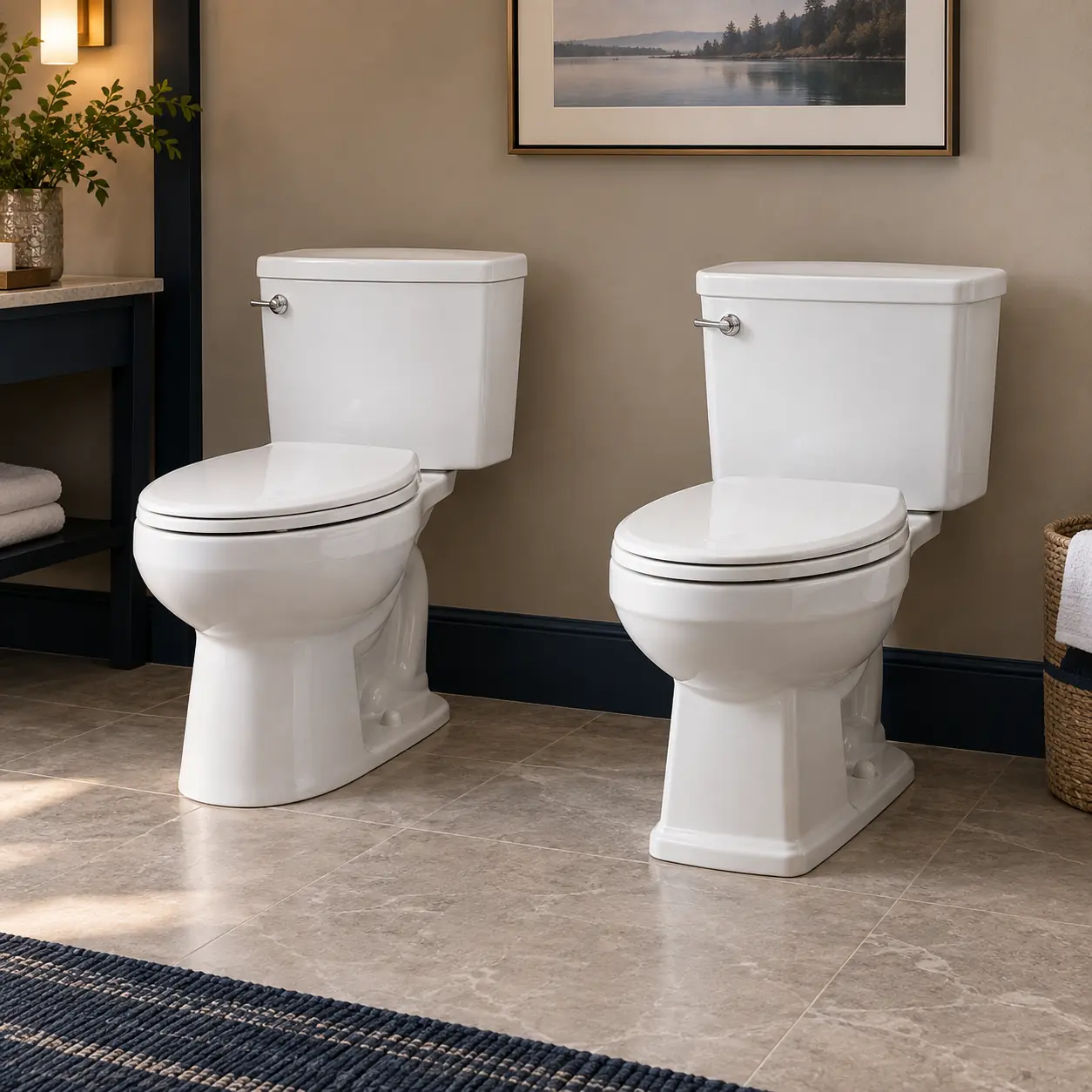
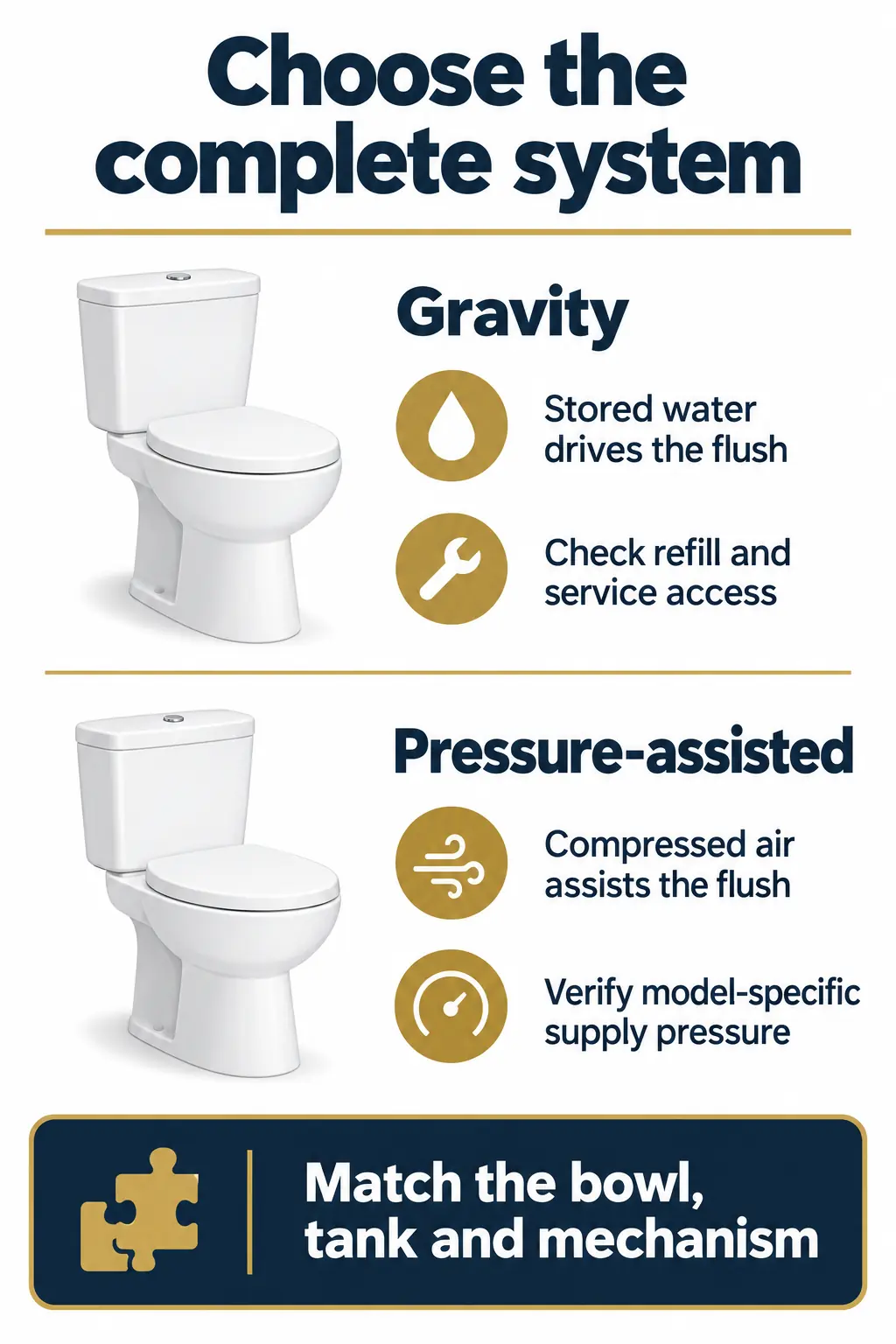
Pressure-assisted and gravity toilets differ in how they deliver stored water to the bowl, but the mechanism alone does not establish guest satisfaction or operating cost. A gravity tank releases water using its stored head; a pressure-assisted tank uses compressed air to help discharge water through a compatible bowl. Compare the exact models at their specified flush volumes, including the seat, handle, tank, and service parts. For hotel purchasing, the decision becomes useful only when the proposed performance benefit can be tested against the property’s actual complaints, plumbing conditions, and maintenance resources.
| Decision factor | Gravity candidate | Pressure-assisted candidate |
| Existing fixture compatibility | Match approved tank, bowl and valve components. | Require a bowl and tank designed for the specified pressure system. |
| Water supply | Confirm fill-valve limits and acceptable refill time. | Confirm complete-fixture operating pressure and reliable recharge. |
| Flush performance | Test bowl clearing, rinsing and repeat flushes. | Test the same outcomes; do not assume every model wins. |
| Bedroom noise | Assess flush and refill in the actual room. | Pay particular attention to the discharge event and transmitted noise. |
| Maintenance | Confirm exact valve, seal and seat availability. | Confirm cartridge, actuator and approved system availability. |
| Purchase basis | Compare installed and operating costs. | Require evidence that any price premium solves a measured problem. |
Define the problem before choosing a mechanism
Separate complaints into bowl blockage, branch-drain blockage, weak rinse, continuous running, slow refill, noise, and loose or uncomfortable seats. Maintenance records that simply say “toilet issue” hide the cause. Review which room types and floors generate calls, what the technician actually repaired, and whether the problem returned. A blocked or defective drain needs diagnosis; selecting a more forceful toilet is not a demonstrated repair for downstream piping.
Pressure assistance deserves a pilot when the property has a documented flushing problem and a compatible model may address it. A gravity candidate deserves equal consideration when a complete, efficient assembly provides satisfactory flushing with manageable noise and readily available parts. Retaining the existing technology can also reduce training and stock complexity, but only if it meets the project’s performance requirements.
Compare rated water use separately from technology
Both gravity and pressure-assisted tank-type toilets can fall within the WaterSense specification. Verify the exact certified fixture combination and flush modes rather than assuming that “pressure-assisted” means lower consumption. EPA’s tank-type toilet specification covers both technologies. Its current Version 1.2 uses different accounting for single- and dual-flush products, so a dual-flush label should not be read as proof that every full flush uses 1.28 gallons or less.
As checked September 19, 2026, EPA says Version 2.0’s effective date remains paused and Version 1.2 remains in effect. Verify the current WaterSense specification status when tendering. Certification supports product selection, but it does not prove that an existing hotel’s drainage, acoustics, or accessible bathroom layout will perform acceptably with the replacement.
Complete the room survey and retrofit checklist
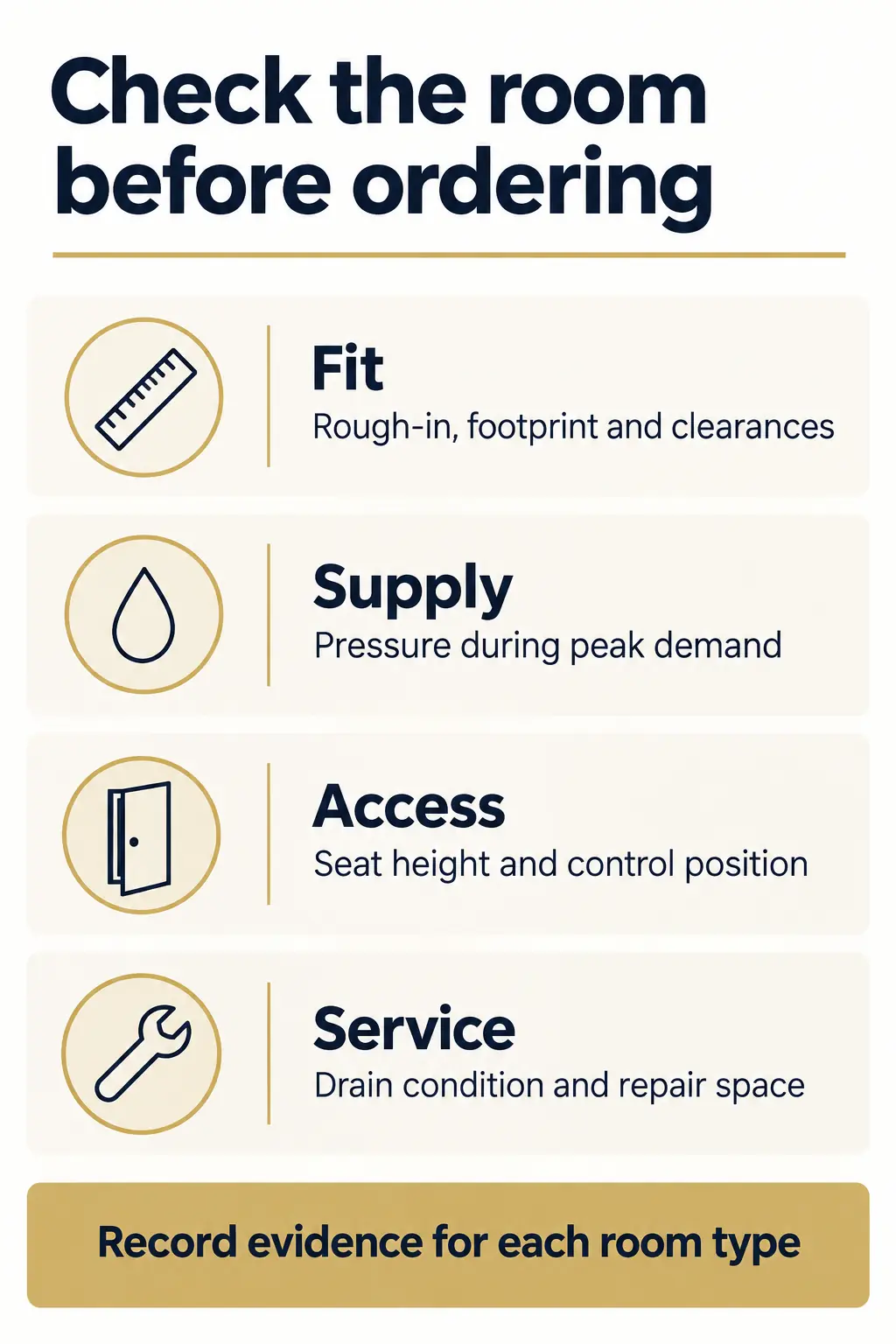
Survey by room type and plumbing condition before establishing quantities. A single sample bathroom is not enough when a hotel has multiple renovation generations, different pressure zones, or accessible guestrooms. Record the existing fixture identification and actual site measurements, then compare each proposed assembly with that record. Mark a check as passed only when the relevant evidence is available; an unresolved supplier answer remains open. This approach makes substitutions reviewable and lets purchasing distinguish a fixture that can be ordered from one that still requires engineering, installation, or brand approval.
Measure fit from the finished surfaces
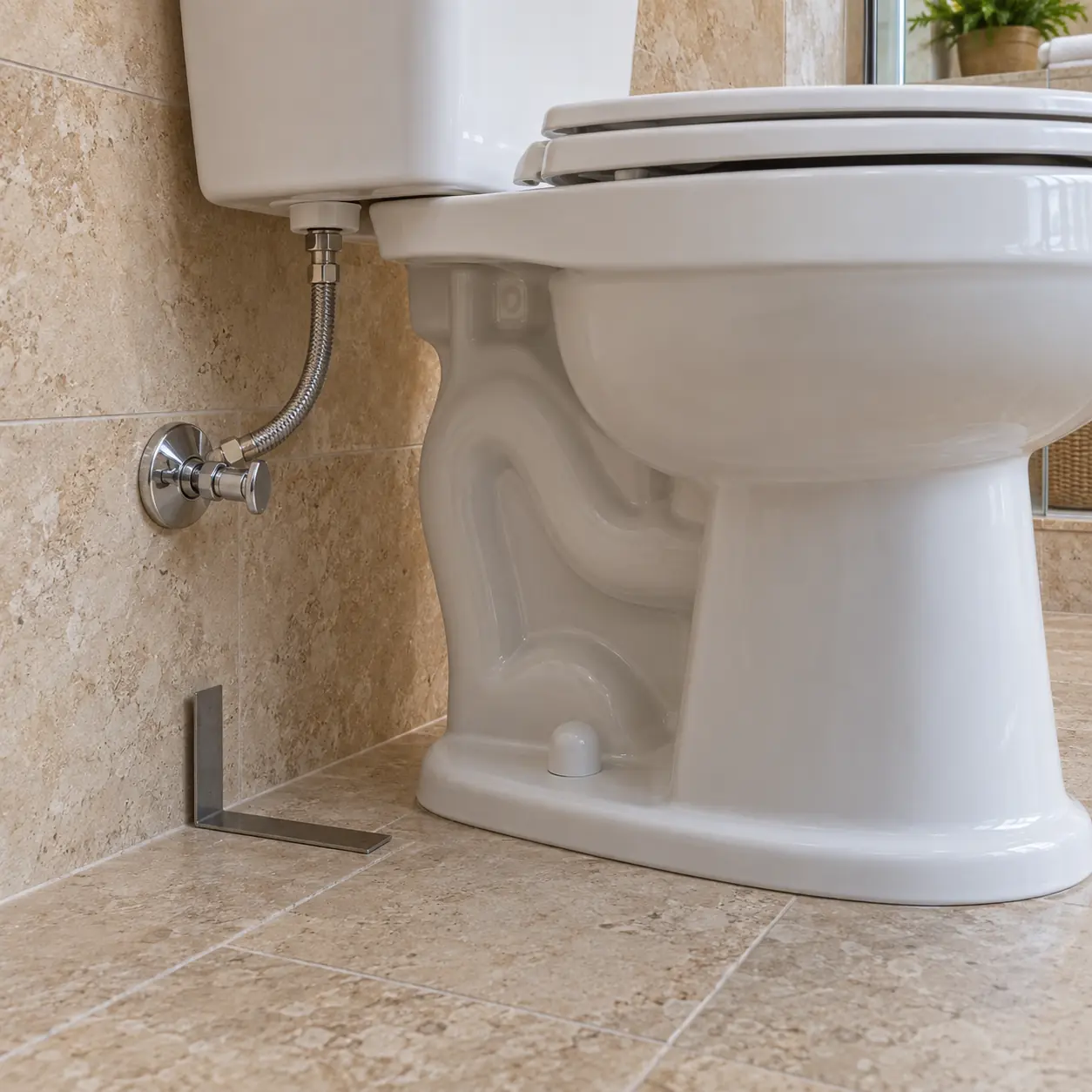
For a typical floor-outlet toilet, verify the rough-in from the finished wall to the outlet centerline using the fixture drawing and installer’s survey. Do not measure from the face of projecting baseboard and assume it represents the wall datum. Record bowl projection, tank width and height, base footprint, seat dimensions, supply-stop location, and clearance needed to remove the tank lid and reach service parts. A nominal rough-in description is not a substitute for the complete dimensional drawing.
Check what the replacement base will cover. Stained grout, a different tile cutout, or damaged flooring can remain visible after removal. Confirm flange condition and elevation with the installer during the pilot and allow for a repair decision before closing up the installation. Rear-outlet, wall-hung, concealed-tank, and floor-outlet arrangements require their own matching connections and support details; do not combine them in one interchangeable purchasing line.
Accessible guestrooms need a separate layout review. Seat height, controls, transfer space, grab bars, fixture position, and door operation work together. A product marketed as accessible does not make the installed room compliant. Use the US Access Board’s toilet-room guidance for US project review; have the project team verify applicable provincial and local requirements for Canadian properties. Do not use US dimensions as an automatic Canadian specification.
Check operating pressure at the fixture
Ask the installer to record static pressure and pressure while water is flowing under representative demand, including the morning peak and the least favorable rooms. Also observe refill or recharge time. A satisfactory static reading does not reveal the effect of a restricted stop, obstructed inlet, or shared supply under load. Record the test location, time, nearby demand, instrument, and whether the fixture had fully refilled before each trial.
For a concrete example, the Flushmate 503H product page lists a 20 psi minimum operating pressure. That is a model-specific reference, not a universal approval threshold. The owner’s installation guide distinguishes system requirements from the toilet manufacturer’s complete-fixture requirements. Obtain the current instructions for both; if documents disagree, secure written clarification for the selected assembly before ordering. Do not resolve a pressure shortfall by improvising changes to the vessel or regulator.
Use one evidence register for purchasing and sign-off
The matrix below is a proposed hotel project checklist, not a regulatory standard. Use one copy per room type and candidate assembly, with additional copies for exceptional rooms. “Pass” means the evidence supports the proposed installation; “Hold” means purchasing must resolve the item; “N/A” requires a recorded reason. The downloadable versions add space for status, evidence, owner, and date.
| ID | Check | Evidence required before release |
| 01 | Existing inventory | Room type, quantity, bowl/tank IDs, flush volume and complaint history. |
| 02 | Complete assembly | Proposed bowl, tank, mechanism, seat and handle IDs with approved compatibility. |
| 03 | Physical fit | Finished-wall rough-in, outlet type, projection, footprint and tank dimensions. |
| 04 | Installation condition | Flange, floor, drain and support review; priced repair allowance where needed. |
| 05 | Supply performance | Static and flowing pressure, test conditions, refill/recharge time and model limits. |
| 06 | Accessible layout | Project review of seat, controls, clearances, grab bars and door operation. |
| 07 | Product approval | Applicable listing, jurisdiction acceptance, flush-volume requirements and label match. |
| 08 | Guestroom acoustics | Flush and refill observations at the bed and in adjacent occupied-room locations. |
| 09 | Pilot performance | Recorded clearing, rinse, repeat flushes, leaks and downtime under a defined protocol. |
| 10 | Housekeeping service | Cleaning access, approved products, seat handling and reporting procedure. |
| 11 | Repair support | Exact service parts, local availability, lead times, training and commercial-use warranty. |
| 12 | Safety and traceability | Model/serial record, applicable recall check and current service instructions. |
| 13 | Commercial scope | Complete installed price, logistics, damage claims, spares and substitution controls. |
| 14 | Release and handover | Named approvals, approved sample, phased schedule and final room acceptance records. |
Download the working checklist in the format your team uses, or take all three versions together.
Before retaining older pressure-assisted equipment or purchasing old stock, check exact model and serial numbers against applicable recall notices. The Flushmate II 501-B recall information identifies a specific affected product range and remedy. That history warrants model-level traceability; it should not be generalized to every pressure-assisted toilet. Follow the relevant manufacturer’s instructions for any affected unit and for depressurization before service.
Run a guestroom pilot and compare the operating cost
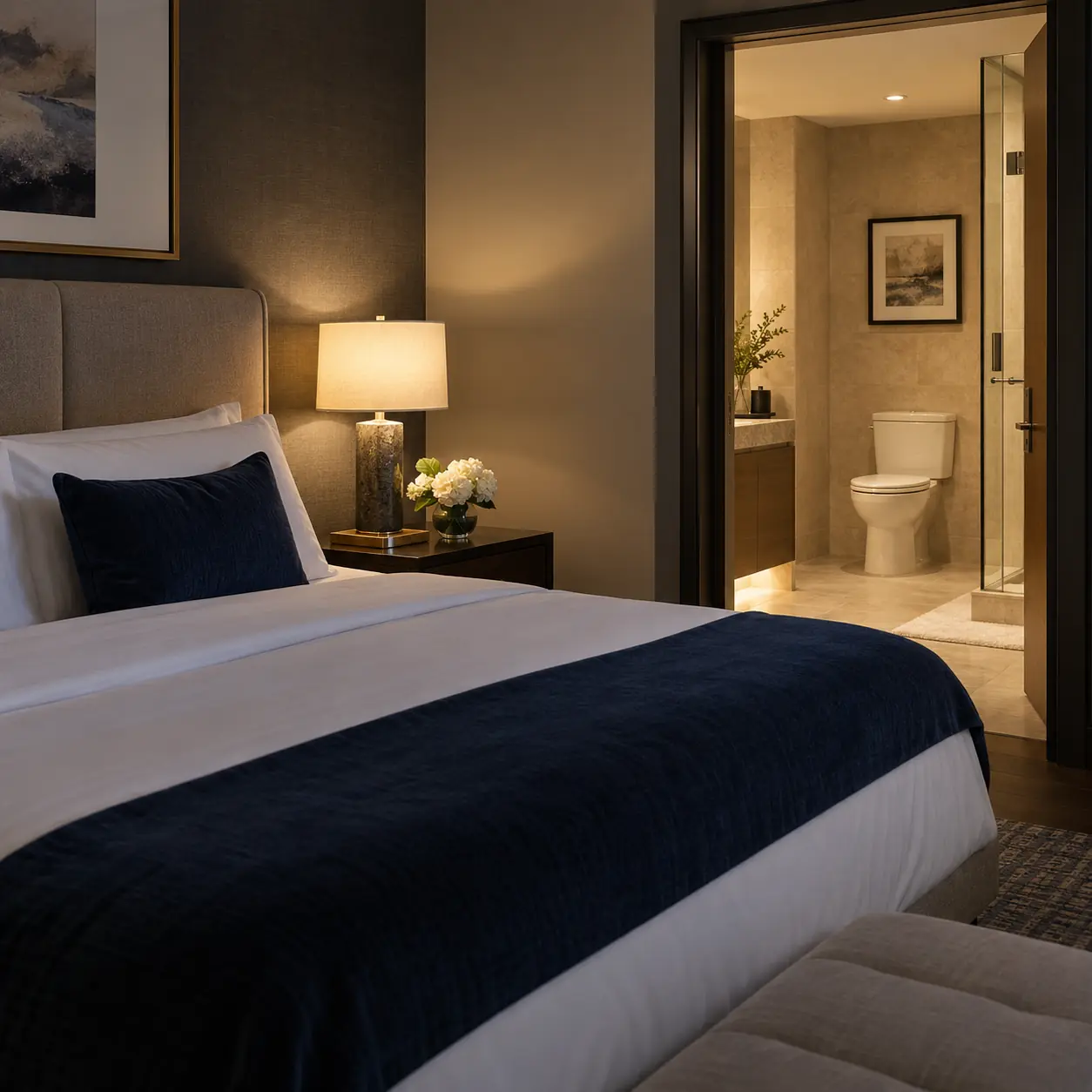
A pilot should answer whether the proposed toilet improves hotel operations without creating a new fit, noise, cleaning, or service problem. Define the observations and acceptance criteria before installing the samples, and test both candidates under comparable conditions. Include representative standard rooms, a challenging supply location, and a room with a sensitive shared-wall arrangement where available. Keep engineering, housekeeping, and operations involved: a fixture can flush satisfactorily yet still be slow to clean, difficult to repair, or disturbing at the bed. Treat the pilot as a controlled purchasing decision, with recorded limitations.
Listen from the places where guests sleep
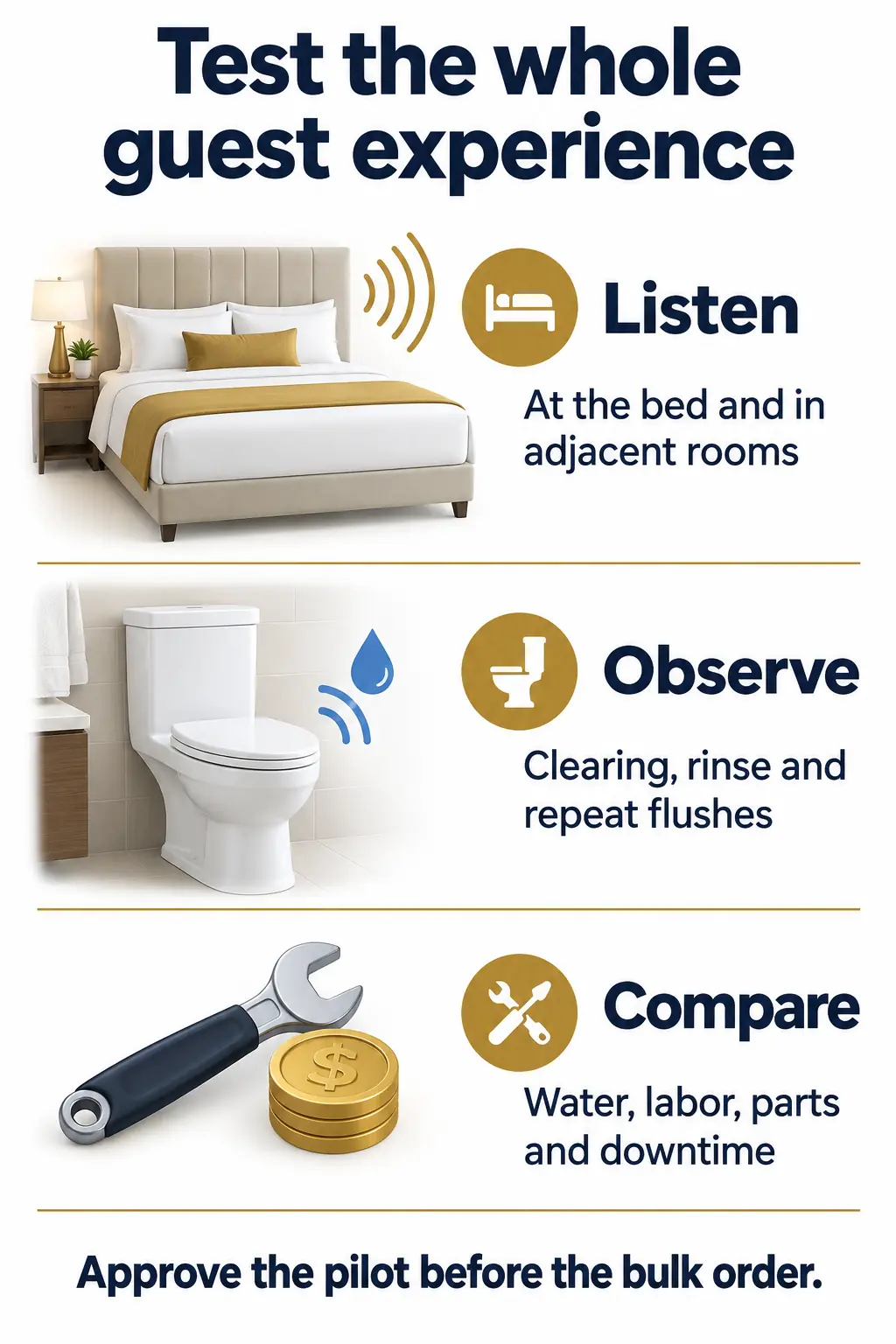
Observe the flush event and the full refill or recharge cycle from the same bathroom, the bed, and adjacent rooms where sound may travel. Include quiet nighttime conditions and normal door positions. Compare against the property’s existing fixture and agreed guestroom standard. An impressive showroom demonstration is not an acoustic acceptance test, and there is no single decibel threshold supplied by this checklist.
If the team uses a sound meter, keep the measurement positions, door settings, background conditions, and method consistent. Phone recordings can document an event but should not be treated as calibrated comparative sound measurements. Separate water discharge noise from refill hiss, pipe impact, vibration, and sound passing through a service penetration. Ask the appropriate trade to address the source rather than assuming every audible event comes from the flush mechanism.
Log failures as well as successful flushes
Use manufacturer-approved commissioning methods and safe, agreed test media; do not improvise with wipes or objects that could block the drain. Record the test conditions and number of trials, whether the bowl cleared, whether rinse was acceptable, whether an additional flush was needed, and how long normal readiness took. Keep cleaning flushes separate from repeat flushes caused by incomplete clearing. A small pilot can expose obvious problems, but it cannot establish a reliable long-term blockage rate or support a promise of zero service calls.
Have housekeeping demonstrate cleaning around the base, hinges, rim, and tank. Have maintenance locate the correct replacement parts and show that the fixture can be serviced within the available space using the approved procedure. Require instructions for safe pressure-system service; this article is not a guide to opening a pressure vessel. Record initial adjustments so they can be repeated consistently during phased installation.
Calculate water use from actual flushing behavior
For a single-flush comparison, annual toilet water use can be estimated as occupied room-nights multiplied by uses per occupied room-night, average flushes per use, and gallons per flush, plus separately estimated cleaning flushes and leakage. Label every assumption. For dual-flush toilets, calculate full- and reduced-flush events separately. Occupied room-nights do not equal guest-nights, so guest count and actual behavior must be reflected in the usage assumption.
Illustrative arithmetic: 100 rooms at 70% occupancy generate 25,550 occupied room-nights over 365 days. At an assumed five toilet uses per occupied room-night and one flush per use, changing from 1.60 to 1.28 gallons per flush reduces calculated use from 204,400 to 163,520 gallons: 40,880 gallons annually, before cleaning and leakage. This is an example, not a forecast or a gravity-versus-pressure performance claim. If the lower-volume candidate instead averages 1.10 flushes per use, calculated use becomes 179,872 gallons and the difference falls to 24,528 gallons.
Apply the property’s avoidable water and sewer charges to the estimated volume change, using consistent units and currency. Add installed capital cost, corrective building work, parts, labor, training, and credible room-unavailability costs. Do not value every maintenance hour as a sold room-night or use full room revenue as automatic lost profit. If a higher-priced option has no positive evidenced annual net saving, do not present a simple payback as though one exists.
Turn the accepted pilot into a controlled order
Specify the approved assembly and prohibit unreviewed changes to the bowl, tank, flush volume, handle position, seat, or mechanism. Request commercial-use warranty terms, the actual repair-parts list, availability in the delivery market, and an installation scope that identifies who handles flange or floor repairs. Tie spare quantities to the property’s existing parts usage, supplier lead time, and ability to keep rooms operating; a generic spare percentage is not evidence of the right stock level.
For sourcing support, submit the completed survey, candidate requirements, quantities by room type, project destination, and phased dates through KW Hospitality’s RFQ form. Ask for a complete specification and sample proposal, including compliance documentation and service support, before accepting a production substitution. The hotel’s project team should retain responsibility for final site suitability and installation approval.
Conclusion
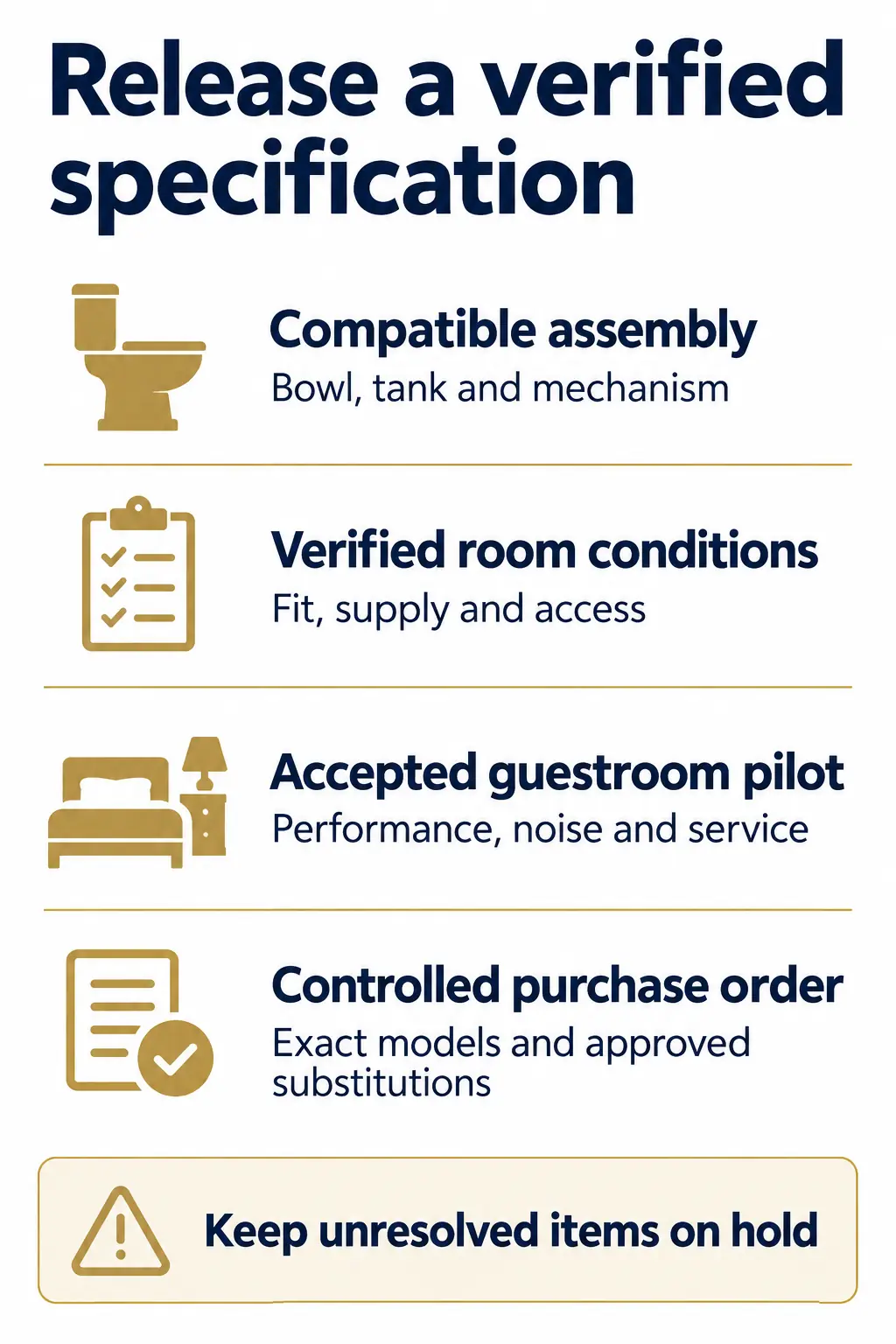
The best toilet retrofit is the assembly that meets the hotel’s documented needs in the actual guestroom. Start with compatibility and site measurements, verify the supply against the exact fixture requirements, and test flushing, nighttime noise, cleaning, and repair access before buying in volume. Compare both technologies at their real flush volumes and include maintenance and room availability in the cost decision. Keep unresolved items on hold, approve a traceable sample, and make the final order reproduce that approved specification. This process gives purchasing a defensible choice without assuming that either flushing mechanism is universally superior.
Frequently Asked Questions
Can a pressure-assisted mechanism be added to an existing gravity toilet?
Do not assume so. Flushmate specifically excludes retrofitting its mechanism into a gravity bowl. Choose a compatible complete assembly, or obtain explicit manufacturer documentation for the exact approved replacement inside an existing pressure-assisted fixture. Physical space inside the tank is not evidence of compatibility.
Does a pressure-assisted toilet require electricity?
A conventional pressure-assisted tank mechanism obtains its energy from the water supply compressing trapped air. It does not need mains electricity for that basic operation. Separately specified sensors, electronic controls, bidet seats, or other accessories may require batteries or electrical connections; include their requirements in the assembly review.
Will a gravity toilet solve low water pressure?
Not automatically. Once filled, a gravity tank uses stored water for the flush, but inadequate supply can still cause slow refill or prevent normal operation. Diagnose the pressure and flow condition, check the proposed fill valve’s limits, and verify readiness between uses instead of treating gravity technology as a plumbing repair.
Is pressure assistance always noisier in a guestroom?
Do not rank an entire technology category by a showroom impression. Compare the selected models through the whole flush and refill cycle, then assess transmission into sleeping areas. Fixture design, installation, piping, wall construction, and background noise can all influence what the guest hears.
Can the hotel use different toilet types on different floors?
Yes, when each approved assembly suits its location and the project team accepts the operational trade-off. Record the room-to-model mapping and stock the correct parts for each family. Do not create mixed inventory merely to work around an unresolved supply or drainage defect.
Should the cheapest quotation be selected after a successful pilot?
Only after confirming it covers the same approved assembly and scope. A lower unit price may exclude seats, freight, damaged-unit replacement, installation, spare parts, or commercial warranty support. Compare equivalent complete offers and keep any proposed substitution subject to review.
References
Official sources reviewed September 19, 2026. Model documents and program status should be rechecked at specification and order release.
Flushmate: Frequently Asked Questions — technology and compatibility.
Flushmate III 503H product specifications — model-specific operating pressure.
Flushmate Owner’s Operation and Installation Guide — system and fixture requirements and service procedures.
US EPA: WaterSense residential toilets and specification status — current program status and certification context.
US EPA: WaterSense Specification for Tank-Type Toilets, Version 1.2 — technology scope and flush-volume accounting.
US Access Board: Guide to Toilet Rooms — US accessibility review context.
Flushmate: II 501-B Recall Information — affected product identification and remedy.