
Before approving bedding and bed linens for a U.S. or Canadian hospitality property, connect every purchase line to its destination, intended use, construction, and supporting evidence. A useful approval file establishes what the product is, which requirements apply, whether the documents cover the production version, and who can authorize shipment and guest-room use. A soft sample, attractive price, or general supplier certificate cannot answer all four questions.
The distinction matters because a sheet, filled duvet, mattress pad, and mattress can sit on the same bed while following different compliance pathways. Requirements can also change when goods move from hotel use into retail sales, cross a national border, or enter a different state or province. Treat “North America compliant” as an invitation to ask for specifics, rather than a completed review. The same caution applies to labels such as “commercial grade,” “eco-friendly,” and “hotel quality”: translate each promise into a measurable specification or a clearly defined claim.
For 2026 orders, buyers should pay particular attention to current product classification, destination-specific chemical restrictions, Canadian bedding flammability, and U.S. certificate-data filing where certification applies. This guide focuses on ordinary adult guest-room bedding and procurement controls. Infant sleep products, electrically heated bedding, medical-use products, and secondhand filled articles require separate reviews. It is a purchasing framework, not a determination that an individual product is legally compliant.
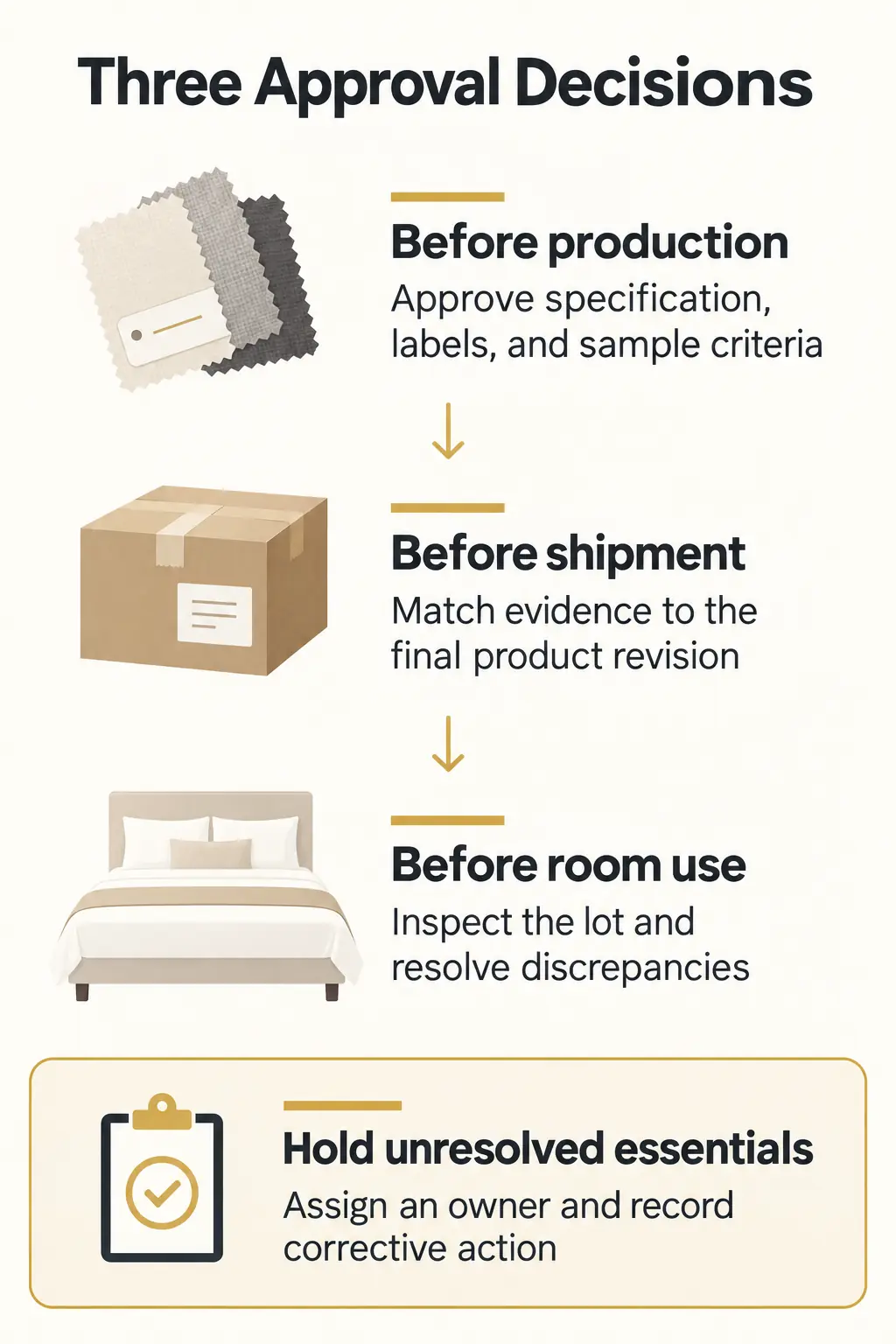
The most effective process runs through three decisions: approve the specification before production, release the shipment only when the evidence matches the goods, and accept the received lot before issuing it to rooms. The following checks explain what to request at each point, how the U.S. and Canadian pathways differ, and which discrepancies justify a hold. Use the accompanying worksheet to record decisions by product and destination, keeping regulatory evidence separate from laundry performance and commercial acceptance.
Classify Each Product Before Requesting Compliance Evidence
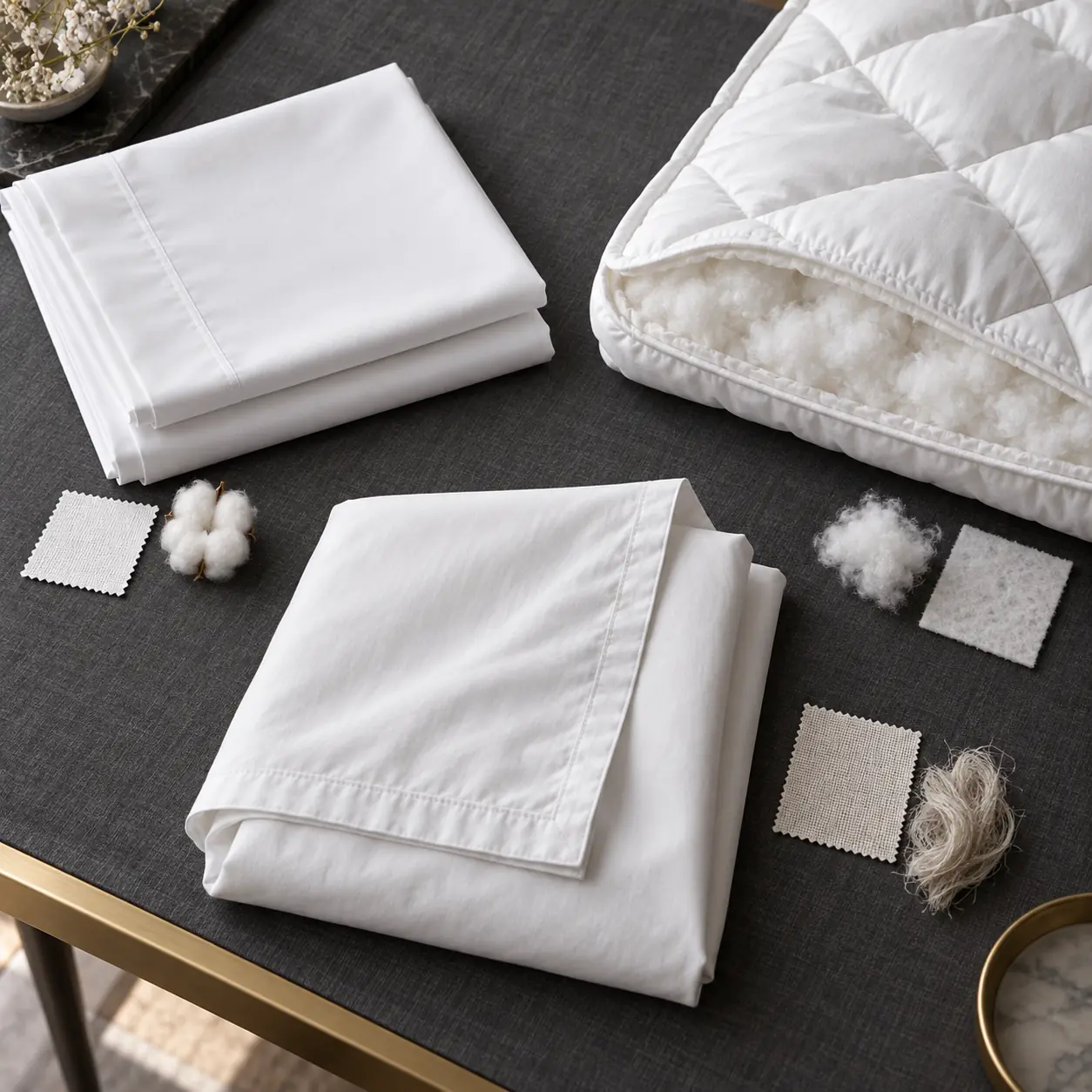
Bedding due diligence begins with an accurate product description, not a generic certificate request. Record the item’s construction and intended use before deciding which tests, labels, or declarations belong in its file. A waterproof cover with no cushioning may need a different classification analysis from a quilted pad, even when both are advertised as mattress protectors. Likewise, a filled topper should not be classified from its marketing name alone. Keep a separate record for each meaningful material or design variant, then map the intended country and state or province. This makes omissions visible before price negotiations and prevents a document for one product from being used to approve another.
Build a product identity that survives production changes
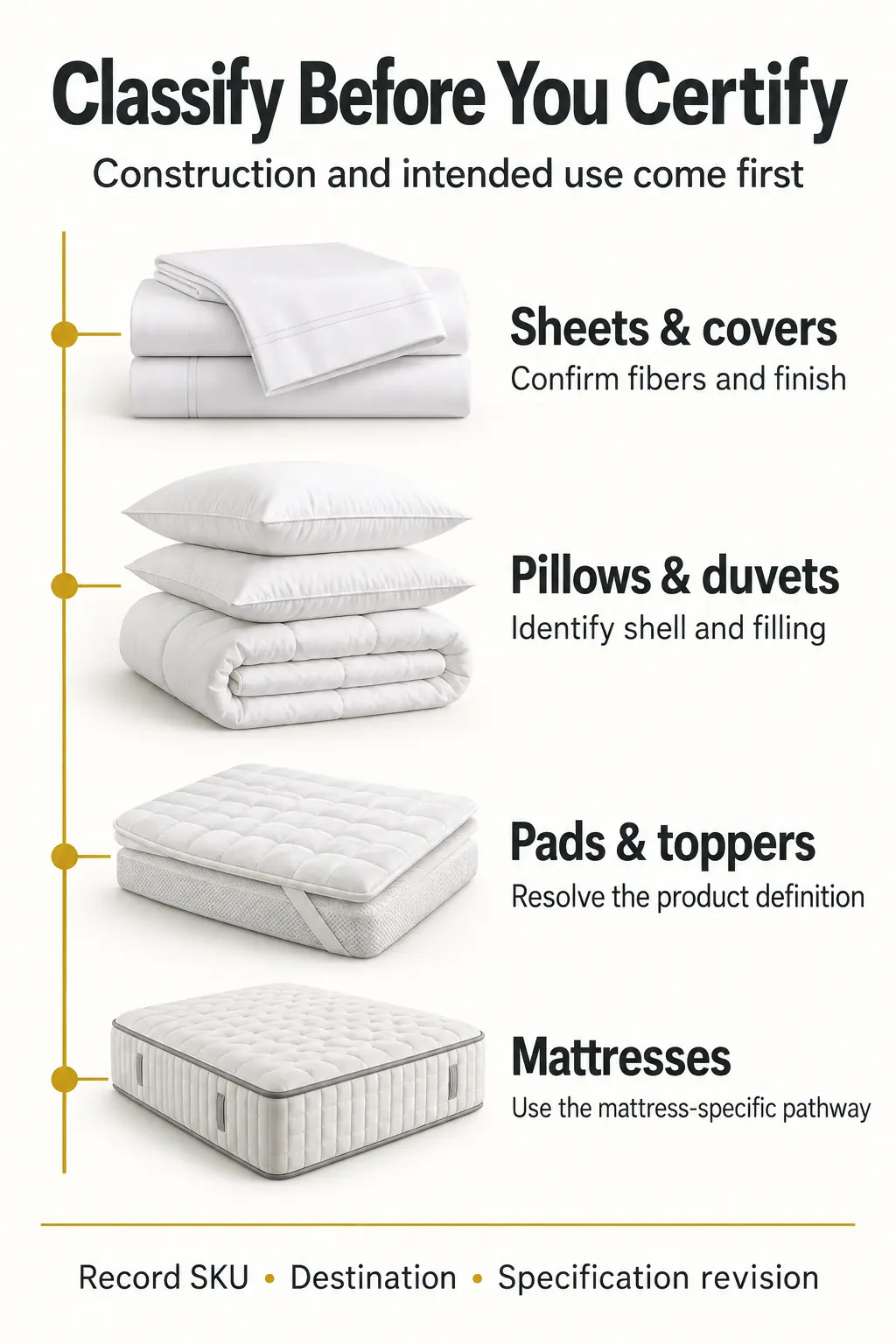
Assign a stock keeping unit, or SKU, to each approved variant. Pair it with the supplier’s model, manufacturing location, specification revision, and a dated sample photograph. Describe the shell, fill, membrane, finish, seams, closures, and dimensions as applicable. For cotton blends, specify fiber percentages; for filled products, identify shell and filling separately. A carton description such as “white hotel bedding” is too broad to support traceability.
The following distinctions help route the review. They are classification prompts, not a substitute for assessing the actual article.
| Purchase line | Detail to establish | Main review consequence |
| Sheets, pillowcases, and duvet covers | Fiber blend, weave, finish, dimensions, sales channel | Assess textile labeling and destination-specific textile requirements. |
| Pillows, comforters, and filled duvets | Shell and filling, new or reused material, intended user | Add a filled-article and destination labeling review. |
| Protectors, mattress pads, and toppers | Whether resilient filling or cushioning is present; how the item is used | Resolve the product definition before accepting a flammability report. |
| Mattresses and mattress sets | Model construction, foundation pairing, and intended sleeping use | Use the mattress-specific regulatory pathway for each destination. |
Separate legal duties, brand requirements, and buyer preferences
Maintain three distinct columns in the specification. The first identifies applicable legal requirements. The second records hotel-brand, insurer, and property requirements. The third contains negotiated performance targets, such as post-wash dimensions or seam appearance. A brand can require a test beyond the legal minimum; conversely, a brand’s approval does not establish legal compliance.
Identify who buys, imports, distributes, and uses the goods. Record any guest-facing retail channel separately from in-room use. Ask the property’s responsible compliance reviewer to confirm local requirements and any relied-upon exemption in writing. Do not let an unexplained “not applicable” entry stand in for a classification decision. When construction or destination changes, reopen the relevant portion of the review before using the previous approval.

U.S. Checks: Labels, Flammability, Chemicals, and Import Records
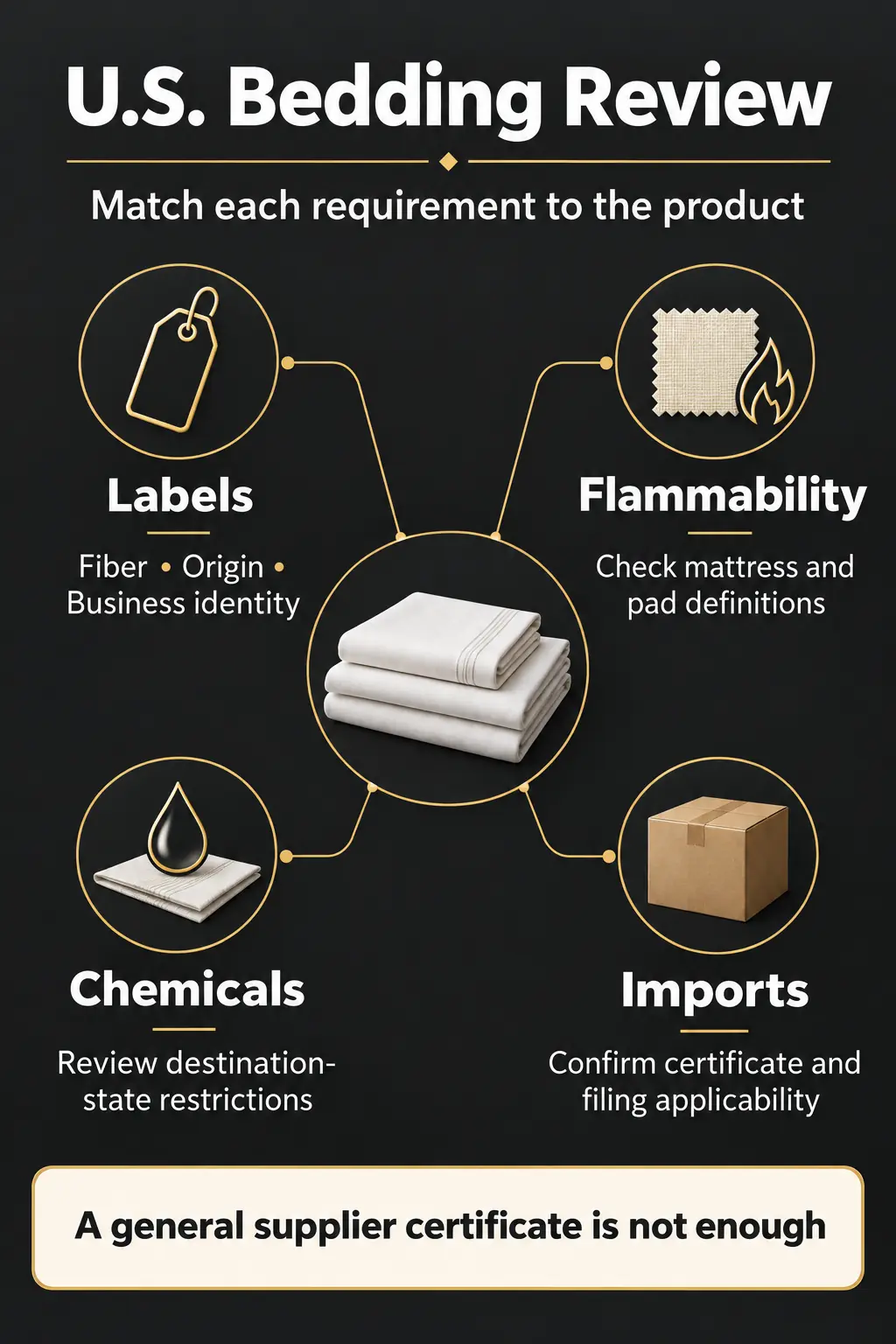
For a U.S. project, begin with the product’s textile identity and then add the rules triggered by its construction, destination, and import route. Federal labeling, mattress flammability, state restrictions, and contractual specifications answer different questions. A supplier may provide useful evidence for one of these while leaving the others unresolved. Ask for a requirement-by-requirement response that names the covered model and explains any claimed exclusion. When the property is the importer, confirm its responsibilities before the purchase order is finalized. Freight arrangements and a broker’s involvement should be reflected in a written responsibility map, rather than assumed to settle the compliance review.
Check fiber, origin, and responsible-business identification
Most covered finished bedding textiles require disclosure of fiber content, country of origin, and the manufacturer or another responsible business. Covered bedding includes sheets, blankets, comforters, pillows, and pillowcases, while mattress outer coverings have a different treatment. A U.S. registered identification number can serve as the permitted business identifier; it is not a product approval or laboratory certificate.
Compare the actual sewn label, packaging, invoice, and approved specification. Resolve inconsistent percentages and ambiguous fiber descriptions before printing production labels. If a fabric is regenerated cellulose made from bamboo, establish the correct generic fiber description rather than accepting “bamboo” as sufficient identification. Keep premium cotton claims consistent with the evidence available for the ordered material.
Separately obtain the supplier’s commercial laundering instructions. Do not assume that a rule written for clothing establishes a universal care-label obligation for bed linens. The hotel still needs usable wash, drying, bleaching, and finishing limits to operate the product successfully.
Apply mattress tests only to the products they cover
The cigarette-ignition standard in 16 CFR Part 1632 covers defined mattresses and mattress pads. Part 1633 addresses open-flame performance of mattress sets. Ordinary sheets and pillows do not become subject to both standards simply because they are bedding. A topper or protector needs an assessment against the definitions, especially when it contains resilient filling.
For a covered purchase, request the supporting test or prototype records, relevant labeling, and required certificate. Check the tested construction and any mattress-foundation combination against the order. A fabric swatch result should not be treated as proof of finished-assembly performance. A report for another model needs a documented basis for coverage; a similar appearance is insufficient.
Include the 2026 certificate-data handoff
For imports requiring a product certificate, the July 8, 2026 implementation of electronic certificate-data filing is a practical shipping checkpoint. The later implementation date for covered foreign-trade-zone entries is January 8, 2027. This does not mean that every bed-linen shipment needs the same certificate. First establish certification applicability, then confirm the required information and entry process with the importer and broker.
Create a handoff linking the product identifier, applicable requirements, certifier, manufacturing information, and supporting testing details. If a registry reference is used, verify that the broker has the corresponding identifiers. Do not assume that entering information in a registry automatically transmits it with a customs entry. Filing data and substantiating compliance remain separate tasks.
Review state restrictions and treatment claims
State-level chemical restrictions can affect bedding even when the federal review is complete. For example, Minnesota’s prohibition effective January 1, 2025 covers textile furnishings containing intentionally added PFAS, and its definition of textile furnishings includes bedding. The statute has specific exceptions; do not generalize this example into a nationwide ban or assume every mattress component has the same treatment.
For stain-resistant or water-repellent products, obtain a declaration identifying the SKU, components, finish chemistry, and destination review. If testing supports a claim, check which substances were measured, the method, and reporting limits. “Not detected” in a limited test is not the same statement as no intentionally added PFAS. Also route antimicrobial, health-protection, and broad environmental claims for a separate claims review before repeating them in guest materials.
For filled articles, check destination-state requirements for registration, filling disclosures, and law labels where applicable. For imports, ask the broker to confirm classification, origin, current duties, and any applicable supply-chain documentation. Retain traceable upstream records for cotton and other materials when needed; a final assembly address alone does not describe the whole supply chain. Avoid quoting a single duty rate for every bedding product or every 2026 shipment.

Canada Checks: Bedding Flammability and the Correct Labeling Path
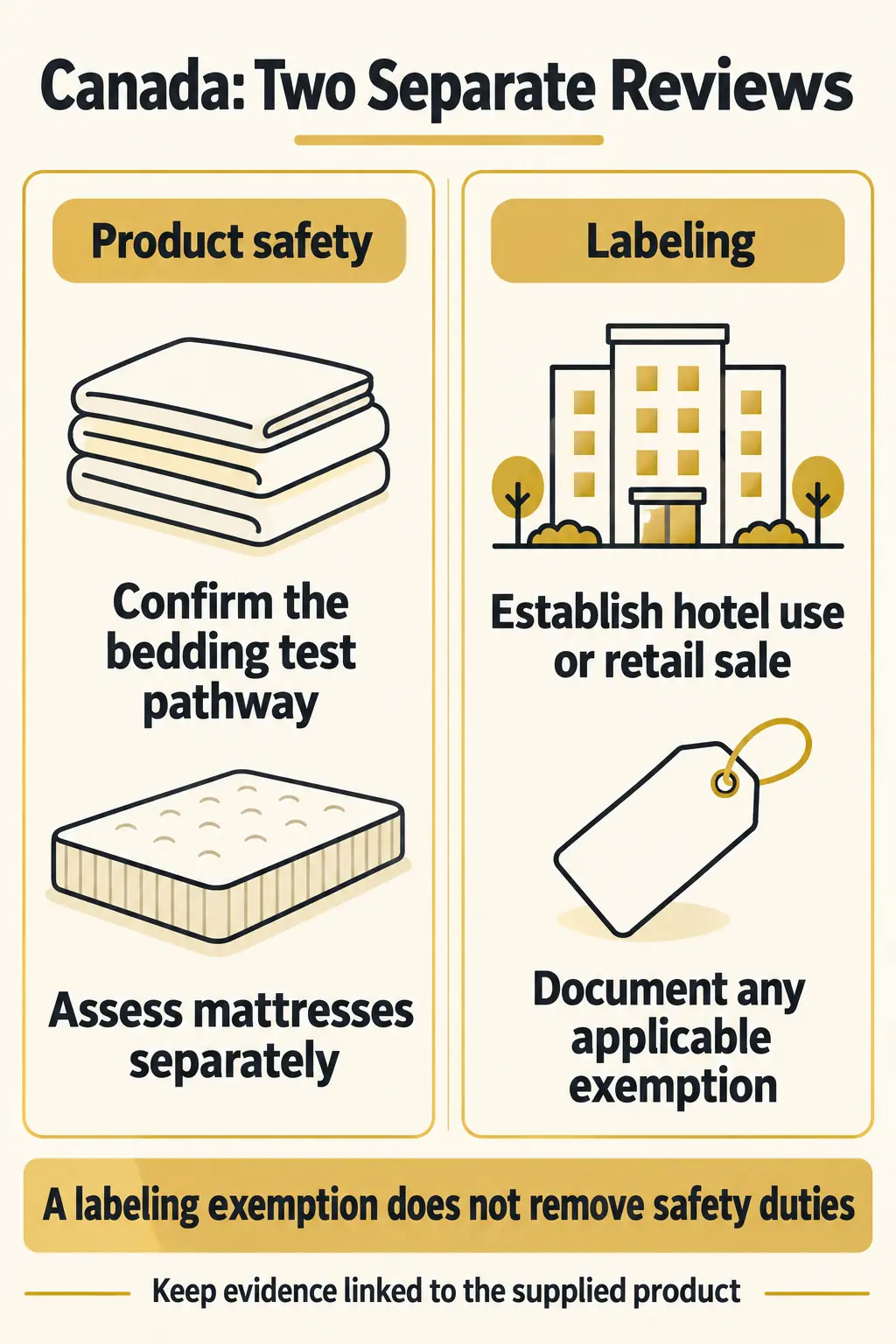
Canadian purchases need their own review even when an identical product has already been accepted for a U.S. hotel. The most important early distinction is between the safety requirements for the product and the labeling pathway for the transaction. A commercial-use labeling exemption may be relevant, but it does not eliminate product-safety duties or the buyer’s need to identify materials. Establish whether the goods are for the hotel’s own operation, retail sale to guests, or another distribution channel. Then check the actual article against the applicable Canadian requirements, including any provincial considerations, instead of treating a U.S. certificate as an automatic cross-border approval.
Use the Canadian bedding flammability criterion
Under the Textile Flammability Regulations, the specified bedding flame-spread time must exceed seven seconds for bedding without a raised fiber surface, or with a raised surface that exhibits ignition or fusion of the base fibers. The prescribed method is the referenced 45-degree textile flame test. Request a report that identifies the bedding specimen, construction, method, and result; a general apparel result does not establish the bedding criterion.
Mattresses follow separate regulations, which exclude mattress pads from the mattress definition. The consolidated mattress requirements amended in June 2026 reference the 2023 edition of the cigarette-test method. For a mattress order, ask the reviewer to check the current incorporated method and the report’s applicability. Do not extend a mattress result to every textile used on top of it.
Resolve commercial use before finalizing labels
The textile labeling regulations include an exemption for articles made up for or sold to a commercial or industrial enterprise for its use. Determine whether the actual hotel transaction fits that provision. Retail sale to guests needs a separate assessment. For nonexempt covered articles, fiber disclosure is generally required in English and French, with dealer identification also addressed by the rules.
Even if a labeling exemption is justified, make product identification a contract requirement. A durable SKU and material record can help housekeeping separate incompatible items, purchasing order replacements, and receiving isolate a disputed lot. These are practical procurement controls; they should not be misrepresented as proof that every hotel linen must carry the same federally prescribed retail label.
Keep any federal exemption analysis separate from Quebec language requirements and other applicable provincial rules. Ask for the final artwork and a documented destination review before production, particularly if the goods will also appear in a guest shop or online store. A bilingual label can be commercially useful without resolving every question about marketing, packaging, or the sales channel.
Keep safety and incident responsibilities visible
Assign an accountable Canadian importer or other responsible party as appropriate to the transaction. Maintain accessible product, supplier, and distribution records, together with a process for escalating a defect or safety complaint. Determine the applicable incident-reporting duties before an incident occurs; internal approval to investigate should not delay a legally required report. Keep the commercial warranty process separate from safety escalation.
For the buyer, the practical output is a destination file that connects the classification decision to the evidence and the person responsible for it. A laboratory report, exemption memo, and packing list are useful only if the receiving team can connect them to the actual shipment. Preserve that connection when orders are consolidated or divided among properties.
Approve the Evidence, Test the Sample, and Control Shipment Release
A complete procurement file must support a decision about the goods being ordered, rather than merely contain documents with impressive titles. Match evidence to the approved product revision, evaluate commercial performance separately, and assign owners to unresolved issues. Use the checklist below as a working record for each SKU and destination. A completed cell should point to a document, observation, or justified applicability decision. Treat a blank as open. The proposed release method is a buyer control, not a government certification scheme, and it should be adapted to the property’s requirements and the product’s risk before it becomes part of the purchase agreement.
Read beyond the certificate cover page
Inspect the full report for sample description, photographs, method and edition, test dates, results, conditioning, exclusions, and laboratory identity. Verify authenticity through the issuer when necessary. A test laboratory’s accreditation can support confidence in a method within its scope; it does not establish that every item sold by the supplier was tested. A management-system certificate is also different from evidence about the ordered product.
For voluntary textile certifications, check the certificate number, current validity, holder, covered article, and permitted claims. Determine whether it covers the complete product or only a yarn, fabric, or filling. Do not turn a voluntary certification into a statement of universal legal compliance. Require written notification before substitutions to fibers, filling, membranes, treatments, factories, or construction details that could affect the approval basis.
Validate performance with the actual laundry process
Request representative production-intent samples and agree on the evaluation procedure before testing. Measure dimensions before and after the agreed wash-and-dry sequence. Inspect seams, pilling, whiteness or color change, fabric feel, fill migration, closures, and protector integrity as relevant. Use the hotel’s intended laundry chemistry and equipment settings within the supplier’s instructions. Record the cycle details so the result can be repeated.
Calculate dimensional change consistently: shrinkage percentage equals the original dimension minus the washed dimension, divided by the original dimension, multiplied by 100. For illustration, a 110-inch dimension that becomes 106.7 inches has shrunk 3%. That number is an example, not a universal pass limit. Set acceptance limits from bed fit, the operating process, and the purchase specification. A product can meet a legal requirement yet fail the hotel’s practical fit test.
Use one complete approval checklist
Record an owner, status, evidence reference, and corrective-action date for every row. Use Open, Pass, Hold, or N/A; justify N/A in the evidence field. Passing this worksheet means the buyer has closed the listed review items, not that a regulator has certified the purchase.
| Check | When | Evidence or decision to record |
| 01 Product identity | Before production | Match SKU, factory, construction, materials, dimensions, and specification revision. |
| 02 Destination and use | Before production | Record country, state or province, property, and internal-use or retail channel. |
| 03 Applicable requirements | Before production | Document product classification, legal pathway, local requirements, and any justified exemption. |
| 04 Labels and claims | Before production | Approve artwork, fiber and filling descriptions, origin and business disclosures, languages, and claims as applicable. |
| 05 Safety evidence | Before shipment | Match complete reports, methods, results, and covered construction to the production revision. |
| 06 Certificates and imports | Before shipment | Confirm certification and filing applicability, responsible importer, broker handoff, origin, and entry documents. |
| 07 Finishes and chemicals | Before production | Review destination restrictions and declarations for treatments, membranes, and other relevant components. |
| 08 Laundry and fit | Before production | Record sample wash settings, measured dimensional change, seam and surface condition, and agreed acceptance limits. |
| 09 Change control | Before shipment | Confirm no unapproved change to factory, fibers, fill, finish, membrane, construction, or destination. |
| 10 Lot and receiving | Before room issue | Match quantities and lot IDs; inspect packaging and sampled units; isolate moisture, contamination, or discrepancies. |
| 11 Commercial terms | Before production | Agree delivery scope, claims period, warranty exclusions, replacement lead time, and inspection or rework costs. |
| 12 Safety escalation | Before room issue | Assign complaint and incident owners, reporting review, stock isolation, and record-retention responsibilities. |
Use the editable Word or Excel version to assign owners and retain evidence references. The PDF provides a print-ready copy; the combined download contains the same three formats.
Set separate production, shipment, and receiving decisions
Before production, approve the specification, destination pathway, label artwork, sample criteria, and change-control terms. Before shipment, match the evidence to the final revision, resolve mandatory compliance gaps, and confirm packaging, lot identification, freight responsibilities, and import-document handoff. Specify who may authorize each decision and where that authorization is recorded.
At receiving, compare cartons and sampled units with the purchase order and approved reference. Record quantities, SKU and lot identifiers, packaging condition, visible moisture or contamination, and workmanship discrepancies. Quarantine an affected lot while the responsible team investigates. A packing-list match alone does not demonstrate material conformity; use additional identity or performance testing when the risk or discrepancy warrants it.
For example, if a supplier replaces a quilted pad’s filling after sample approval, hold the revised product pending a review of the affected classification, testing, labeling, and performance evidence. Do not release it solely because the dimensions and price stayed the same. Conversely, a documented administrative correction with no effect on product identity can be resolved through the designated reviewer without repeating unrelated tests.
Define claims periods, replacement lead times, shortage handling, evidence needed for a claim, and responsibility for inspection or rework costs in the order. Ask whether commercial laundering affects warranty coverage. Keep the approved sample and records accessible for repeat orders, and require a fresh review when the destination, construction, supplier, rule, or sales channel changes.
Once the requirements and open questions are organized, discuss your bedding sourcing requirements with KW Hospitality. Include the destination, product list, quantities, material specifications, sample needs, required documentation, and target delivery date so the sourcing discussion starts from a defined scope.

Conclusion
Reliable bedding due diligence connects a defined product to a defined destination and a defensible approval record. For U.S. and Canadian hospitality purchases in 2026, that means resolving classification first, checking the relevant labeling and safety pathway, matching evidence to the production revision, and validating commercial performance with the intended laundry process. Keep legal requirements distinct from brand standards and negotiated preferences. Give production approval, shipment release, and receiving acceptance separate owners and records. When an essential requirement is unresolved, hold the affected product until the gap is closed; when the facts change, revisit the approval before repeating the order.
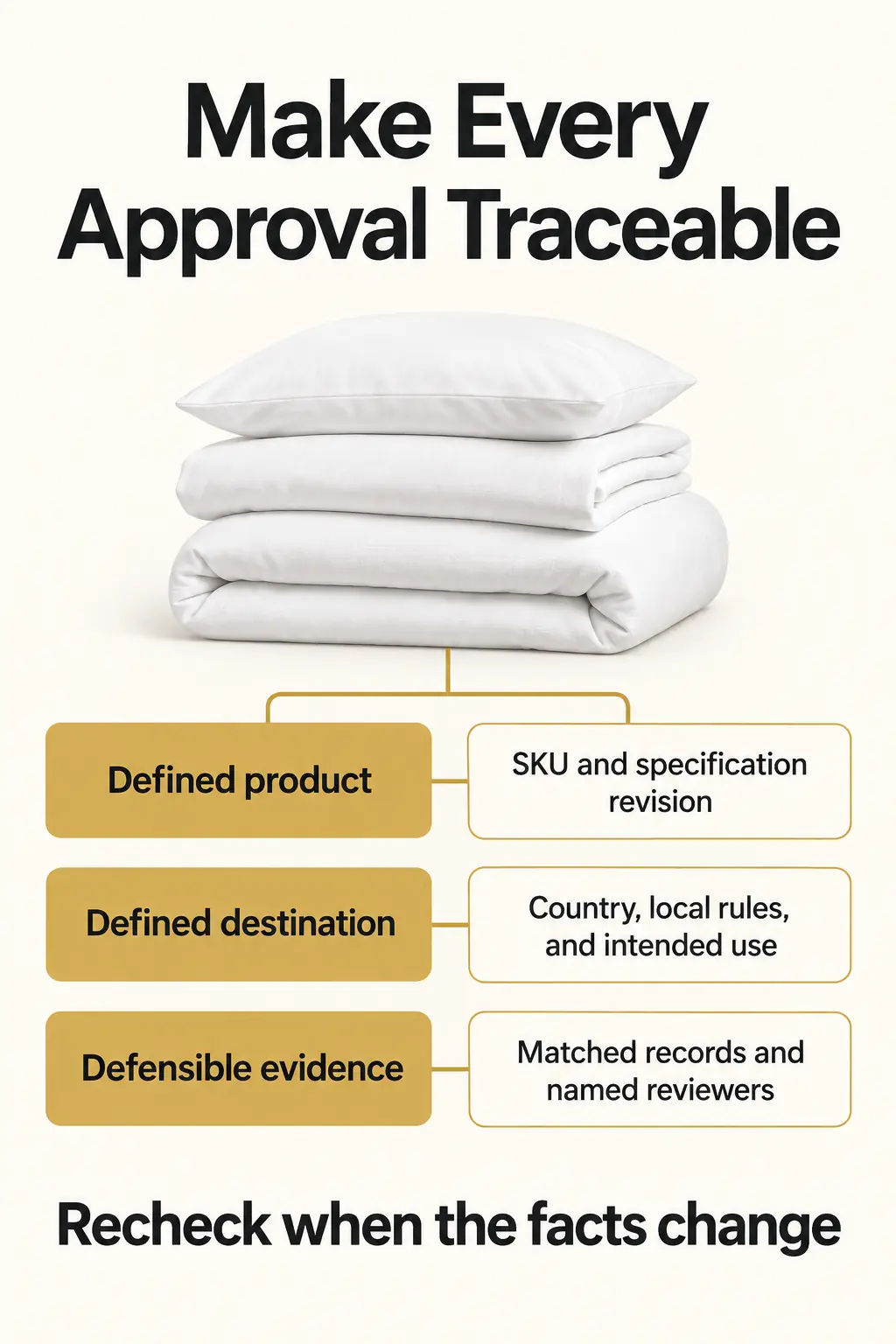
Frequently, the best purchasing improvement is a clearer question: which document proves this requirement for this SKU, in this destination, under this approved specification? If the team can answer it consistently, the procurement file becomes useful during production, at the border, in housekeeping, and when a problem needs investigation.
Frequently Asked Questions
Can one approved product be used at properties in both countries?
Potentially, but approve it for each destination. A shared construction and sample can reduce duplication, while the legal pathway, labeling analysis, import records, and local requirements may differ. Keep a common product specification with separate destination approvals. If one destination requires a material or label change, confirm whether that creates a separate variant and whether the existing evidence still applies.
Is a three-year-old test report automatically unacceptable?
No universal age cutoff applies to every bedding report. Check the applicable rule or certification scheme, the method edition, whether construction has changed, and whether the report still supports the product being supplied. An older report can need additional justification; a recent report can still be irrelevant if it covers another material or model. State any contractual retesting interval explicitly.
Does a successful wash trial prove the product is safe or compliant?
No. A wash trial evaluates the performance conditions actually tested, such as fit, seams, appearance, and integrity. It does not substitute for an applicable flammability test, chemical assessment, labeling review, or import obligation. Keep its result as one part of the acceptance file and preserve the process settings so subsequent samples can be compared fairly.
Can a sourcing agent take responsibility for all compliance tasks?
A sourcing agent can coordinate specifications, samples, documents, and inspections within the agreed scope. Identify which legal entity remains responsible for each applicable duty and who signs each approval. Contractual service arrangements should be reviewed against those duties; using an agent does not, by itself, establish that the buyer or importer has no remaining obligations.
What if the hotel later sells the same linens to guests?
Review the new sales channel before offering the goods. A prior approval for internal hotel use may have relied on assumptions that no longer hold, especially for Canadian labeling. Recheck packaging, disclosures, claims, traceability, and the responsible seller. Keep retail inventory identifiable so staff do not accidentally sell units approved only for a different use.
What should happen when an apparently compliant shipment has a serious defect?
Isolate the affected stock, preserve labels and lot records, document the issue, and notify the designated safety and procurement owners promptly. Assess whether already-issued items should be withdrawn and whether an incident report or other external action is required. The existence of paperwork should support the investigation, not override evidence of a product problem.