
Buying hotel supplies in bulk can lower purchasing costs, simplify replenishment, and reduce the operational noise created by frequent small orders. It can also lock a property into too much inventory, inconsistent specifications, or a seemingly cheap product that fails early. The difference is not the size of the order. It is the discipline used to define quality, compare costs, and control production before the purchase order becomes irreversible.
The most reliable savings come from treating bulk procurement as a total-cost decision. A lower unit price matters, but so do packaging, freight, duties, inspection, storage, replacement, and the labor required to resolve defects. For linens, amenities, housekeeping tools, tabletop items, guestroom accessories, and back-of-house products, the right target is the lowest sustainable cost per usable unit—not the lowest quotation on a spreadsheet. That target changes by category because failure consequences, consumption patterns, storage needs, and brand standards are different.
This guide provides a practical purchasing framework for owners, operators, procurement managers, and project teams. It explains where bulk savings actually originate, how to set a non-negotiable quality floor, how to compare landed and lifecycle cost, and how to use volume without accepting an unsuitable minimum order quantity. It also shows how samples, production controls, and inspection protect quality at scale. Use the framework for a single high-consumption category, a multi-property consolidation, or a coordinated opening package, adjusting the depth of control to the commercial and guest-facing risk. The result is a sourcing process that preserves guest experience and operational reliability while giving suppliers enough clarity and volume to quote competitively.

Where Bulk-Buying Savings Actually Come From
Bulk buying creates value when it removes cost or uncertainty from the supply chain. The obvious lever is volume pricing, but the larger opportunity often comes from consolidating compatible products, improving carton efficiency, filling freight more effectively, and reducing emergency orders. A supplier can usually offer a better commercial position when demand is predictable, specifications are stable, and production can run in efficient batches. The buyer benefits only if those savings remain after inventory carrying cost and quality risk are included. Therefore, start by identifying which cost pools the larger order is expected to improve, then require the quotation to make those improvements visible.
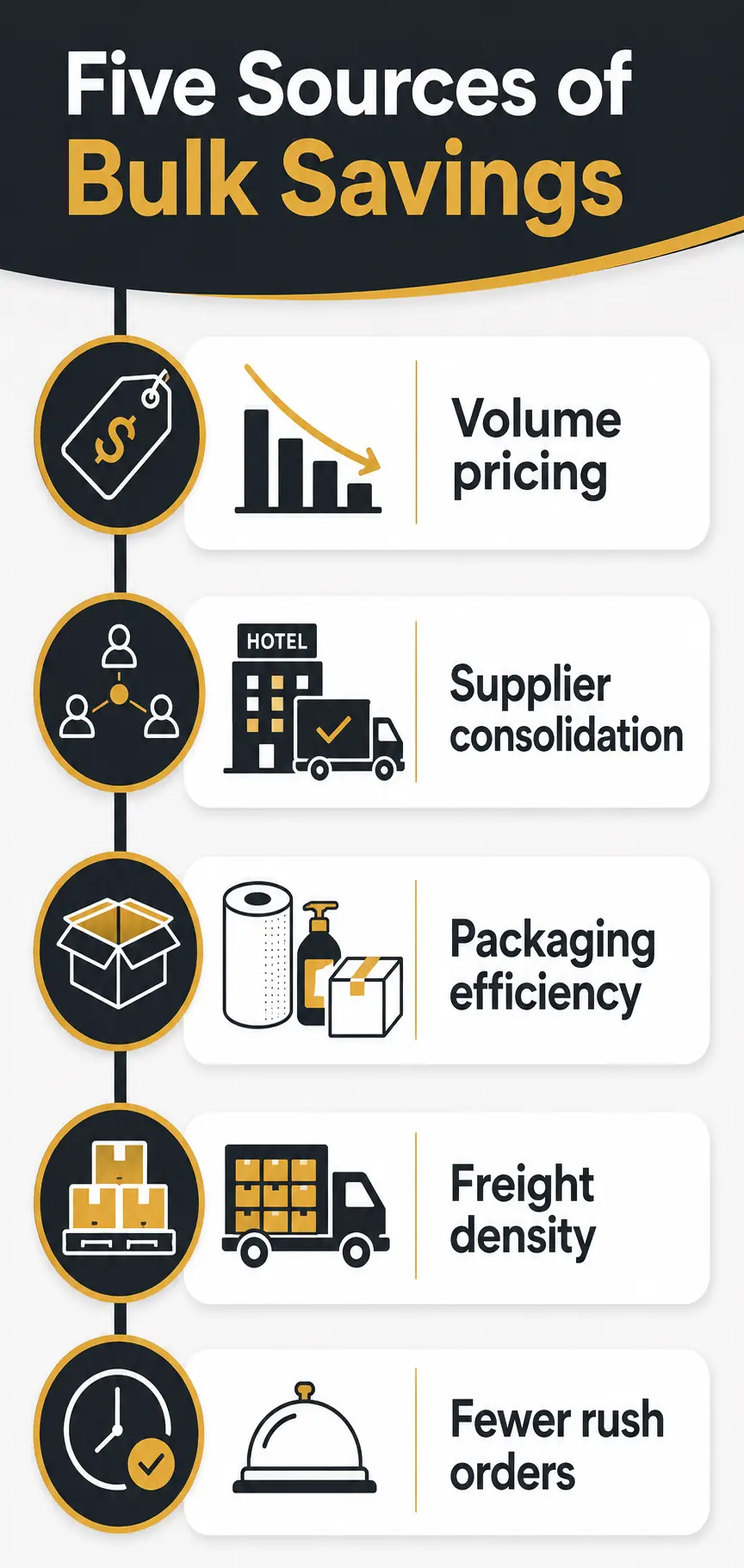
Separate negotiated savings from operational savings
Negotiated savings are visible in the quotation: lower unit prices, reduced setup charges, or more favorable packaging. Operational savings occur after the order: fewer purchase orders, fewer receiving events, less time spent matching small deliveries, and lower exposure to expedited freight. Keep these two categories separate. Doing so prevents a weak unit-price discount from being presented as a complete business case, and it helps the operations team validate whether the planned benefits actually appear.
Prioritize high-consumption, stable-specification categories
Bulk commitments work best when consumption is repeatable and the specification is unlikely to change. Standard towels, bed linen, tissue products, dispensers, housekeeping consumables, basic tabletop items, and selected guestroom amenities may fit this profile. Trend-sensitive decorative items, property-specific products, and categories awaiting a renovation decision are less suitable. Use property-level consumption history, occupancy assumptions, replacement rates, and opening-stock requirements to estimate demand. Add a deliberate buffer for variability, but do not convert uncertainty into an oversized order.
Ask every supplier to explain the price-break logic
A useful quotation shows price breaks at realistic quantities and identifies what changes at each break. The driver may be raw-material purchasing, production setup, carton configuration, pallet utilization, or container loading. Knowing the driver helps the buyer combine SKUs intelligently. It also reveals whether the lowest tier creates value or merely shifts storage and cash-flow costs to the hotel.
For a broader category and supplier-screening framework, review how to choose the right wholesale hotel supplies for your property. It is a useful companion when deciding which items deserve a bulk-sourcing project.

Set a Quality Floor Before You Request Prices
Quality is difficult to negotiate after prices have anchored the discussion. Before requesting quotes, convert brand and operating expectations into a specification that suppliers can measure. The quality floor should define materials and grade, dimensions and tolerances, finish and color, performance requirements, packaging, labeling, and defect classifications. It should also identify the approved sample that will become the physical reference for production. This does not require a long engineering document for every item. It requires enough precision that two suppliers are quoting the same product and that an inspector can distinguish conforming goods from unacceptable goods without relying on subjective impressions.
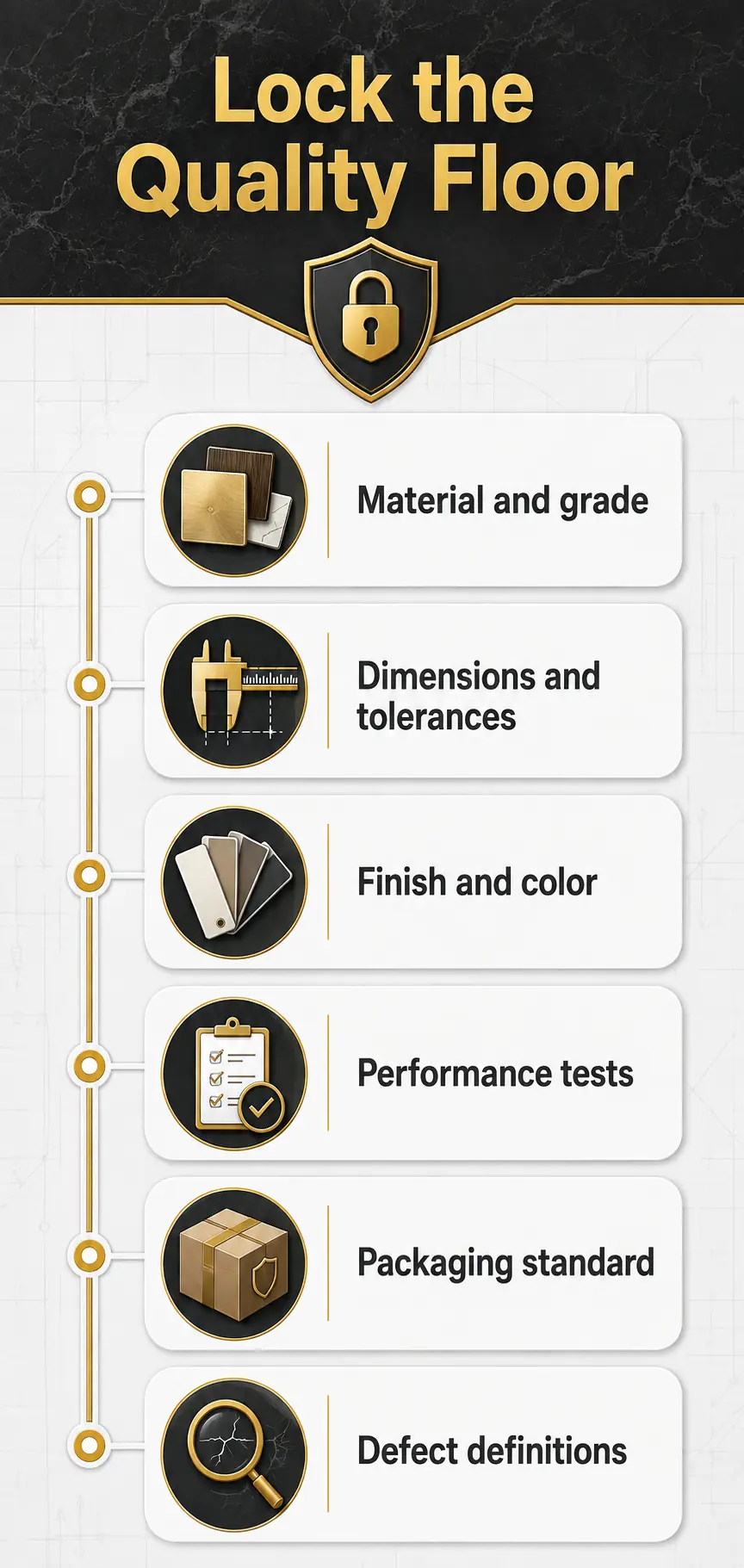
Write specifications around use, not marketing language
Terms such as premium, hotel grade, luxury, or heavy duty are not testable specifications. Replace them with observable attributes. For a towel, define dimensions, weight basis, fiber composition, construction, color tolerance, laundering expectations, labeling, and packaging. For stainless serviceware, define alloy or grade where appropriate, dimensions, weight, finish, edge condition, corrosion expectations, and acceptable surface defects. For dispensers or guestroom accessories, define materials, mounting details, pump or mechanism performance, finish, compatibility, and spare-part expectations.
Classify defects by operational consequence
Defect definitions should reflect what the property cannot accept. A safety issue, contamination risk, sharp edge, failed mechanism, or materially wrong product is more serious than a small cosmetic variation in a non-visible area. Define critical, major, and minor defects in category-specific language and include photographs or approved references when appearance matters. The acceptance-sampling plan should be documented, agreed before production, and appropriate for the product and risk.
Control packaging as part of product quality
Bulk orders can arrive unusable even when the underlying item is correct. Weak cartons, excessive empty space, poor moisture protection, mixed labels, and inconsistent pack quantities create damage and receiving errors. Specify inner packs, master-carton quantities, carton strength, protective materials, barcode or label content, pallet requirements, and any plastic-reduction goals. Packaging should survive the intended route and allow hotel teams to count, store, and issue goods efficiently.

Compare Total Landed and Lifecycle Cost
A quotation becomes comparable only after every material cost is placed on the same basis. Calculate total landed cost by adding the product price, tooling or setup, packaging, freight, duties, destination fees, inspection, and other required transaction costs. Then estimate lifecycle cost by adding storage, handling, expected failure, replacement, and disruption. Use the same currency, delivery basis, quantity, specification, and time horizon for each supplier. If an assumption is uncertain, show it as a range rather than hiding it. This approach often reveals that the second-lowest unit price is the best commercial choice because it produces fewer failures, better freight utilization, or more predictable replenishment.
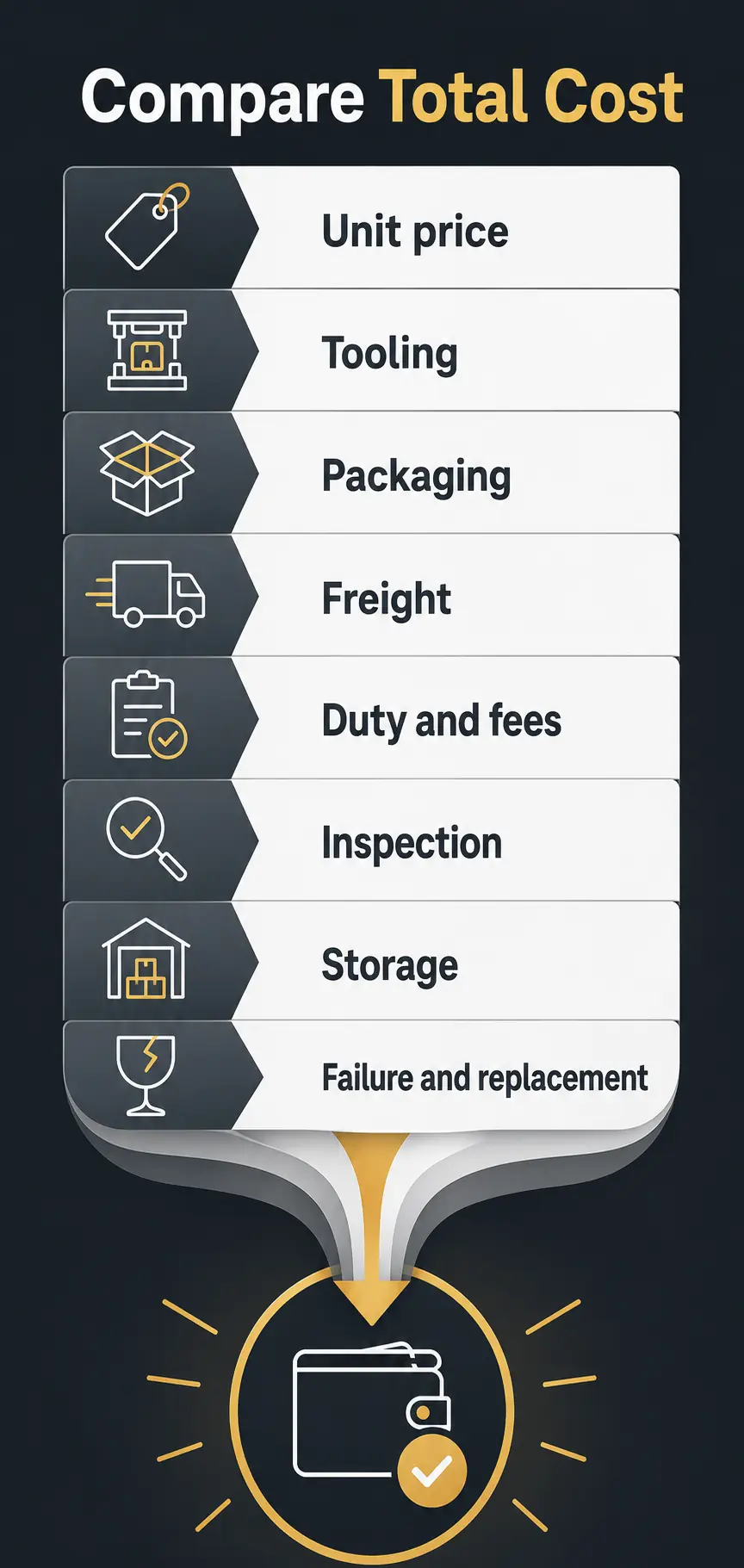
Use a normalized comparison sheet
Create one row per supplier and one column per cost component. Keep supplier quotes in their original form, but normalize the analysis to a common delivered quantity and unit of measure. Separate one-time charges from recurring charges. If tooling will be reused, allocate it across a realistic production volume. If different pack sizes affect labor or waste, normalize to the usable hotel unit rather than the factory carton.
| Cost component | What to include | Common blind spot | Decision use |
| Product | Unit price, setup, tooling | Different specifications | Normalize the base offer |
| Logistics | Packaging, freight, duties, fees | Poor load utilization | Compare landed cost |
| Assurance | Samples, testing, inspection | Treating prevention as overhead | Price risk controls |
| Ownership | Storage, handling, failure, replacement | Ignoring usable life | Compare lifecycle value |
Model the cost of failure
A defective item costs more than its replacement price. Include the labor to identify and segregate defects, the cost of replacement freight, the impact of shortages, and the possibility of guest-facing service recovery. Use conservative estimates and test multiple scenarios. A practical comparison can show expected cost per usable unit: total landed cost plus expected failure cost, divided by the quantity expected to pass inspection and perform through the planned service life.
Keep project and operating budgets aligned
Hotel procurement often spans both project assets and operating supplies. Align the sourcing model with the distinctions explained in hotel FF&E versus OS&E planning so that acquisition, replenishment, storage, and approval responsibilities are assigned correctly.

Use Volume Levers Without Forcing a Bad MOQ
A minimum order quantity is a supplier constraint, not a buying target. The correct order size is the quantity that supports demand, cash flow, storage, and quality risk while capturing meaningful production efficiencies. Begin with a consumption forecast and ask for multiple price breaks rather than a single bulk quote. Separate firm volume from optional or forecast volume, and identify products that can share materials, finishes, packaging, or production runs. Suppliers may be able to combine compatible SKUs, stage deliveries, or hold selected materials without forcing the hotel to take every finished unit at once. Each concession should be written into the commercial terms.
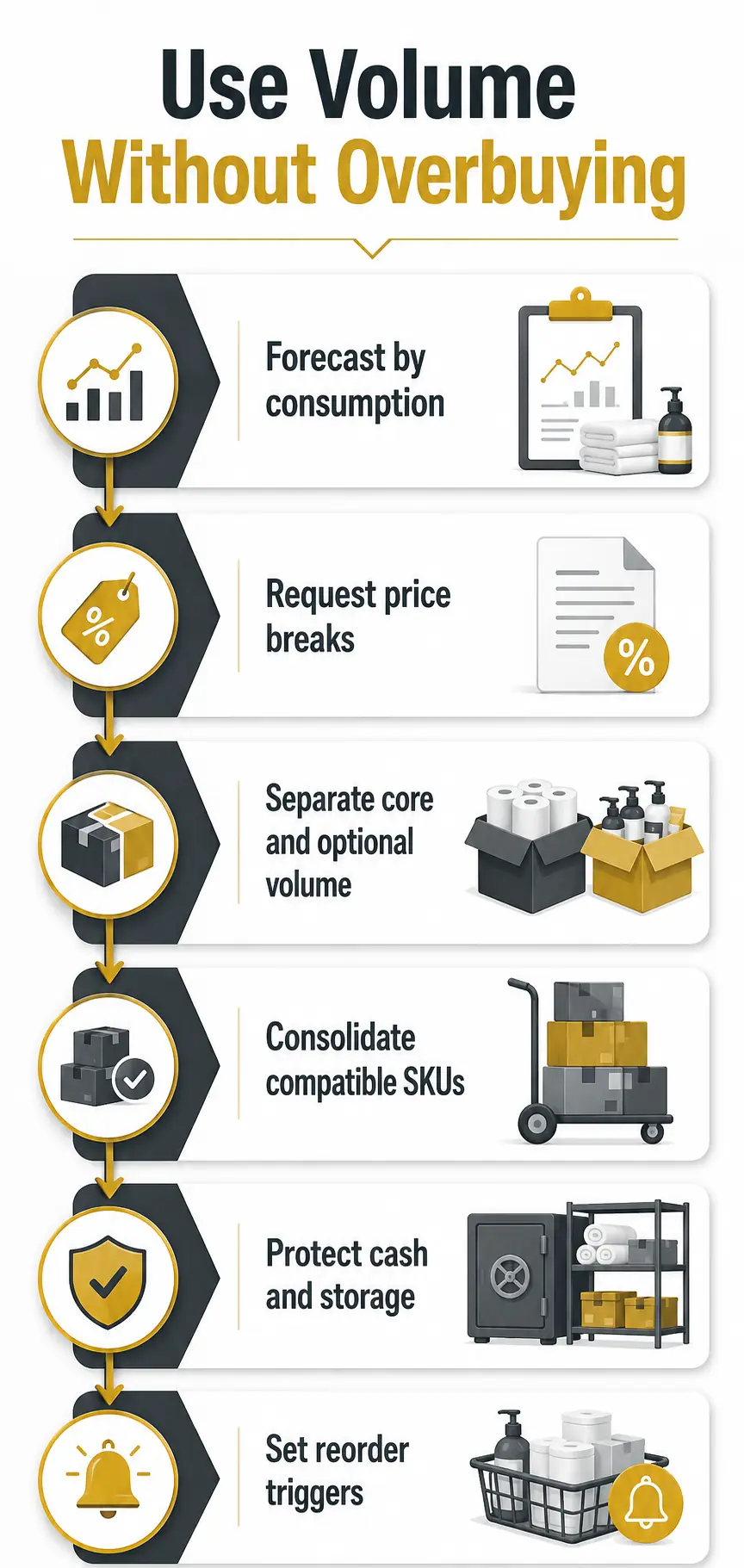
Build the order from consumption and service level
Estimate demand by property, item, and month. Include opening stock, par levels, planned room openings, replacement needs, housekeeping consumption, food-and-beverage usage, lead time, and an agreed safety buffer. Then compare the resulting quantity with supplier price breaks. If the discount requires inventory far beyond the forecast, calculate the extra storage, financing, obsolescence, and damage exposure. The apparent discount may disappear.
Negotiate the structure, not only the number
When the factory MOQ is too high, explore operational alternatives. A supplier may accept mixed colors or sizes within a shared material run, consolidate several properties, split production into releases, use standard components with customized packaging, or quote a small surcharge for a lower quantity. The buyer can also designate core volume and optional volume, with clear validity periods and price rules. These approaches preserve efficiency while reducing the risk of stranded inventory.
Use SKU rationalization carefully
Reducing unnecessary variation can create substantial leverage. Standardize hidden or functionally equivalent items across departments or properties when doing so does not weaken brand experience or operational fit. Keep deliberate variation where it supports room tier, service concept, accessibility, local regulation, or a real performance need. The purpose is not uniformity for its own sake; it is to concentrate volume where variation adds no value.
Set reorder triggers before inventory arrives
Bulk purchasing should improve replenishment, not postpone it. Define the inventory owner, issue unit, lead time, safety stock, reorder point, and review cadence before the first shipment. Track actual consumption against the forecast and update the next release. This feedback prevents a one-time bulk buy from becoming a cycle of overstock followed by urgent reordering.

Protect Quality Through Samples, Production Controls, and Inspection
A large order magnifies small specification gaps, so quality control must begin before production. Approve a clear written specification and a representative pre-production sample, then identify the checks required during production, at completion, and during loading. The purchase order should state inspection rights, acceptance criteria, remedies, and responsibility for corrective action. Inspection does not replace supplier qualification or process control; it verifies that the agreed controls produced conforming goods. The best program is proportional to risk: a simple standard item may need limited checks, while a customized or guest-critical product may require material verification, performance testing, staged inspection, and tighter change control.
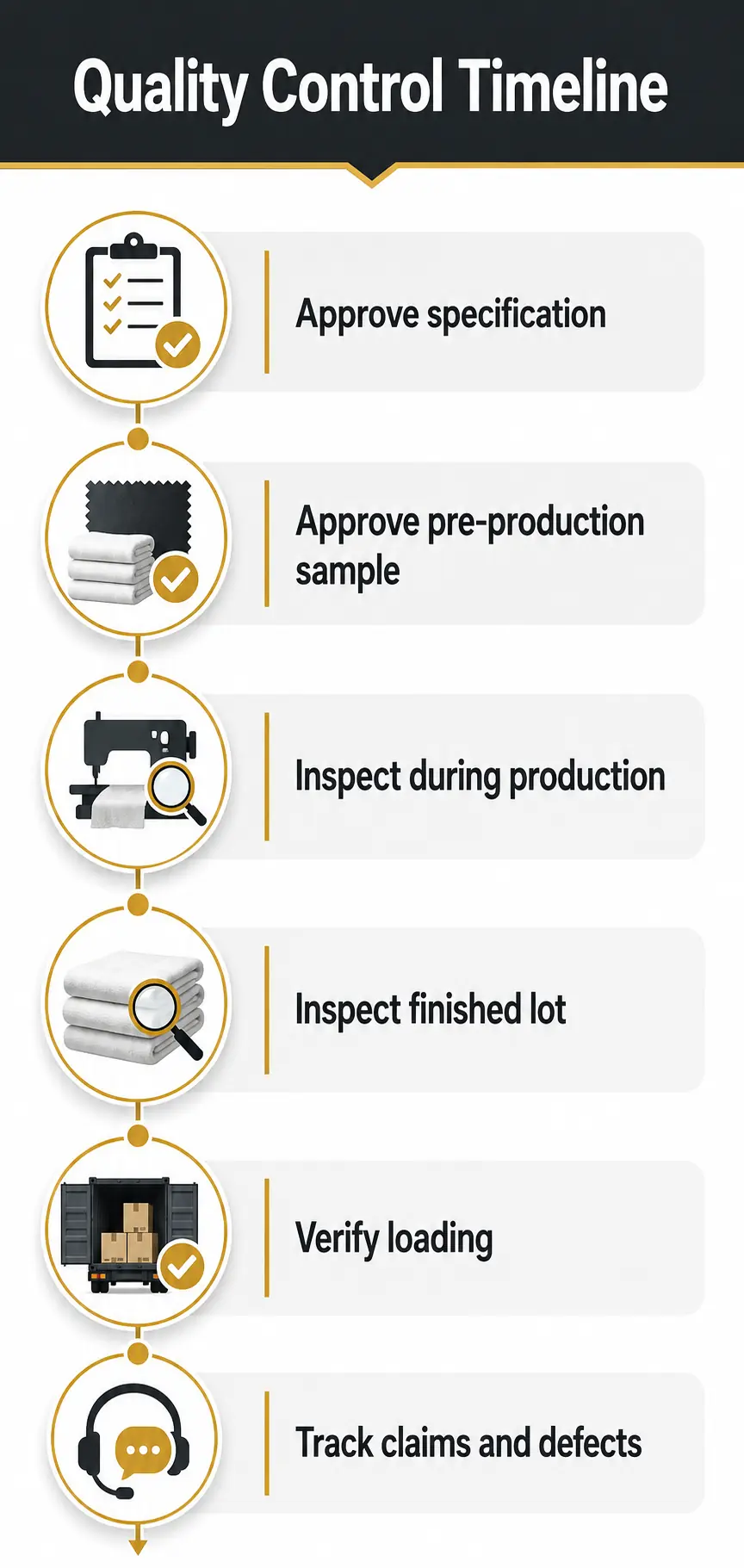
Approve samples with a controlled record
Record the sample version, date, item code, supplier, materials, finish, measurements, packaging, and approval status. Photograph important details and seal or sign the physical reference when practical. State whether the sample is for appearance, construction, performance, or all three. A beautiful sample that has not been tested under actual operating conditions is not a complete approval.
Verify production before problems become expensive
For higher-risk or customized orders, inspect early enough to correct the process. Confirm that approved materials and components are present, first production units match the reference, workmanship is stable, and packaging is being prepared correctly. A during-production check is especially valuable when rework is possible. Finished-lot inspection should then verify quantity, workmanship, function, dimensions, labeling, packaging, and defect levels against the documented plan.
Control changes and nonconformities
Suppliers should not substitute materials, components, factories, finishes, or packaging without written approval. If inspection identifies a problem, document the finding, isolate affected goods, determine scope, and agree on rework, replacement, credit, or another remedy before shipment. Avoid vague promises to fix issues in the next order when the current lot does not meet the contract.
Close the loop after delivery
Receiving teams should verify carton counts, visible damage, labels, pack quantities, and selected product attributes. Operations should track failures, guest complaints, unusual consumption, and replacement frequency by item and supplier. Feed this evidence into the next specification and supplier review. A supplier that responds quickly, investigates root causes, and prevents recurrence may create more value than one that merely offers the lowest initial price.
Ready to compare a bulk hotel-supply program on specification, landed cost, and quality controls? Submit a detailed hotel supplies RFQ so the sourcing team can review category, quantity, customization, delivery, and inspection requirements together.

Conclusion
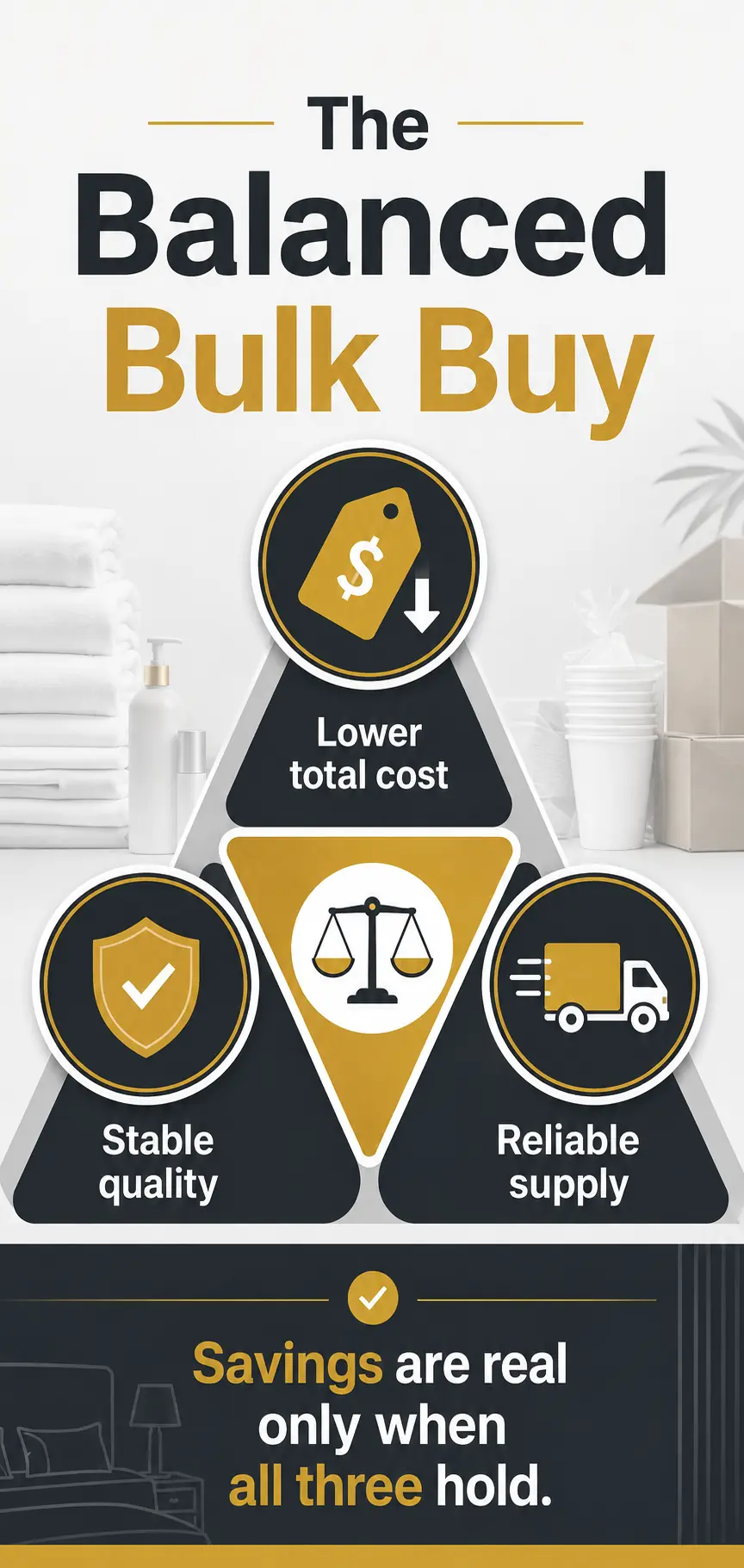
The strongest bulk-buying decision balances three outcomes: lower total cost, stable quality, and reliable supply. None can compensate for a serious failure in another. A low price loses value when products fail, an excellent product becomes impractical when replenishment is unreliable, and dependable supply is not enough when the landed and carrying cost exceeds the operating benefit. Build the decision in that order: define the need, lock the quality floor, normalize the cost model, choose a defensible volume, and verify execution. This makes supplier negotiations clearer and gives hotel teams a repeatable way to protect both budget and guest experience.
The practical goal is not to buy the most units or win the lowest quoted price. It is to purchase the right specification in the right quantity, with enough evidence and control to know that the savings will survive delivery and use. When procurement, operations, finance, and quality share the same assumptions, bulk hotel supplies become a disciplined source of margin improvement rather than an inventory gamble.
Frequently Asked Questions
What hotel supplies are best suited to bulk purchasing?
High-consumption items with stable specifications and predictable replenishment are usually the best candidates. Examples may include core linens, selected amenities, housekeeping consumables, tissue products, standard tabletop items, and repeat guestroom accessories. The final choice should reflect demand stability, storage capacity, shelf life, customization, and the cost of failure.
How can a hotel compare suppliers with different MOQs?
Normalize each offer to the same specification, usable unit, currency, delivery basis, and time horizon. Compare several quantity tiers and include storage, financing, waste, and obsolescence created by quantities above forecast demand. A lower MOQ with a slightly higher unit price may produce a lower total cost if it protects cash and reduces excess inventory.
Does the lowest unit price usually deliver the best value?
Not necessarily. Unit price excludes freight, duties, packaging, inspection, storage, handling, failures, replacements, and disruption. The better measure is cost per usable unit over the intended service life. A higher-priced product may be the better decision when it lasts longer, fails less often, arrives in more efficient packaging, or is supported by more reliable production controls.
How should hotels maintain quality on a large order?
Use a measurable specification, an approved pre-production sample, documented defect definitions, an appropriate acceptance plan, and clearly assigned inspection points. Control material or process changes in writing. Verify finished goods and loading, then track delivery and in-use performance so evidence from the current order improves the next one.
Can multiple hotel properties combine volume without using identical products?
Often, yes. Properties may combine demand for shared materials, standard components, colors, packaging formats, or core SKUs while preserving deliberate differences in size, branding, or service tier. The supplier must confirm how mixed production affects MOQ, setup, price, lead time, labeling, and shipment allocation. Each property should still receive a clear specification and quantity schedule.
How far ahead should a hotel place a bulk supply order?
Work backward from the required delivery date and include specification development, sampling, testing, quotation, negotiation, production, inspection, freight, customs or destination handling, and a contingency buffer. Customized products and peak manufacturing or shipping periods require more time. Confirm the timeline with the supplier and logistics plan rather than relying on a generic lead-time estimate.