
A larger order saves money only when the value created by scale is greater than the extra cost and risk created by inventory. That sounds obvious, yet many hotel procurement decisions still stop at the unit-price column. A supplier offers a lower price at 5,000 pieces than at 1,000, and the difference is recorded as savings before anyone accounts for freight, duties, inspection, storage, capital tied up, damage, obsolescence, or product that will never be used. The result can be a purchase order that looks economical and performs poorly.
The better question is not, “How much does the price fall when we order more?” It is, “At what quantity is total cost per usable unit lowest for this property?” That calculation changes by category. Standard towels, tissue products, housekeeping consumables, core guest amenities, and repeat tabletop items may support larger commitments because demand is predictable and specifications are stable. Trend-sensitive décor, customized items for a renovation, products with limited shelf life, and equipment awaiting final site conditions require more caution.
This guide gives hotel owners, operators, purchasing managers, and project teams a practical way to find the boundary between productive scale and expensive overbuying. It explains where genuine bulk savings originate, how to calculate a break-even quantity, which hidden costs can erase a discount, and how to structure tiered quotations, samples, inspection, and delivery releases. The objective is not to buy the largest possible quantity. It is to secure the right specification, at the right volume, with savings that remain visible after the order is delivered, stored, issued, used, and replaced.
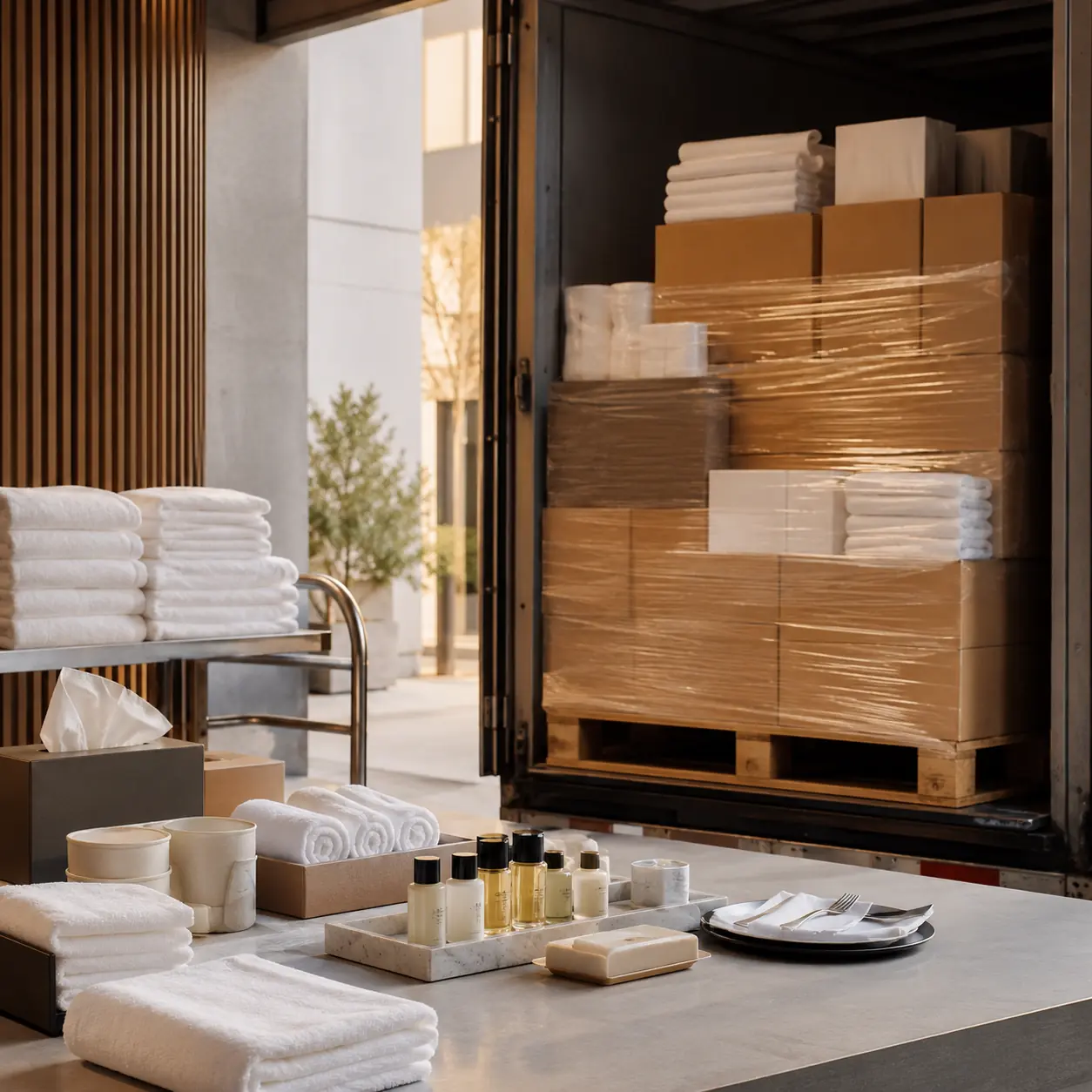
Where Larger Orders Create Real Savings
Bulk savings are real when a larger commitment removes cost from production, packaging, purchasing, or transport. Volume by itself has no economic value; the benefit comes from using machines, labor, cartons, pallets, containers, and administrative time more efficiently. Procurement teams should therefore ask suppliers to explain what changes at each quantity tier. A price break supported by lower setup cost, fuller cartons, better pallet utilization, or consolidated freight is more defensible than an unexplained percentage discount. The hotel should also separate supplier-side savings from internal operating savings so that neither is counted twice.
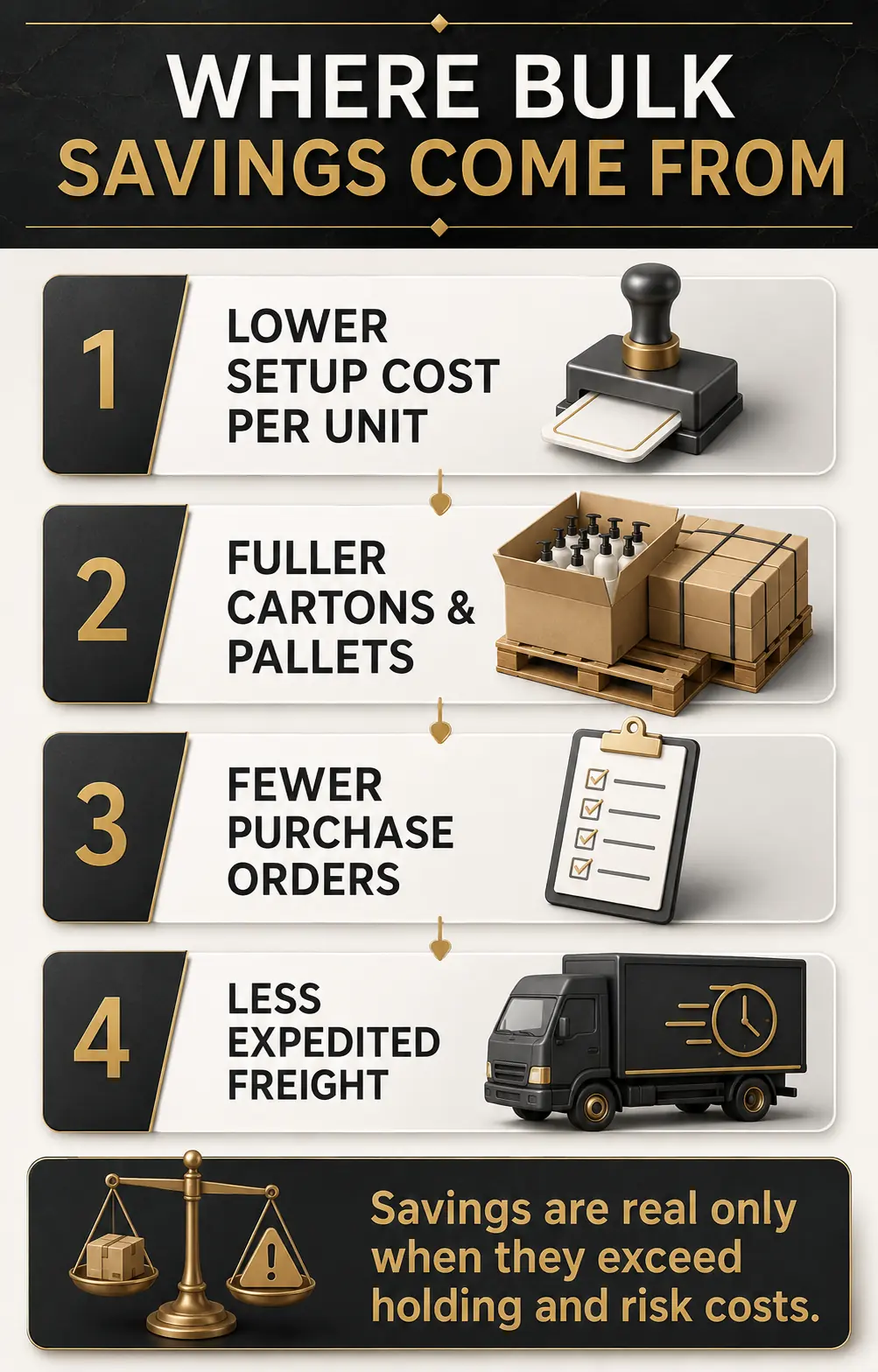
Production and setup costs are spread across more units
Many hospitality products carry fixed costs before the first production unit is completed. These may include machine setup, color matching, embroidery programming, artwork preparation, mold installation, material changeover, sample approval, or production-line cleaning. A larger run spreads those costs over more units and may allow the manufacturer to buy material in a more efficient lot. The saving is strongest when the specification is stable and the order can run as one controlled batch. It weakens when multiple colors, finishes, sizes, labels, or packaging versions fragment the order into several small runs.
Packaging and freight become more efficient
A supplier may be able to reduce cost when cartons are filled to a standard pack, pallets use their footprint efficiently, and compatible categories share a shipment. These efficiencies should be evaluated as part of total landed cost, not treated as an automatic consequence of a larger order. A higher quantity can still ship inefficiently if cartons contain too much empty space, products cannot be stacked, several factories deliver at different times, or the order exceeds the most economical loading point and triggers another pallet or container.
Fewer transactions reduce operating cost
Every purchase order consumes staff time: requesting and leveling quotations, creating approvals, processing deposits, tracking production, booking freight, receiving deliveries, matching documents, resolving shortages, and posting invoices. Replacing four small orders with one planned order can reduce that work. It can also lower the chance of emergency freight and stockouts. These savings matter, but they should be measured with a realistic internal cost per order rather than inserted as a vague efficiency benefit.
The best bulk candidates share three traits
Demand is repeatable enough to forecast from occupancy, covers, laundry cycles, issue records, or replacement history.
The specification is unlikely to change during the period in which the inventory will be consumed.
The item can be stored safely without excessive space, special environmental controls, expiry risk, or loss of presentation quality.

Calculate the Break-Even Cost per Usable Unit
The correct comparison uses cost per usable unit, not quoted price per unit. Start with every acquisition and holding cost created by a scenario, then divide by the number of units expected to remain usable. This denominator matters: defective, damaged, expired, obsolete, or surplus units were purchased, transported, inspected, and stored, but they do not serve the hotel. A modest discount can disappear when the larger order increases the unused share. The comparison should use the same specification, currency, destination, delivery basis, and planning horizon for every quantity tier.
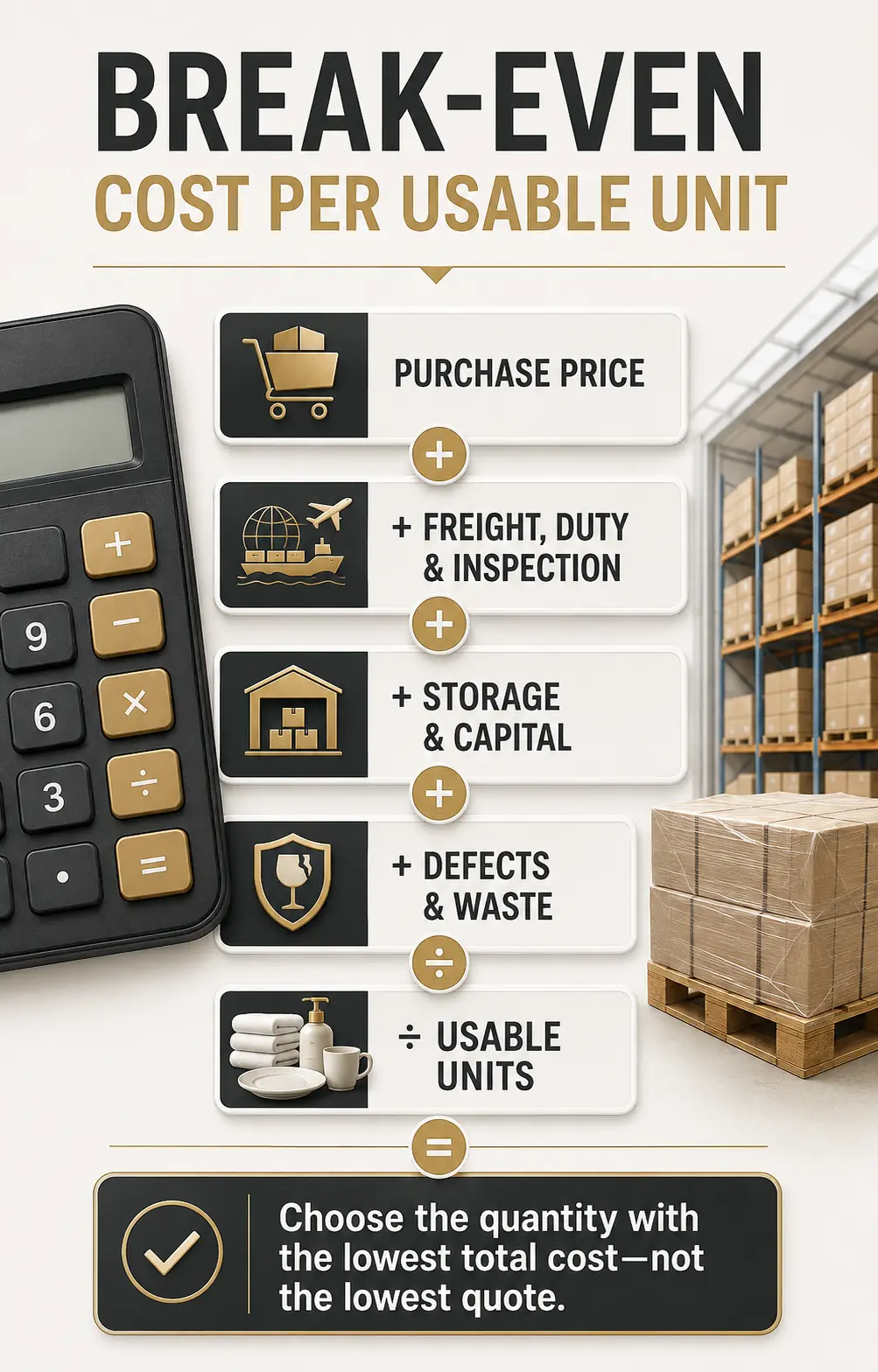
Use a complete cost equation
For a practical purchasing model, calculate total scenario cost as purchase price plus setup or ordering charges, packaging, freight, insurance, duties and import charges, inspection or testing, receiving, storage, financing, expected waste, and any foreseeable shortage or emergency-order cost. Then calculate usable units as total units purchased multiplied by one minus the expected defect and unused rates. The core measure is:
Core formula: Cost per usable unit = Total scenario cost ÷ Expected usable units
A simple example shows why quantity alone is misleading
| Scenario | Quoted unit price | Total cost | Cost per usable unit |
| Four smaller releases | $12.00 | $53,164 | $13.70 |
| One larger order | $10.80 | $51,855 | $14.41 |
In this illustrative case, the larger order has the lower unit price and lower total invoice-related cost, yet it produces a higher cost per usable unit because more stock is held longer and a larger share is expected to become unused. The exact numbers will differ by hotel and category; the lesson is to make all assumptions editable and visible.
Normalize quantity tiers to the same demand
A fair comparison must cover the same forecast demand. If a small-order scenario provides only half the required units, do not compare its total directly with a full-year bulk order. Convert each scenario to an effective cost for the same number of usable units, or model the correct number of releases. Include expected lead-time variability and an agreed safety stock separately. Safety stock protects service; surplus stock created only to reach a discount tier does not.
Find the break-even bulk unit price
Once the model is complete, calculate the highest bulk unit price at which the larger scenario would equal the smaller scenario’s cost per usable unit. This becomes a useful negotiating boundary. If the supplier’s bulk price is below that level and the assumptions are credible, the larger order may save money. If it is above the level, the buyer needs a better price, lower freight, a staged-release arrangement, reduced waste, or a different quantity.

When Bulk Orders Stop Saving Money
A volume discount becomes expensive when the hotel absorbs more inventory risk than the discount can pay for. The most common warning signs are uncertain demand, limited storage, changing specifications, short shelf life, and restricted cash. These risks are category-specific. A stable white towel program and a customized decorative accessory should not use the same ordering rule. Procurement should test the downside before award: slower occupancy, a delayed opening, a renovation change, a packaging update, a quality problem, or a six-month shift in consumption.
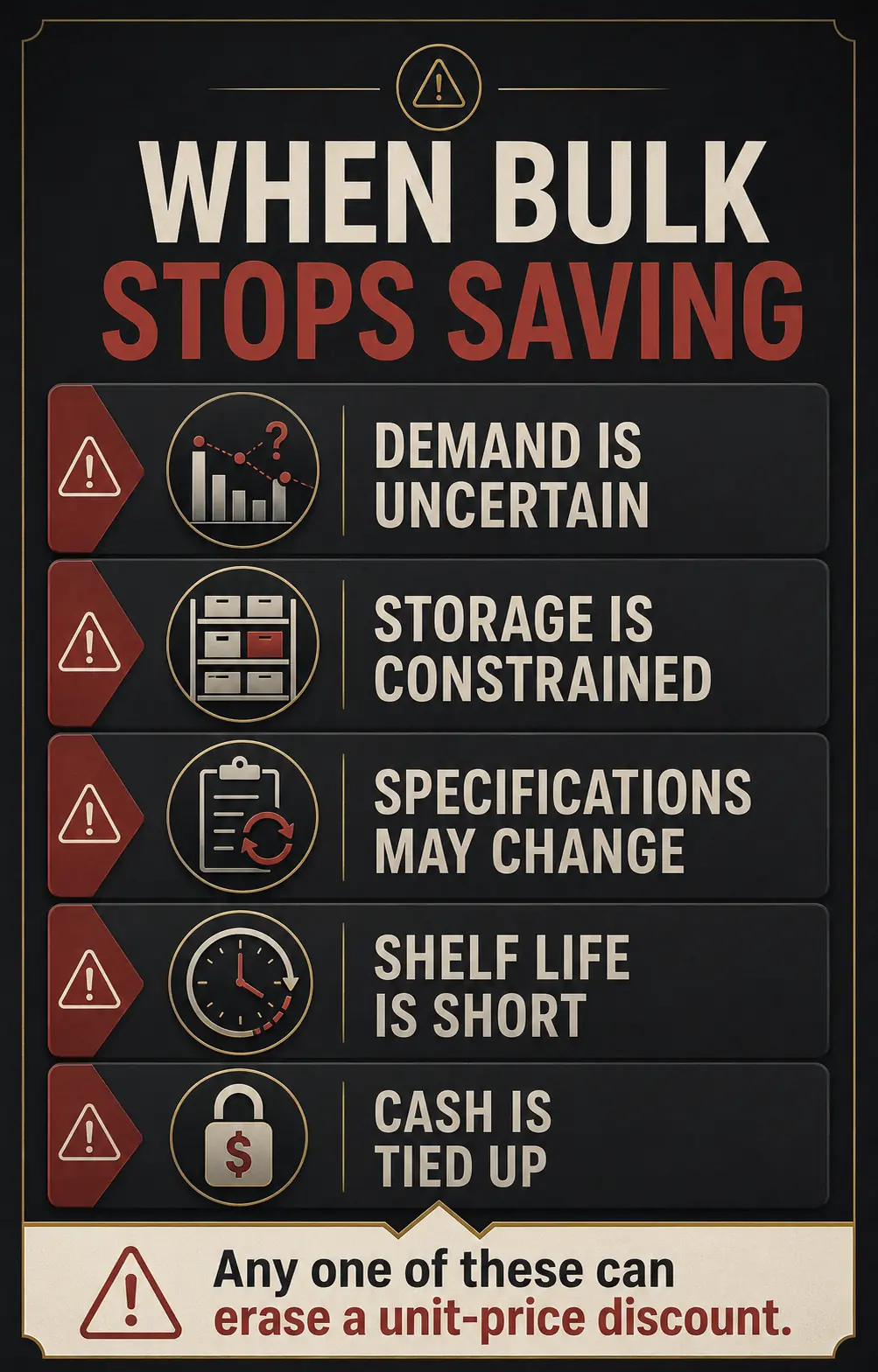
Inventory carrying cost grows with time
Inventory consumes working capital and space while it waits to be used. Carrying cost may include financing or opportunity cost, warehouse rent, utilities, insurance, handling labor, inventory systems, counting, shrinkage, damage, and obsolescence. The appropriate rate should come from the hotel or ownership group’s finance and operations data. A generic industry percentage can be useful for an early sensitivity test, but it should not replace local assumptions in the approval model.
Uncertain demand turns a discount into surplus
Opening occupancy, outlet volume, spa utilization, laundry losses, amenity consumption, and replacement rates can all differ from plan. Use at least three demand cases—expected, low, and high—and check how much inventory remains at the end of the planning horizon. Bulk quantity is strongest when it remains economical in the expected case and acceptable in the low-demand case. If the business case works only under the highest forecast, the order is fragile.
Specification drift can strand usable-looking stock
A product does not need to expire physically to become unusable. A brand refresh, new dispenser, revised room design, changed logo, different bed size, updated table setting, discontinued finish, or altered operating standard can turn sound inventory into an exception. Custom and property-specific products deserve shorter commitment periods or stronger continuity planning. Where consistency matters, retain approved specifications, artwork, color references, and control samples so replenishment can be evaluated against the original standard.
Low price cannot rescue poor quality
Defect rates that look small can become material at scale. A two-percent problem in a 500-piece order affects ten units; the same rate in a 20,000-piece order affects four hundred. More importantly, one systemic fault can affect the entire batch. Cost models should include expected defects, inspection, replacements, claims labor, and operational disruption. Guest-facing or safety-relevant categories require a stricter quality floor because failure cost is much larger than the purchase price.
Prefer staged releases when consumption is stable but storage is not
A useful compromise is to negotiate annual or project volume while releasing goods in scheduled batches. This may preserve some production and commercial efficiency while reducing on-site inventory. The agreement must state ownership, payment milestones, storage responsibility, release dates, maximum holding period, price validity, material commitments, inspection points, and what happens if the forecast changes. A vague promise that a supplier will “hold stock” is not a complete risk allocation.

Build an Order and Quotation That Protect the Savings
Savings survive execution only when the order is comparable, measurable, and controlled. Before requesting a price, lock the specification, acceptable substitutions, packaging, quality criteria, destination, delivery schedule, and quantity scenarios. Ask each supplier to quote the same tiers and disclose what is included or excluded. Then test samples, define the inspection plan, and document responsibility for freight, duties, delays, shortages, and defects. This process turns a unit-price negotiation into an auditable purchasing decision that finance, operations, design, and receiving teams can support.
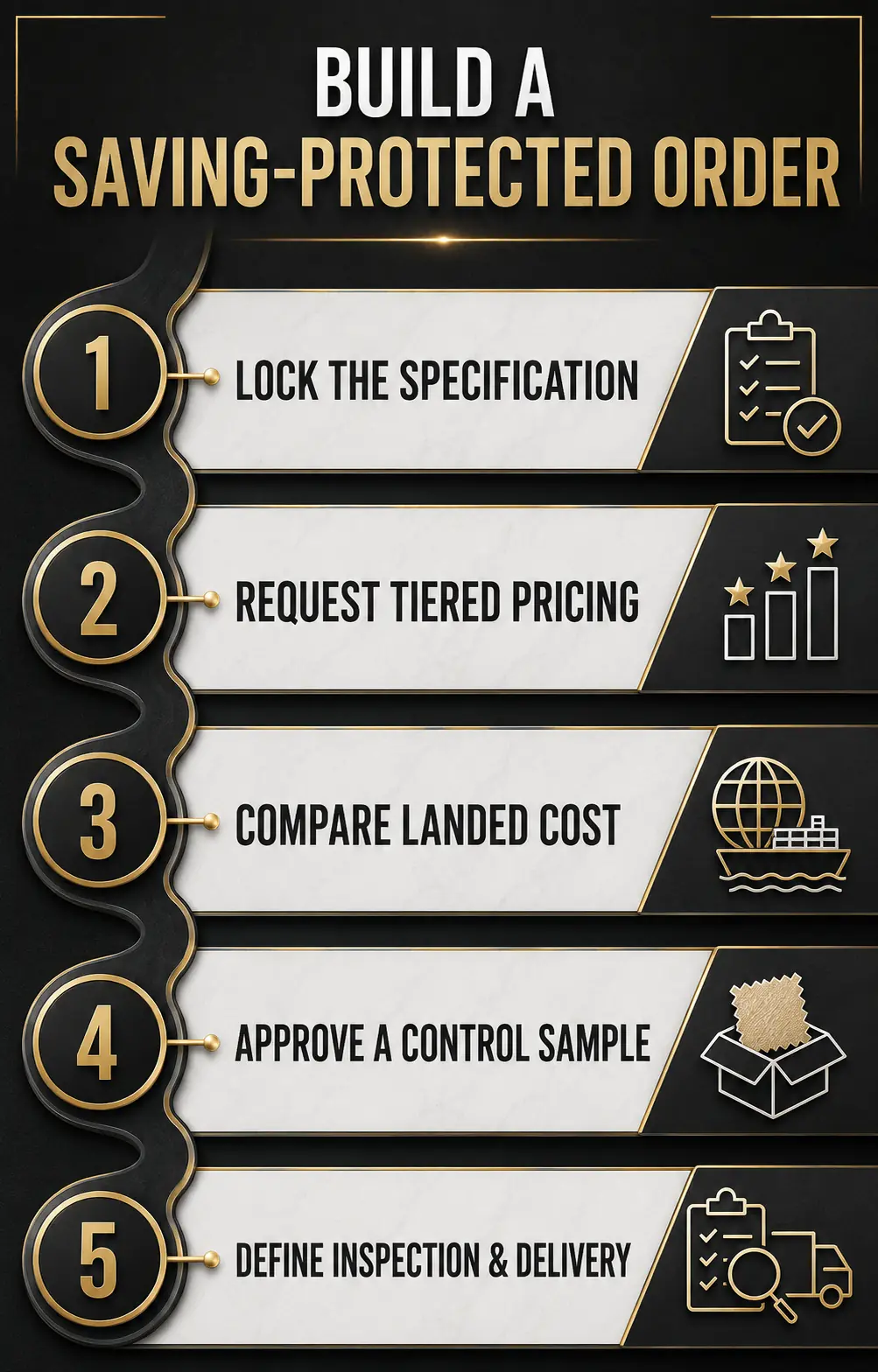
1. Lock the specification before prices anchor the decision
Define material, dimensions, construction, finish, color tolerance, performance, commercial-use requirements, labeling, pack quantity, carton marks, and acceptance criteria. Avoid relying on words such as premium, luxury, heavy duty, or hotel grade without measurable attributes. If suppliers are pricing different products, the lowest quote is not a saving.
2. Request tiered pricing around realistic quantities
Ask for several decision-relevant tiers rather than one low quantity and one extreme MOQ. Useful tiers may include an opening order, six-month demand, annual demand, multi-property demand, and a staged-release alternative. Require the supplier to identify pack multiples, setup charges, tooling, packaging minimums, production lead time, quote validity, and the commercial reason for each price break. A structured schedule from a complete hotel-supplies purchasing process makes bid leveling much easier.
For broader preparation before supplier contact, use the complete hotel supplies purchasing guide to align property requirements, specifications, quantities, samples, logistics, and approval responsibilities.
3. Compare landed and lifecycle cost on one basis
State currency, Incoterm or delivery basis, named destination, freight inclusion, insurance, duties, taxes, brokerage, port or terminal charges, final delivery, unloading, and installation where applicable. Use the same planning horizon and demand assumption for every scenario. For durable items, compare expected service life, replacement rate, maintenance, cleaning compatibility, and spare-part continuity in addition to acquisition cost.
4. Approve a control sample and measurable acceptance standard
A signed specification and approved control sample provide a shared production reference. State who holds the sample, which attributes govern acceptance, whether preproduction approval is required, how substitutions are handled, and how inspection findings will be resolved. Sampling does not eliminate risk, but it reduces ambiguity before the full order becomes irreversible.
5. Define inspection, delivery, and remedy before award
Specify inspection timing, sampling basis, defect classifications, reporting, reinspection, replacement, credit, rework, and responsibility for related costs. Align delivery releases with opening or operating needs, and confirm site access, receiving hours, unloading, pallet restrictions, storage capacity, and documentation. The best commercial price is not useful if the goods arrive too early, too late, incomplete, or nonconforming.
Use the calculator before approving the quantity
The accompanying workbook compares a smaller-release scenario with a bulk-order scenario using editable inputs for unit price, order quantity, number of releases, setup cost, freight, duty, inspection, storage duration, carrying rate, defects, unused stock, and emergency costs. It calculates cost per usable unit, normalized cost for the same demand, expected savings, and the break-even bulk unit price. Replace the example values with your property’s data and run low-demand and higher-waste sensitivities before approval.
Prepare an RFQ that exposes the economics
A useful RFQ asks suppliers to complete the same quantity and cost schedule, identify assumptions, and price alternatives without hiding exclusions. Use the hotel supplies RFQ guide to structure specifications, commercial terms, landed-cost fields, quality controls, and evaluation criteria before bids are released.
Ready to compare a real bulk program?
Send the category, specification, quantity tiers, destination, required date, customization needs, and sample or inspection requirements through the KW Hospitality RFQ form. The sourcing team can then compare production feasibility, tiered pricing, packaging, freight, and quality controls on one commercial basis.
Conclusion
Larger hotel-supply orders save money when scale reduces production, packaging, freight, and transaction costs by more than it increases carrying cost, waste, quality exposure, and cash commitment. The decision should be made at the level of cost per usable unit for a defined period and demand forecast. That requires comparable specifications, normalized quantity scenarios, visible assumptions, and a downside test—not a single discounted unit price. When procurement, operations, finance, quality, and receiving teams agree on those inputs, the final quantity becomes easier to defend and monitor after award.
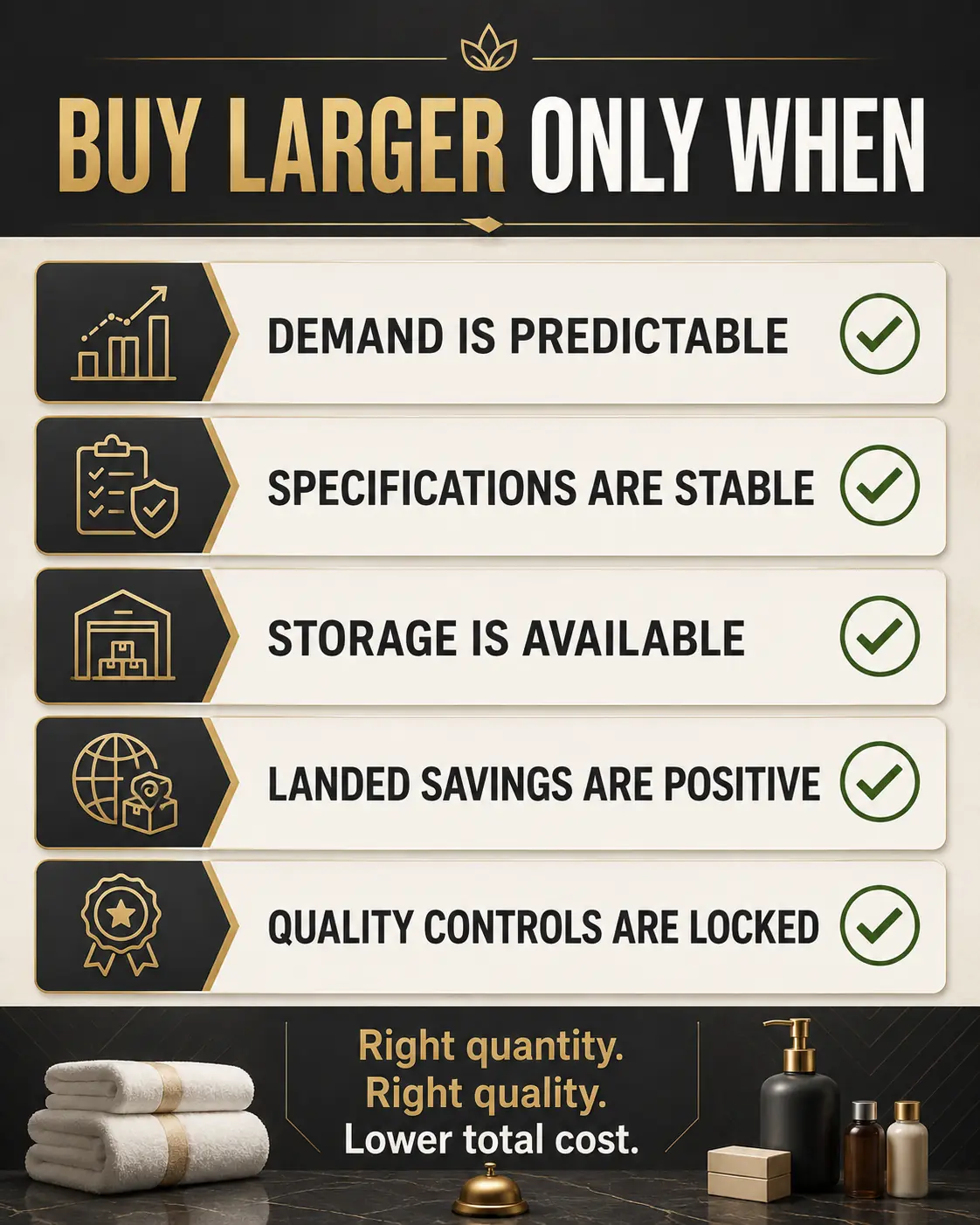
The practical rule is simple: buy larger only when demand is predictable, specifications are stable, storage is available, landed savings remain positive, and quality controls are locked. If one of those conditions is weak, negotiate a smaller tier, staged releases, better packaging, a stronger price, or a different product. The right order is the one that protects service and quality while producing the lowest sustainable total cost—not the one that places the most units on a purchase order.
Frequently Asked Questions
Bulk purchasing decisions vary by product category, property type, demand pattern, and commercial terms. These answers summarize the most common questions procurement teams should resolve before committing to a larger quantity.
What hotel supplies are usually best for bulk purchasing?
High-consumption items with stable specifications and predictable replacement are usually the strongest candidates. Examples may include core towels and linens, selected guest amenities, housekeeping consumables, tissue products, standard tabletop pieces, and repeat back-of-house supplies. Storage, shelf life, customization, and the cost of failure must still be checked for each category.
How much of a unit-price discount is enough to justify a larger order?
There is no universal percentage. The discount is sufficient only when the larger scenario has a lower cost per usable unit after freight, duties, inspection, storage, capital, defects, unused stock, and risk are included. Use the break-even model to calculate the bulk price required for your property’s assumptions.
Should a hotel include inventory carrying cost in the comparison?
Yes. Carrying cost is one of the main reasons an apparently cheaper bulk order can become more expensive. Use a rate that reflects the hotel’s actual capital, storage, handling, insurance, shrinkage, and obsolescence costs. Test more than one rate when the estimate is uncertain.
How should hotels compare suppliers with different MOQs?
Normalize each offer to the same specification, currency, delivery basis, destination, planning horizon, and usable demand. Model the cost of quantity above demand rather than treating it as free. A supplier with a lower MOQ and slightly higher unit price may produce a lower total cost.
Can staged deliveries preserve bulk pricing?
Sometimes. A hotel may negotiate a total annual or project volume with scheduled releases, but the arrangement must define ownership, payment, storage, release dates, price validity, inspection, and forecast changes. Commercial feasibility depends on the product and supplier.
Why calculate cost per usable unit instead of cost per purchased unit?
Purchased units include goods that may arrive defective, become damaged, expire, become obsolete, or remain surplus. Cost per usable unit assigns the complete scenario cost to the units expected to serve the operation, producing a more realistic comparison.
What information should be included in a bulk hotel-supplies RFQ?
Include measurable specifications, quantity tiers, pack requirements, destination, delivery dates, currency, delivery basis, customization, samples, inspection, testing, quality acceptance, documentation, commercial terms, and a schedule that separates included and excluded costs.