
A minimum order quantity, or MOQ, is the smallest quantity a supplier will accept under a particular set of commercial and production conditions. For hotel buyers, that number is rarely as simple as “500 pieces.” The minimum may apply to each SKU, color, size, finish, packaging design, production run, or total order value. A supplier may accept a mixed order of 1,000 units while still requiring 300 units of every color. Another may offer a low unit MOQ but impose a carton multiple, private-label packaging minimum, or setup charge that changes the real commitment.
The practical question is not whether an MOQ is high or low in isolation. It is whether the order threshold fits the property’s opening plan, consumption rate, replacement needs, available storage, cash-flow limits, shelf life, delivery schedule, and ability to reorder the same product later. A minimum that looks expensive for one boutique hotel may be efficient for a multi-property rollout. Conversely, an attractive bulk price can become costly when excess inventory sits unused, expires, occupies valuable back-of-house space, or creates a mismatch with future brand standards.
This guide gives owners, purchasing managers, operators, designers, and project teams a practical way to interpret MOQ terms, identify what drives them, calculate the buyer’s real exposure, and negotiate alternatives without weakening quality or delivery control. It complements KW Hospitality’s broader wholesale hotel supplies ordering guide by focusing specifically on the quantity decision. The goal is not to force every supplier below its stated minimum. It is to create an order structure in which supplier economics and hotel demand are both visible, comparable, and written into the quotation and purchase documents.

What Minimum Order Quantity Means in Hotel Procurement
MOQ is a supplier-set threshold, not a universal measure of product value or supplier quality. It indicates the smallest order the supplier considers commercially workable for the quoted specification, packaging, and production method. Buyers should ask exactly where the threshold applies and which assumptions support it. A single number can conceal several different requirements, so the quotation should separate per-item minimums, order multiples, minimum order value, customization minimums, and any one-time charges. This distinction determines the hotel’s true inventory and cash commitment.
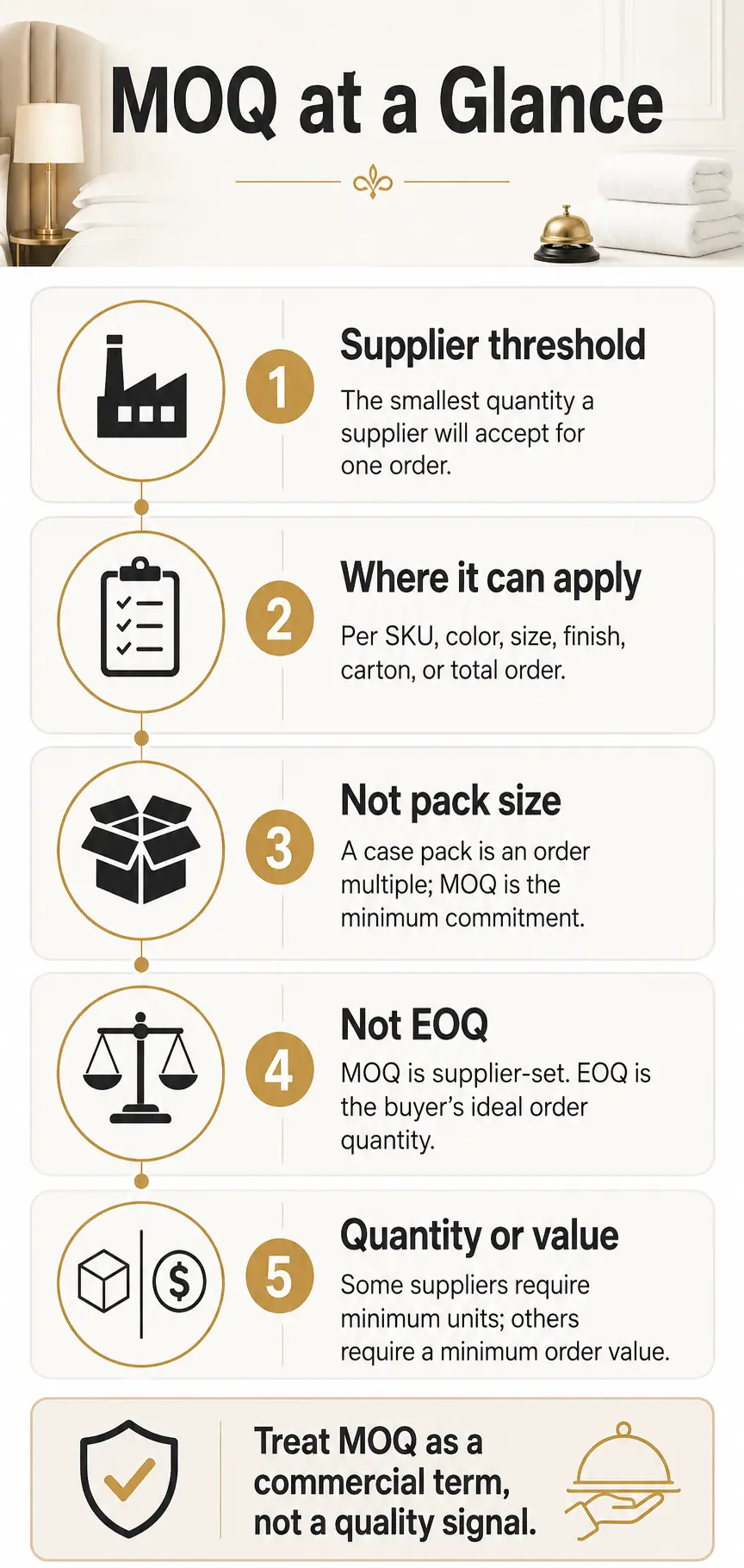
MOQ can be defined at several levels
A unit MOQ sets the minimum number of pieces for a line item. A supplier may also set a value-based minimum for the whole order, a minimum weight or volume for a material, or a production-batch minimum tied to a machine, dye lot, mold, or assembly line. In hospitality purchasing, the most important distinction is often the level at which the requirement applies. “MOQ 500” can mean 500 total units across a range, 500 units of each SKU, 500 per color, or 500 per packaging design. Those outcomes create very different inventory commitments.
| Term | Who sets it | What it controls | Hotel-buyer question |
| MOQ | Supplier | Smallest accepted order | Does it apply per SKU, variant, or total order? |
| Case pack | Supplier / packer | Units inside a selling carton | Must orders be placed in full-case multiples? |
| Order multiple | Supplier | Quantity increments above the minimum | After MOQ, can the quantity increase only by 12, 24, or one pallet? |
| Minimum order value | Supplier | Lowest monetary value accepted | Can several product lines be combined to reach it? |
| EOQ | Buyer | Order size that balances ordering and holding costs | Is the supplier’s MOQ above the property’s economically useful quantity? |
MOQ is not the same as pack size or economic order quantity
Pack size determines how products are grouped for sale and shipment. If glassware is packed 24 pieces per carton, a hotel may need to order in multiples of 24 even when the MOQ is 240 pieces. Economic order quantity, by contrast, is a buyer-side planning concept: it estimates the order size that best balances ordering cost, inventory holding cost, and demand. MOQ and EOQ can align, but they often do not. When the supplier minimum exceeds the hotel’s useful order quantity, procurement must either justify the excess, restructure the requirement, negotiate the terms, or select another supply route.
An MOQ should be attached to a complete commercial basis
The number is meaningful only when the quotation also states the product specification, unit of measure, pack configuration, variant mix, price tier, setup or tooling cost, sample status, lead time, allowed overrun or underrun, delivery basis, and validity period. If the specification changes, the MOQ may change too. A lower minimum quoted for a stocked item cannot be compared directly with a higher minimum for a custom-colored, branded, tested, and export-packed version unless the scope is normalized first.

Why MOQ Varies Across Hotel Supply Categories
Hotel supplies do not share one manufacturing model. Ready-stock amenity containers, woven linens, molded plastic accessories, printed packaging, ceramic tableware, metal carts, electronics, and custom furniture each have different setup costs, batch constraints, raw-material commitments, testing needs, and production lead times. The same category can also support several routes: a standard item from stock, a lightly customized item, or a fully bespoke product. As customization and process-specific setup increase, the supplier usually needs a larger or more valuable order to spread those costs across the production run.
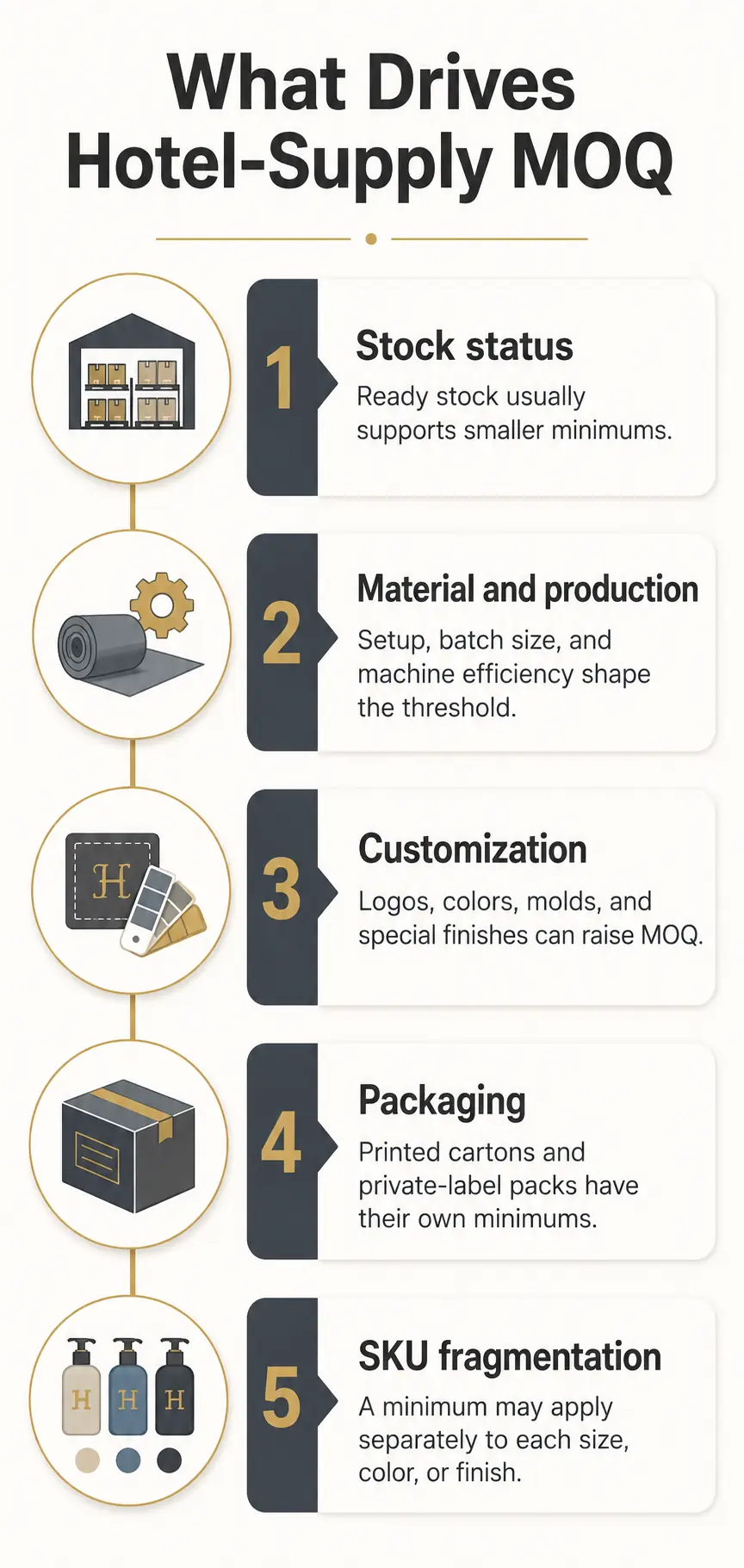
Stocked products usually permit smaller commitments
A distributor or manufacturer holding finished stock can often sell smaller quantities because the main production batch has already been completed. The buyer may still face case-pack or pallet multiples, but the threshold is usually linked to handling and shipment rather than factory setup. This route can be useful for urgent replenishment, pilot properties, seasonal demand, or small independent hotels. The trade-off is less control over materials, colors, packaging, and long-term model continuity.
Custom materials and processes create batch economics
A supplier may need to purchase a minimum quantity of fabric, leather, resin, metal, foam, paperboard, or chemical formulation before production begins. Dyeing, weaving, injection molding, casting, printing, coating, embroidery, engraving, and assembly can also require machine setup or a minimum efficient run. The factory’s stated MOQ may therefore be driven by the most restrictive component rather than the finished product itself. Asking which component drives the threshold often reveals more useful negotiation options than simply requesting a lower number.
Branding and packaging may have separate minimums
A standard amenity bottle may be available in modest quantities, while custom-colored bottles, printed labels, branded caps, and printed cartons each have independent supplier requirements. The finished-product assembler may be flexible even when the packaging converter is not. Hotels should request a component-level explanation: product minimum, decoration minimum, label minimum, carton minimum, and any excess packaging that must be purchased or stored. This prevents a low product MOQ from hiding a much larger packaging commitment.
| Supply family | Common MOQ driver | Risk if misunderstood | Possible alternative |
| Amenities and consumables | Bottle, formulation, label, carton, filling run | Shelf-life exposure or excess branded packaging | Stock formula with standard pack; customize selected components |
| Linens and uniforms | Fabric lot, dye lot, size/color split, embroidery | Per-size minimums and shade variation | Common fabric/color across sizes; phase embroidery |
| Tableware and glassware | Kiln or production run, pattern, decoration, carton | Breakage reserve or pattern discontinuity | Standard body with limited decoration; consolidate patterns |
| Furniture and fixtures | Material purchase, tooling, finish, prototype, production cell | Excess custom units or costly small repeat orders | Modular design, shared finishes, planned spare parts |
| Equipment and electronics | Model batch, components, certification, firmware, packaging | Obsolete stock or destination incompatibility | Verified standard model; combine compatible properties |
SKU fragmentation can turn one MOQ into many
A hotel may require one product in several sizes, room types, colors, voltages, finishes, or language versions. If the minimum applies separately to each variant, the total commitment can multiply quickly. Procurement should build a variant matrix before accepting the quote and identify which differences are operationally necessary. Standardizing an invisible component, using one finish across departments, or limiting low-volume variants may reduce cost and complexity without changing the guest experience.

How to Decide Whether an MOQ Works for Your Property
A workable MOQ is one the property can consume, install, or hold within a deliberate planning horizon without creating disproportionate cash, storage, quality, or obsolescence risk. The assessment should begin with demand rather than the supplier’s price break. Calculate the hotel’s installed quantity, opening reserve, average consumption, replacement rate, expected growth, and replenishment lead time. Then compare the supplier threshold with months of cover, usable shelf life, back-of-house capacity, and total landed commitment. The final decision should remain practical under a delayed opening or lower-than-expected usage scenario.
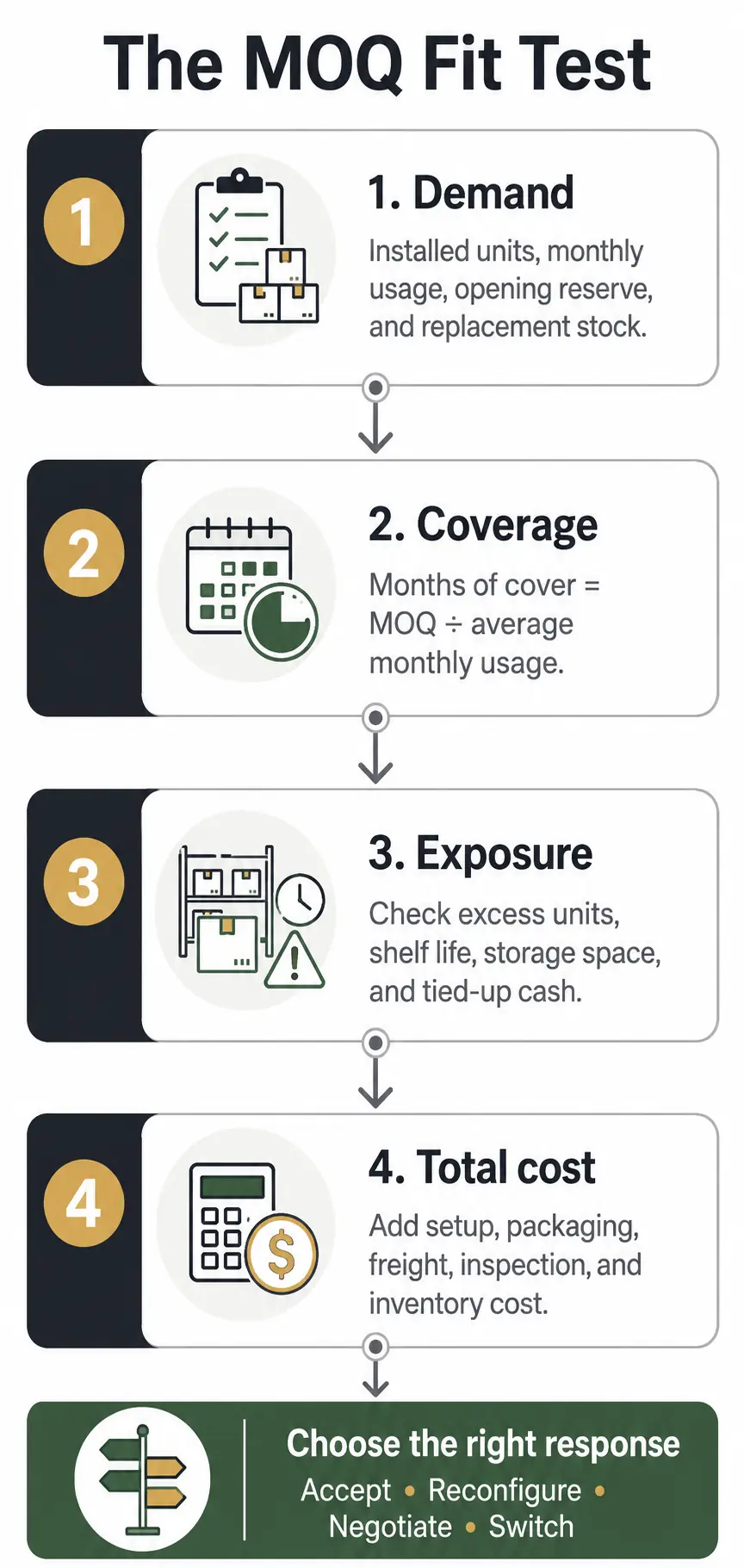
Build demand from operational units, not a rounded purchasing guess
For durable products, begin with installed units by room, outlet, workstation, or operating position. Add the approved opening reserve and a replacement allowance linked to expected breakage, loss, wear, or maintenance. For consumables, estimate average monthly usage from rooms occupied, service frequency, portions or uses per occupied room, expected occupancy, seasonality, and waste. Separate firm demand from optional growth or future phases so a supplier does not treat an unapproved forecast as the opening order.
Calculate coverage and excess exposure
For a regularly consumed item, a simple first check is months of cover: divide the MOQ by average monthly usage. If a 120-room property expects to use 2,800 amenity kits per month and the supplier MOQ is 10,000, the order represents about 3.6 months of gross usage before safety stock and seasonal variation. That may be practical if shelf life, storage, and lead time support it. The same calculation is less useful for a custom in-room tray: if the property needs 120 installed units plus 12 spares, a 500-unit MOQ leaves 368 units without an identified operational use.
Price the full commitment, not only the unit rate
The minimum cash commitment begins with MOQ multiplied by unit price, but a responsible comparison adds tooling, artwork, samples, packaging, testing, inspection, inland transport, freight, insurance, duties, brokerage, unloading, storage, and any installation or commissioning. Inventory also consumes capital and space. A lower unit price at a higher MOQ can cost more than a higher unit price at a practical quantity, especially when a product has limited shelf life or design relevance. The framework for comparing hotel supply companies beyond the quoted price provides a broader method for normalizing these cost and risk differences.
| Illustrative item | Demand basis | Supplier MOQ | Initial interpretation |
| Guest amenity kits | 2,800 per month plus safety stock | 10,000 kits | Potentially workable if shelf life, storage, and replenishment lead time fit |
| Custom in-room trays | 120 installed plus 12 spares | 500 trays | High excess exposure; redesign, combine demand, or change supply route |
| Dinner plates | Outlet par level plus breakage reserve | 1,200 pieces | Check carton multiple, future pattern continuity, and split by size or decoration |
| Embroidered uniforms | Staff roster by role and size | 200 per style/color | Variant fragmentation may be the real constraint; consolidate fabric and branding |
Stress-test timing, shelf life, storage, and change risk
Ask what happens if occupancy is lower than planned, an opening is delayed, packaging regulations change, a formula expires, a finish is revised, or a brand standard is updated. Confirm whether the property can receive and store the full order safely, whether humidity or temperature controls are required, and whether stock will remain usable through the planned coverage period. For multi-property programs, confirm that pooled demand is genuinely approved and that delivery phases, ownership, and allocation are documented rather than assumed.
Compare the MOQ with the reorder path
The first order is only half the decision. Procurement should ask whether the same MOQ, specification, materials, colors, packaging, and price logic will apply to replenishment. A low opening minimum is not valuable if future orders require a much larger batch or if the supplier cannot maintain the model. The hotel supplies purchasing guide for procurement managers explains how reorder continuity, quality control, delivery, and supplier risk fit into the wider purchasing process.

How to Negotiate and Restructure MOQ Terms
MOQ negotiation works best when the buyer understands the cost or process that creates the threshold. A request to “reduce MOQ” gives the supplier little room to redesign the offer. A stronger discussion asks which material, setup, variant, packaging component, or shipment condition drives the minimum and proposes a practical alternative. The objective is not to transfer unreasonable cost to the supplier. It is to restructure product scope, volume, timing, or commercial terms while protecting specification, quality, lead time, and repeat-order consistency.
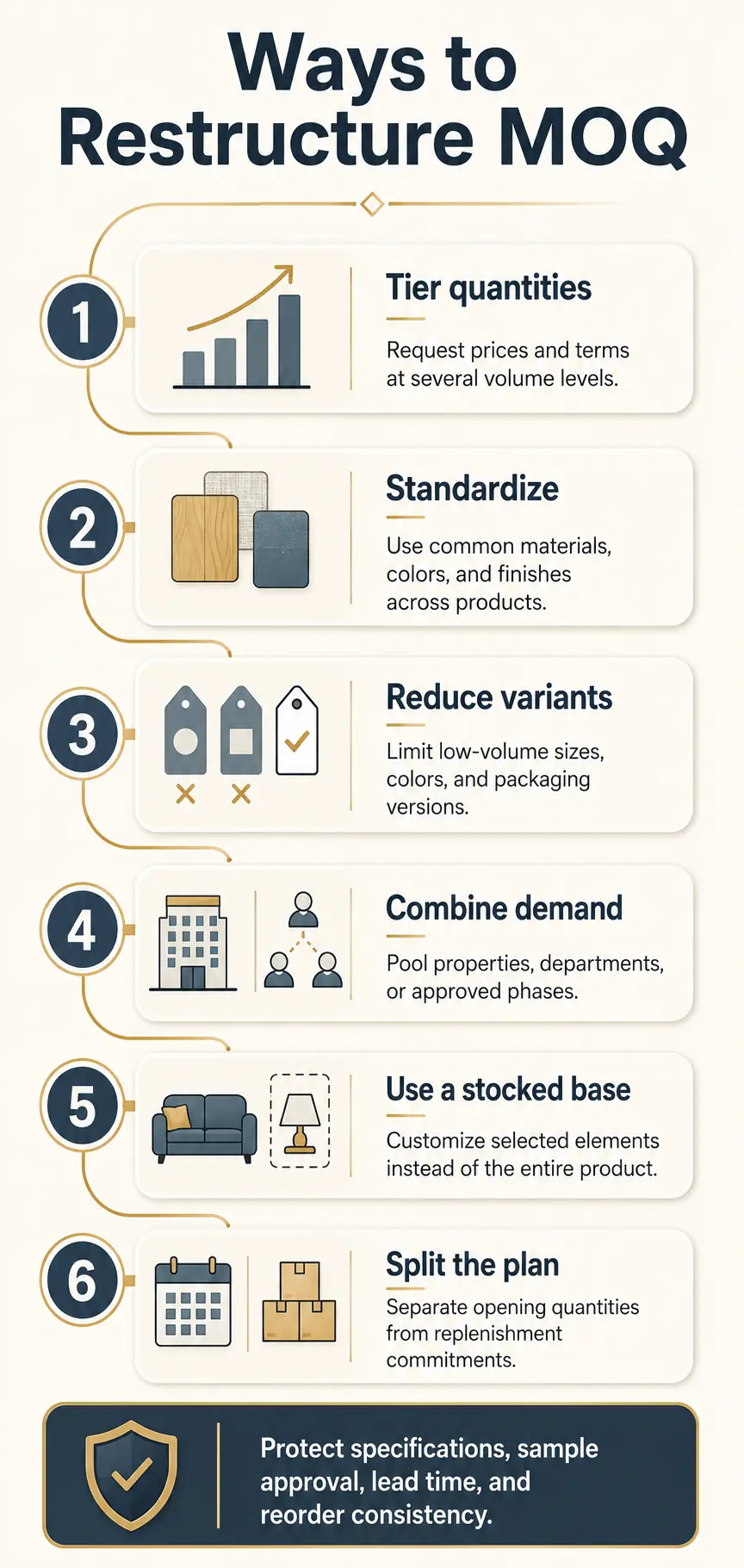
Request tiered pricing and terms
Ask the supplier to quote several realistic quantity levels rather than one preferred number. Each tier should show unit price, setup charges, pack configuration, lead time, freight basis, and any change in specification or production method. This makes the cost of a lower minimum visible. A small order may remain feasible when the buyer accepts a higher unit rate, pays a one-time setup charge, or uses a different packaging method. Tiered offers also help distinguish a genuine production constraint from a commercial preference.
Standardize materials, colors, finishes, and components
If a raw material or process drives MOQ, combine products around a common input. Several linen sizes may share one fabric and color. Guestroom accessories may use the same finish. Furniture families may share hardware, upholstery, or modular parts. Amenities may use a stock bottle with a custom label instead of a fully custom container. Standardization should be deliberate and approved by design and operations; it should not silently reduce performance or brand fit.
Reduce low-volume variants
Review whether every size, color, language version, finish, or packaging format is necessary. Low-volume variants can trigger separate setup and production minimums. Consolidating room-type differences, using universal packaging where appropriate, or limiting customization to guest-visible elements can reduce the total commitment. The supplier should confirm which variants can share a batch and which cannot.
Combine demand across approved properties or phases
A hotel group may pool demand across properties, departments, or scheduled phases to reach a workable batch. This approach requires more than an annual estimate. The purchase documents should identify committed quantities, delivery dates, allocation, storage responsibility, price validity, quality reference, and what happens if a later phase changes. A supplier may accept a blanket commitment with scheduled releases, but the buyer must understand payment, inventory ownership, and cancellation exposure.
Separate product and packaging decisions
When packaging has the higher minimum, consider neutral cartons, standard labels, digital printing, or limited branded components for the first order. The hotel may purchase excess printed packaging for future use only when artwork, regulations, shelf life, storage conditions, and reorder plans are stable. Ask who owns that material, where it will be stored, how it will be counted, and whether unused packaging can be applied to later production.
Use a stocked or semi-custom route
For a boutique property, pilot program, emergency replacement, or uncertain demand, a standard product with controlled customization can be more economical than a fully bespoke run. The buyer can preserve the most important guest-facing choices—such as label, finish accent, embroidery, or selected components—while using an existing product platform. Compare the result on performance, lifecycle value, brand fit, and continuity rather than treating full customization as automatically superior.
Protect the negotiated terms in the RFQ and purchase order
Every accepted MOQ arrangement should be written into the same controlled commercial record as the specification and price. State the minimum by SKU and variant, order multiples, allowed mix, setup charges, price tiers, sample approval, quantity tolerance, surplus materials, scheduled releases, lead time, delivery basis, reorder terms, and change-control process. KW Hospitality’s hotel supplies RFQ page allows buyers to submit required quantities—even when they may be below an expected minimum—and request quantity-tier options. A precise request gives the sourcing team a better basis for evaluating stocked, semi-custom, fully custom, consolidated, or phased alternatives.
Know when to reject the MOQ
Do not accept a threshold merely because the unit price is attractive. Reject or redesign the offer when the excess has no approved use, shelf life or storage is inadequate, cash exposure is disproportionate, the supplier cannot explain the basis, the required variant mix is unsupported, quality controls weaken at the lower quantity, or future replenishment is uncertain. A technically lower MOQ can still be a worse business decision if it changes materials, moves production to an unverified process, or creates inconsistent repeat orders.

Conclusion
Minimum order quantity is best treated as a design variable in the procurement plan, not as a fixed number to accept or fight. The right agreement aligns real hotel demand with a repeatable supplier process while keeping inventory, cash, storage, timing, quality, and replenishment risk within deliberate limits. Buyers make better decisions when they identify the level at which MOQ applies, expose every related cost, test the order against operational usage, and document any negotiated mix, phase, or exception. That discipline keeps the quoted threshold connected to an operational purpose.
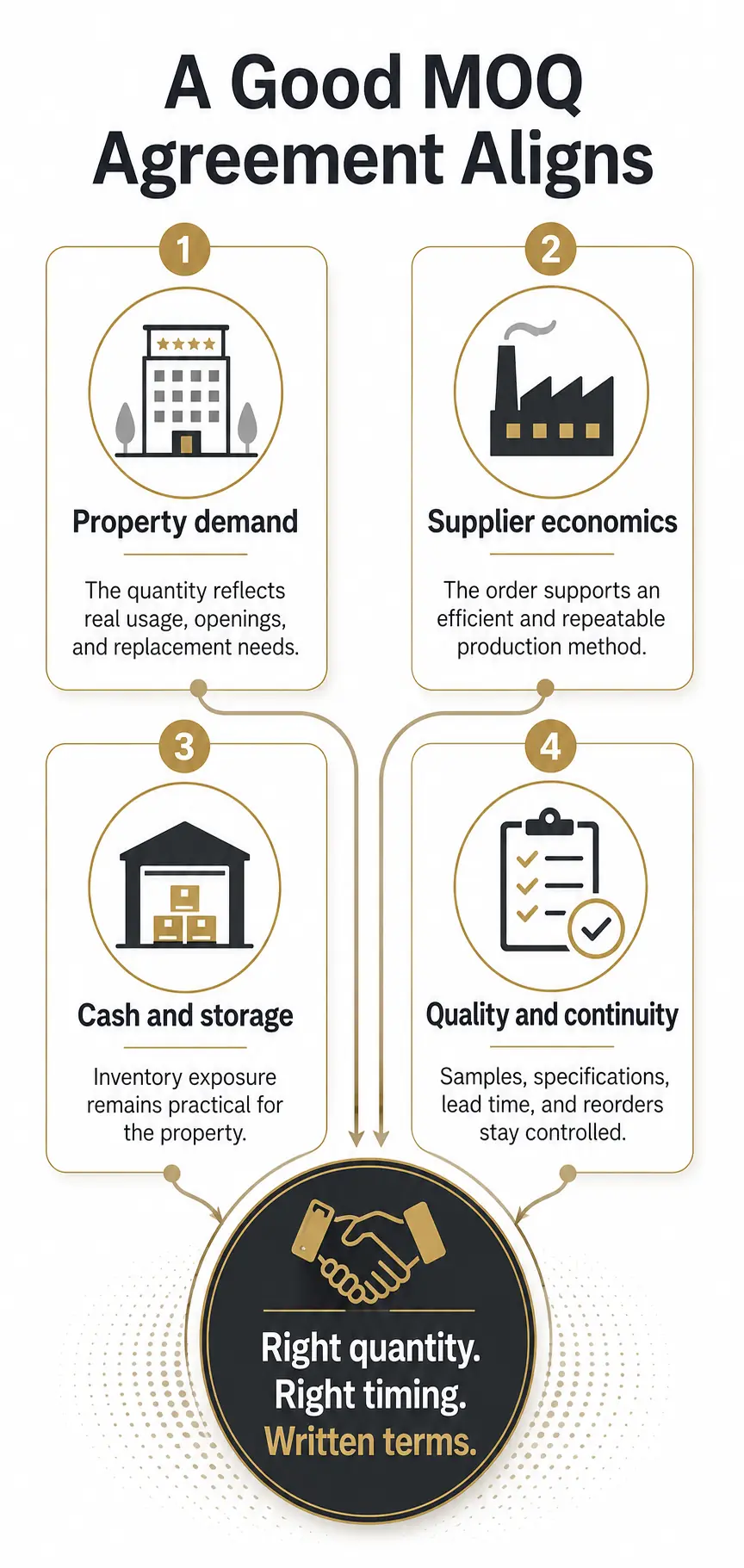
Before issuing a purchase order, confirm the product specification, unit of measure, variant matrix, pack multiple, price tier, setup and packaging charges, lead time, quantity tolerance, approved sample, delivery basis, and reorder terms. If the supplier’s threshold remains above the property’s useful quantity, change the product architecture, consolidate approved demand, use a stocked or semi-custom route, or select another supplier model. The strongest outcome is not the smallest MOQ; it is a quantity and commercial structure the hotel can defend, receive, use, store, and replenish without avoidable surprises.
Frequently Asked Questions
These questions address the MOQ issues that most often create confusion after a hotel receives a wholesale quotation but before the quantity, customization, and purchase terms are finalized.
What is a typical MOQ for wholesale hotel supplies?
There is no reliable universal number. MOQ varies by product, supplier model, stock status, material, production method, color or size split, packaging, branding, testing, and destination. Standard stocked products may be available by the case, while custom packaging, molds, finishes, furniture, textiles, or electronics may require larger production commitments. Ask for the minimum at every applicable level rather than relying on a category average.
Does MOQ apply to the total order or each SKU?
It can apply either way. Some suppliers accept a mixed total across a range; others require the minimum separately for every SKU, color, size, finish, or packaging design. The quotation should state the permitted mix and identify any variant-level minimums. Without that detail, a seemingly manageable total MOQ can multiply after the final assortment is selected.
Can a hotel order below the supplier’s MOQ?
Sometimes. The supplier may offer ready stock, a standard alternative, a semi-custom version, a higher unit price, a separate setup charge, neutral packaging, fewer variants, or a trial quantity. A sourcing partner may also identify another factory or consolidate demand. The lower-quantity route must still meet the required specification, quality controls, delivery schedule, and reorder plan.
Is the lowest MOQ always the best option?
No. A low MOQ may carry a higher unit cost, less efficient freight, weaker customization, different materials, limited production control, or uncertain replenishment. Compare total landed and lifecycle cost, sample quality, supplier capability, lead time, order multiples, stock continuity, and claims support. The best MOQ is the threshold that fits the property’s demand and risk profile, not simply the smallest number quoted.
How should a hotel calculate whether an MOQ is too high?
Compare the threshold with installed quantity or average monthly consumption, then add opening reserve and replacement or safety stock. Calculate months of cover for consumables, excess units for durable goods, total cash commitment, storage requirement, usable shelf life, and the time until a realistic reorder. Stress-test delayed opening, lower occupancy, product changes, and future phases. If the excess has no approved operational use, the MOQ is probably too high for the current structure.
What information should be included when asking for MOQ pricing?
Provide the exact product specification, estimated and preferred quantities, SKU or variant mix, customization, packaging, delivery destination, required-on-site date, sample requirements, quality or testing needs, and whether future phases or multi-property demand are approved. Request tiered pricing and ask the supplier to state MOQ by item, variant, packaging component, and total order, along with order multiples, setup charges, lead time, and reorder terms.
Can different hotel products be combined to meet one MOQ?
Only when the supplier confirms that the products share an eligible material, process, packaging run, or total-order value requirement. Different products from one catalog do not automatically belong to one production batch. Ask which components can be combined, which minimums remain separate, and whether consolidation changes price, lead time, quality control, or shipment planning.