
A reliable hotel supply company is not simply the vendor with the largest catalog or the lowest opening price. It is a company that can prove it understands commercial hospitality use, translates your requirements into measurable specifications, delivers the approved product within an agreed schedule, and resolves shortages or defects without disrupting hotel operations. For buyers in the United States, reliability also means clarity about where inventory is held, who is responsible for freight and final delivery, which documents support the product, and how warranty or replacement service will work after the invoice is paid. KW Hospitality supports commercial buyers with product sourcing and procurement coordination, but the same disciplined evaluation process should be applied to every potential supplier.
The safest approach is to begin with your property requirements, not with supplier marketing. Define the hotel type, room count, operating departments, product categories, quantities, quality level, delivery destination, opening or replacement date, and any brand, accessibility, safety, maintenance, or customization requirements. Then give each shortlisted company the same information and compare the responses on product fit, total delivered cost, production or stock availability, logistics, quality controls, service commitments, and evidence of past performance. A supplier that answers precisely and identifies assumptions is usually easier to evaluate than one that promises everything immediately.
This guide provides a practical decision process for independent hotels, branded properties, management companies, developers, restaurants, resorts, and procurement teams. It covers domestic distributors, manufacturers, sourcing partners, and companies that combine U.S. project support with global production. It also explains how to verify the business behind the website, evaluate hospitality experience, compare quotations fairly, approve samples, test a small order, and use a weighted scorecard before awarding a larger package. The goal is not to eliminate every supply-chain risk. It is to convert unknowns into documented requirements, checkpoints, and remedies before they affect guests, staff, budget, or opening dates.

Start With a Property-Specific Purchasing Brief
Supplier selection becomes much easier when every company is responding to the same purchasing brief. The brief should describe the property, intended commercial use, product scope, quantities, destination, required date, and acceptance requirements. It does not need to be long, but it must remove the assumptions that commonly produce noncomparable quotations. A bath towel for a limited-service hotel, a luxury resort, and a spa may share a generic product name while requiring different weights, dimensions, construction, finishes, laundering performance, packaging, and replenishment plans. The clearer the requirement, the more accurately a supplier can demonstrate fit and disclose exceptions.
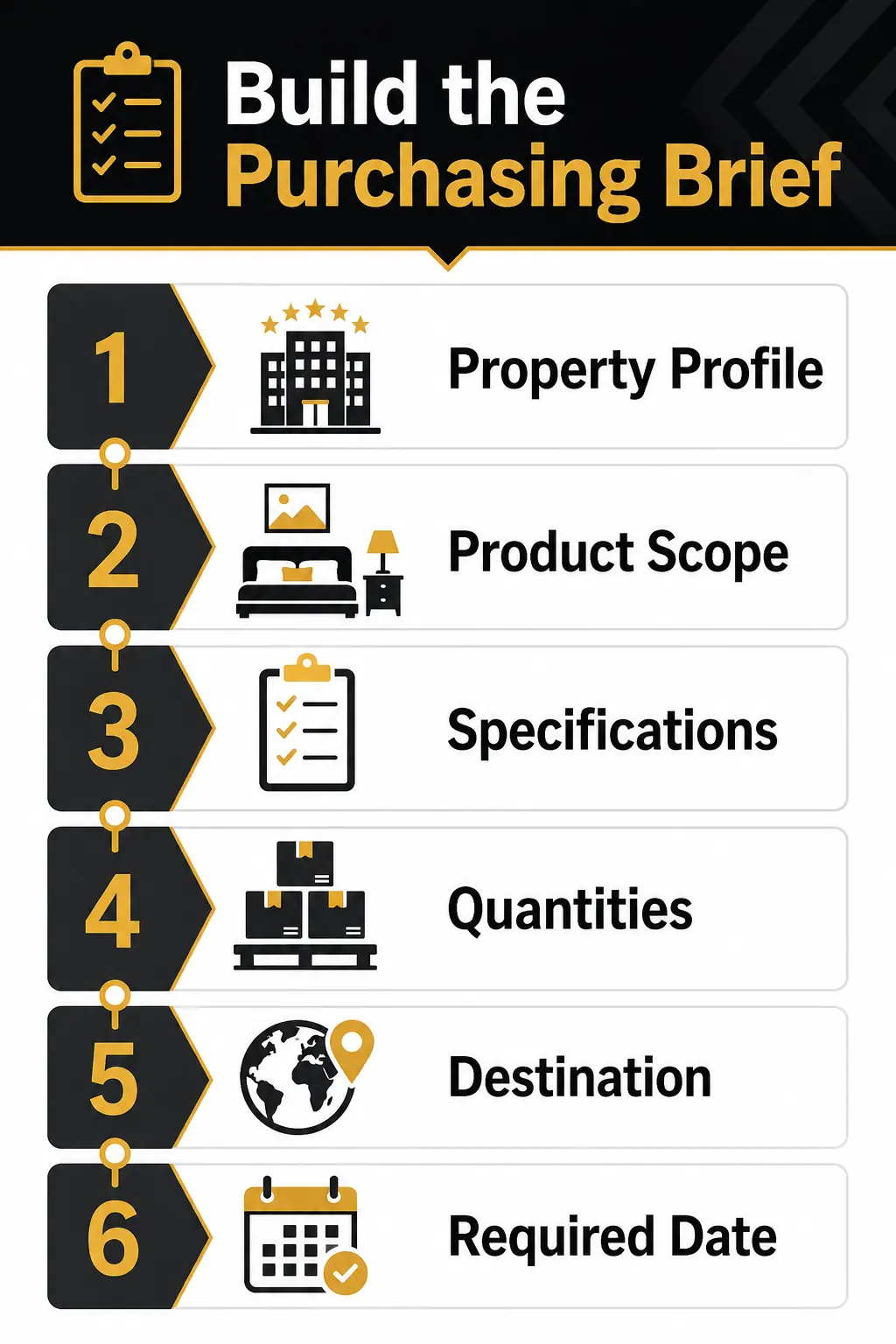
Begin by separating hotel FF&E and OS&E because the buying process, lead time, installation needs, and replacement cycle may differ. For each product line, state the function, dimensions, material, finish, performance requirement, unit of measure, case pack, quantity, spare quantity, and permitted alternatives. If the item must match a brand standard, existing room, utility connection, cart footprint, dishwashing system, or cleaning method, include that interface explicitly.
The commercial scope is equally important. State whether the requested price must include samples, artwork, tooling, packaging, freight, unloading, inside delivery, assembly, installation, training, spare parts, and removal of packing material. Identify the destination ZIP code, receiving restrictions, dock conditions, storage limitations, delivery phases, and the date by which the product must be available for inspection or staging—not merely the public opening date.
Use a structured hotel supply RFQ when the specification is sufficiently stable for suppliers to quote on a common basis. Ask every bidder to list assumptions, exclusions, minimum order quantities, lead-time triggers, offer validity, payment milestones, warranty terms, and proposed substitutions. A quotation that exposes an uncertainty is more useful than a low total that silently assumes a cheaper material or incomplete delivery scope.
Write measurable requirements instead of relying on terms such as premium, heavy duty, or hotel quality.
Use one line number and one unit of measure for every item so quantities and prices remain comparable.
Separate mandatory requirements from preferences and clearly state whether equivalents are allowed.
Define who will approve samples, commercial terms, logistics, and final acceptance before the RFQ is issued.

Build a Shortlist and Verify the Company Behind the Website
A polished website can help a buyer discover a supplier, but it is not proof of operating capability. Before requesting sensitive project information or paying for samples, confirm the legal business name, physical address, primary contacts, years of operation, ownership or authorized sales relationship, tax documentation, payment beneficiary, and the location of offices, showrooms, warehouses, service teams, and inventory. The purpose is not to create unnecessary paperwork. It is to establish that the company named on the quotation, contract, invoice, bank instructions, and warranty is the same entity you evaluated and that it can actually perform the promised scope.
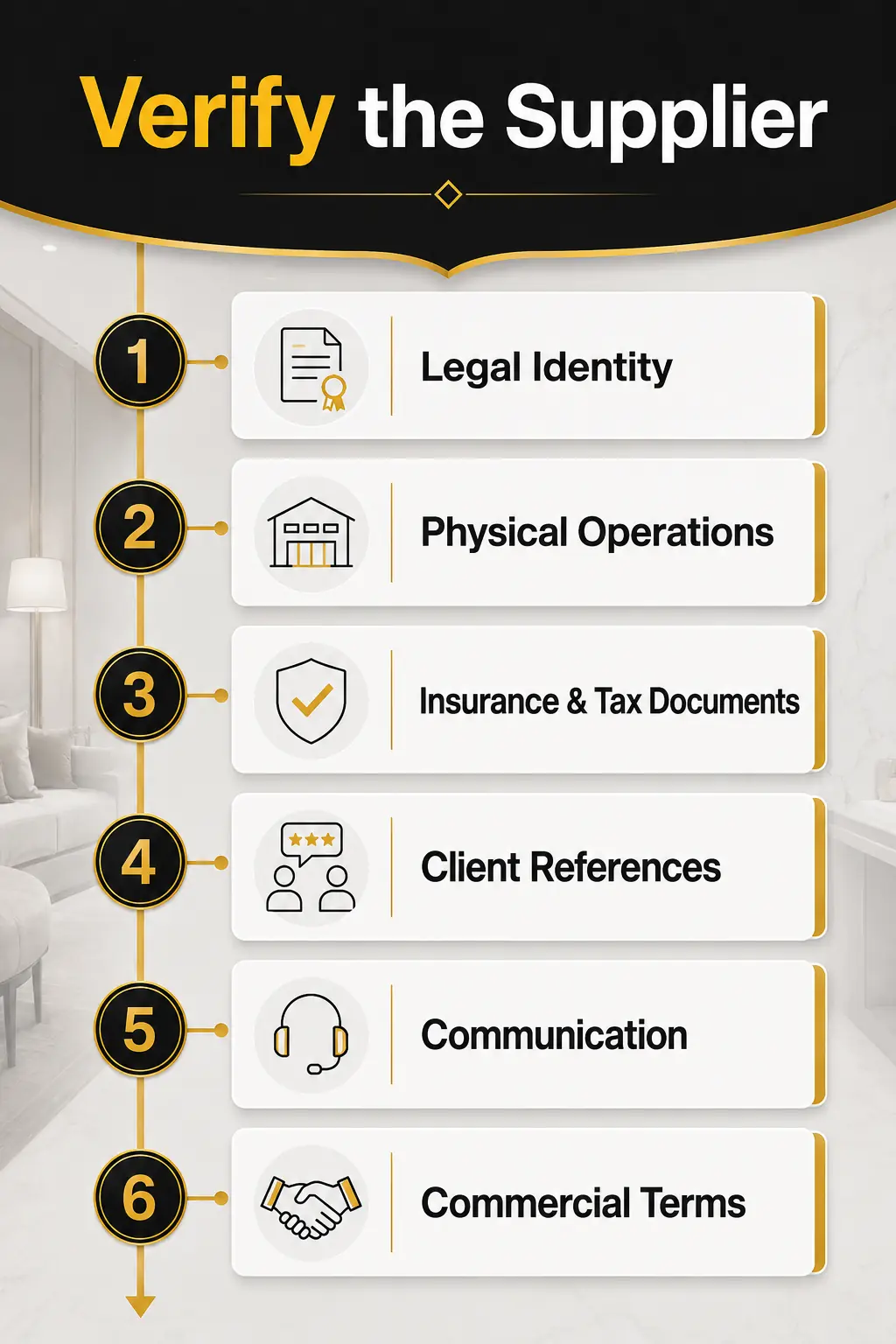
For a U.S. supplier, check the company record through the relevant state business registry and confirm that the legal name and status match the proposal. Request a current W-9 when appropriate, a certificate of insurance for the required coverage, and any licenses that genuinely apply to installation or regulated work. If the purchase involves a franchise, public entity, owner-mandated vendor program, tax-exempt organization, or federally funded project, additional onboarding or exclusion checks may be required. Do not treat one universal directory as proof for every private hotel purchase; verify what your own organization, contract, and jurisdiction actually require.
Verification should extend to the operating model. Some companies manufacture; some distribute stock; some represent factories; some coordinate sourcing, inspection, freight, and delivery; and others subcontract most activities. None of these models is automatically unreliable, but the buyer should know who owns each responsibility. Ask where the quoted product is manufactured, where it is stocked, who performs quality inspection, who arranges freight, who bears risk at each delivery point, and who handles claims in the United States.
Confirm payment instructions through a known contact using a second communication channel before sending funds, especially when bank details change. Use purchase orders and written contracts that identify the legal entity, products, quantities, approved sample or specification, price basis, payment milestones, delivery term and location, inspection rights, warranty, claims procedure, cancellation rights, and remedies. A reliable company should welcome precise documentation because it protects both parties.
Be cautious when the legal name, email domain, invoice entity, and bank beneficiary do not match and the differences are not clearly explained.
Treat copied catalog images, unverifiable addresses, pressure for immediate full payment, or refusal to provide a written quotation as red flags.
Verify references by contacting the client directly and asking about scope, date, delivery performance, claims, and repeat orders.

Test Hospitality Experience and Product-Category Fit
General business experience is useful, but hotel procurement requires category-specific judgment. A company may be excellent at selling residential products and still misunderstand commercial cleaning cycles, guest safety, housekeeping labor, food-contact use, replacement parts, brand approvals, or the wear created by continuous occupancy. Ask the supplier to explain how the proposed item performs in the exact environment where it will be used. Strong answers connect materials and construction to operating conditions, identify limitations, and propose a verification method rather than relying on broad claims such as contract grade or five-star quality.
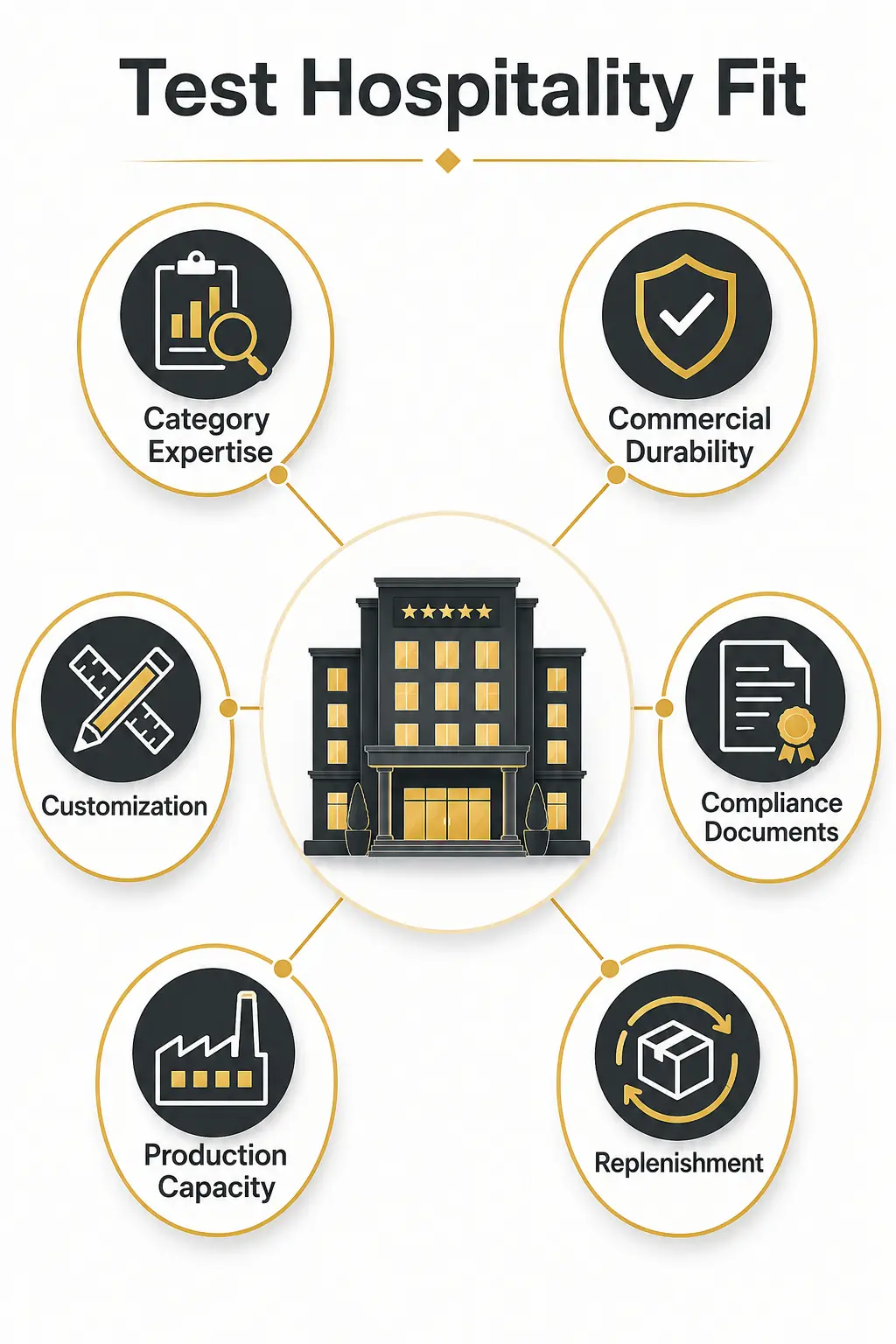
Request examples of comparable work by property type, scale, product category, customization level, delivery geography, and project phase. A reference for a small local replenishment order does not prove the capacity to coordinate a multi-property opening package. Conversely, a large project logo does not prove that the company supplied your specific category or managed the full scope. Ask what the supplier actually provided, which services it performed, whether the delivery was phased, and whether the client reordered.
Category fit also includes documentation. Depending on the product, buyers may need material declarations, care instructions, technical data, test reports, electrical information, food-contact documentation, accessibility dimensions, flammability evidence, safety certifications, country-of-origin data, or installation requirements. The correct documents vary by item and use. Ask the supplier to identify the applicable requirement and provide the product-specific evidence before award, not a generic certificate with no connection to the quoted model.
Evaluate production or stock capacity against your schedule. For stocked goods, confirm available quantity, reservation rules, replenishment frequency, and whether the exact model may change. For made-to-order goods, confirm raw-material availability, sample timeline, production capacity, quality checkpoints, peak-season constraints, and the event that starts lead time. If customization is required, clarify artwork ownership, color standards, tolerances, tooling, approval stages, and the cost of revisions.
Finally, test whether the company can support replacement purchases after opening. Hotels rarely replace an entire category at once. Ask about minimum reorders, smaller case packs, spare components, approved substitutes, record retention, color continuity, and the expected commercial life of the model. A slightly higher-priced product may be the better choice if it remains identifiable, repairable, and replenishable.

Compare Quotations on Total Delivered Value
A fair supplier comparison uses a common commercial baseline. Unit price matters, but it is only one component of delivered value. A low quotation can become expensive after sample fees, molds, custom packaging, freight, fuel or accessorial charges, duties, taxes, warehousing, installation, replacement stock, and claims are added. It can also create operational cost if the product wears quickly, arrives in inconvenient case packs, needs more labor to clean, or cannot be replaced in small quantities. Require each supplier to price the same scope and show every exclusion so the evaluation team can normalize the offers.
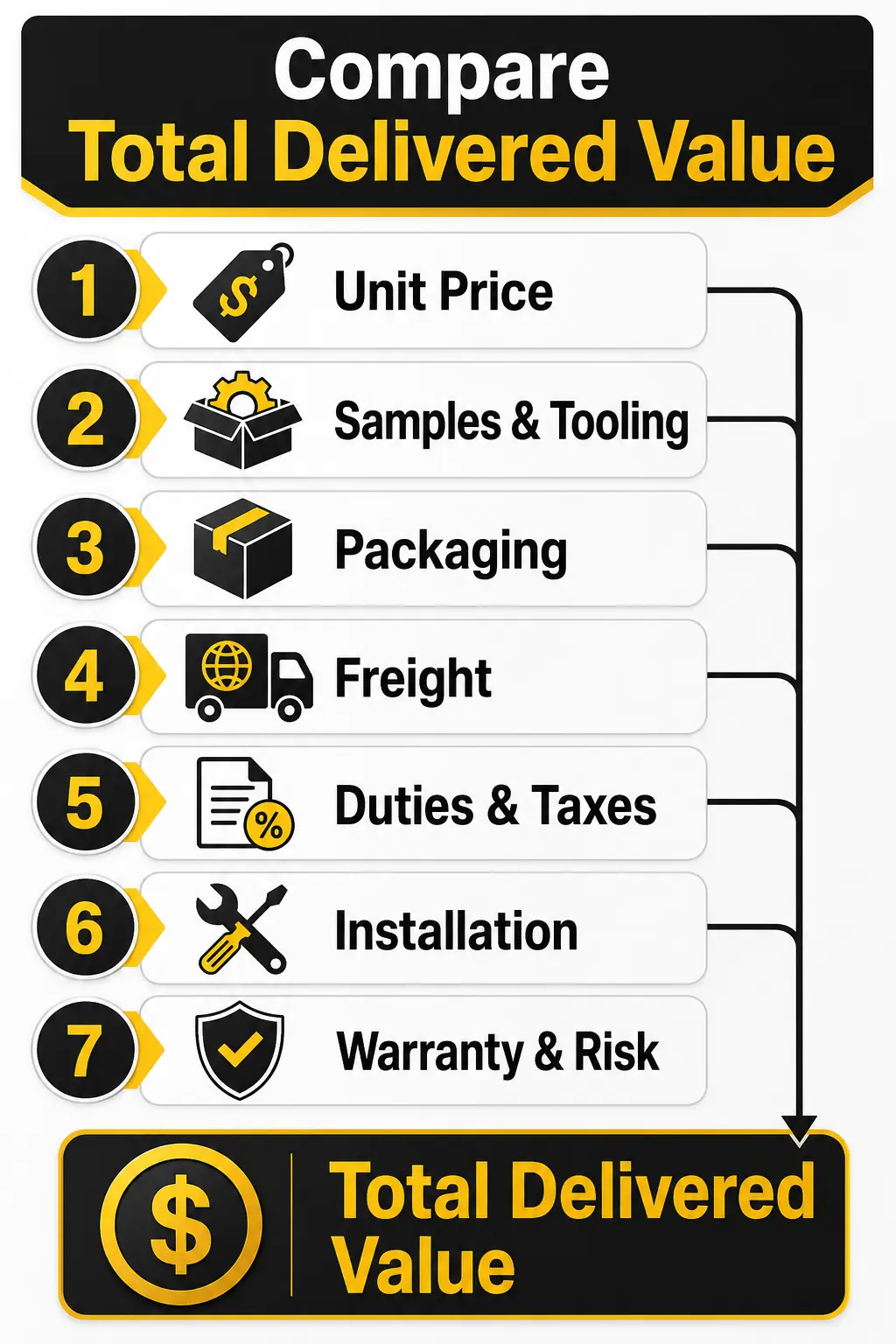
Create a comparison sheet with one row per item and separate columns for unit price, quantity, extended price, sample or tooling costs, packaging, freight, duties or taxes if included, inside delivery, installation, spare parts, and other one-time charges. Record the delivery term and named location exactly. For imported goods, identify who acts as importer, who prepares documents, who clears customs, when risk transfers, and whether the quotation is port-to-port, door-to-door, or something in between. Do not compare a warehouse pickup price with a delivered-and-installed price as if they were equivalent.
Commercial terms should be evaluated alongside cost. Compare deposit, progress payments, balance trigger, retainage where applicable, offer validity, cancellation terms, storage charges, late-delivery remedies, warranty start date, claim deadlines, return restrictions, and credit terms. Payment milestones should correspond to verifiable progress, such as approved sample, completed inspection, shipment, or accepted delivery. Avoid using price alone to justify terms that concentrate most of the risk with the buyer before the supplier has performed.
Lead time must also be normalized. Ask for separate durations for specification review, sample development, approvals, production or allocation, inspection, export preparation, transit, customs, final delivery, and installation. Require the quotation to state what starts each clock. A promise of eight weeks is incomplete if the supplier counts from an approval that may itself take several weeks or excludes transportation.
Finally, compare lifecycle value. Estimate expected service life, cleaning and maintenance needs, consumable parts, energy or water use where relevant, repairability, warranty coverage, and replacement availability. Use ranges rather than false precision when future cost is uncertain. The purpose is to make the tradeoff visible: a more durable or serviceable product may justify a premium, while an expensive feature that adds no operational benefit should not receive automatic credit.

Validate Quality, Logistics, and After-Sales Support
Reliability should be tested before the full order is exposed to risk. Approve a physical sample, mock-up, finish chip, prototype, or first article that represents the intended production. Record the approved item with photographs, dimensions, materials, color reference, construction details, labeling, packaging, and dated signatures or digital approval. A sample is not useful when the quotation allows the supplier to substitute materials later without notice. The purchase order should connect the approved reference to production and define how deviations will be reviewed.
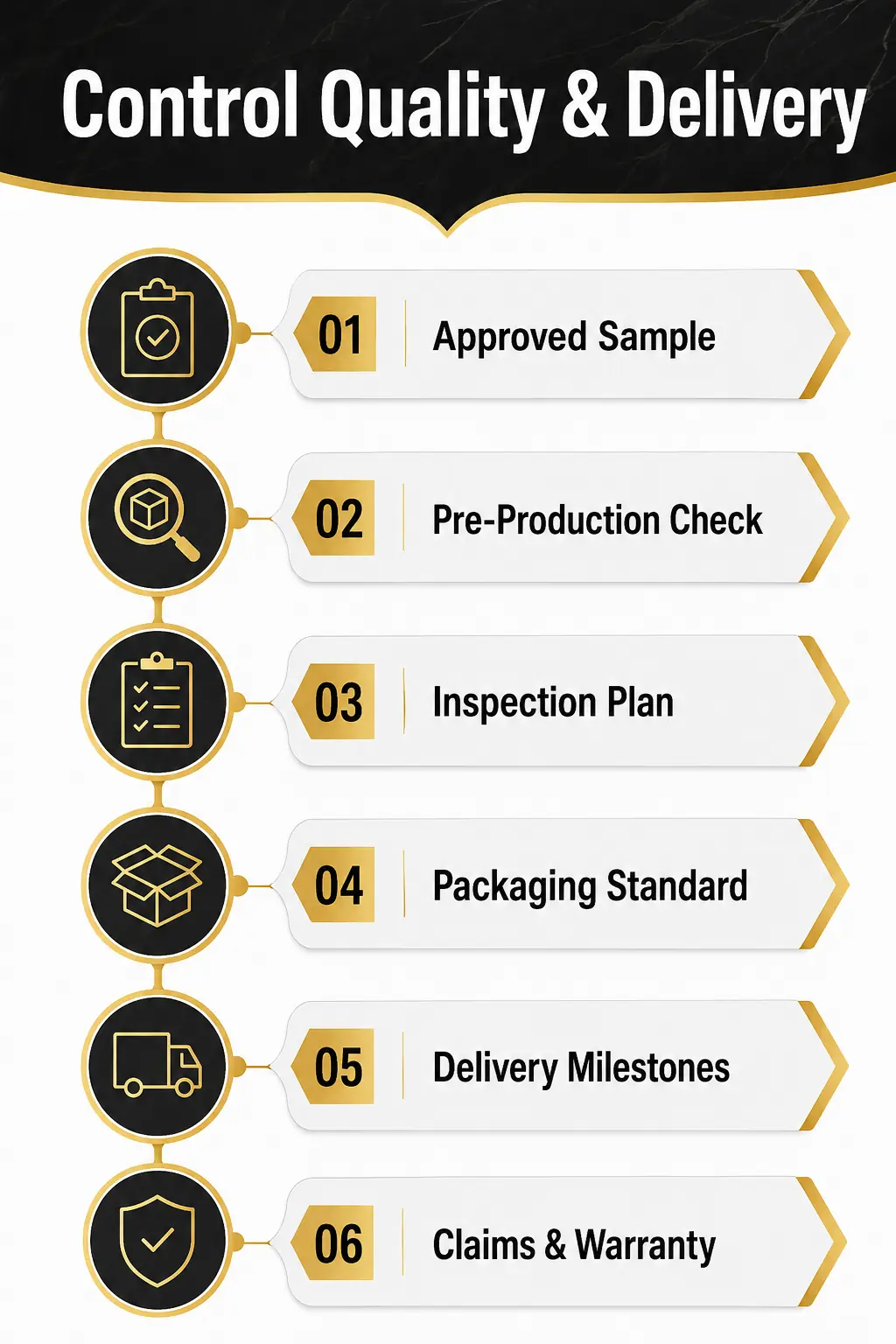
Build a quality plan around the failure modes that matter to the hotel. For linens, this may include dimensions, weight, stitching, shade consistency, laundering performance, shrinkage, and packaging. For carts, it may include capacity, wheel performance, noise, braking, stability, finish, clearances, and replacement parts. For furniture, it may include dimensions, joinery, finish samples, hardware, upholstery, load performance, and installation readiness. Define tolerances, sampling method, inspection stage, evidence required, and disposition for nonconforming goods.
Logistics capability should be checked with the same precision. Confirm origin, consolidation plan, pallet and carton configuration, carton markings, packing list format, freight provider responsibilities, insurance, shipment tracking, receiving appointment process, liftgate or dock needs, inside-delivery scope, storage, installation sequencing, and handling of split shipments. When planning hotel opening supplies, allow time for receiving, counting, inspection, room or department distribution, assembly, commissioning, and corrective action before the product is needed in live service.
A broader hotel opening supply plan should connect supplier milestones to construction, operating readiness, storage capacity, and department training. A delivery can be technically on time yet operationally late if it arrives before a loading area is available, after the installation team has left, or without the components needed for testing.
After-sales support must be measurable. Ask for the warranty duration and start event, exclusions, response target, documentation required for a claim, responsibility for return freight, availability of replacement parts, repair options, and the process for shortages or concealed damage. Identify a claims contact and escalation path. For mission-critical equipment or frequently damaged items, consider backup stock, alternate approved sources, and a service-level commitment rather than relying on a general promise to help.

Use a Weighted Scorecard, References, and a Pilot Order
A weighted scorecard makes the selection logic visible before competing quotations create pressure to favor a familiar name or the lowest price. Set the criteria and weights before final bids are opened, then score every supplier against the same evidence. The model below gives product and quality the largest weight, followed by delivery, logistics, and total cost. Those weights are suitable for many hotel supply purchases, but they should be adjusted for the category. A replacement amenity order may emphasize availability, while custom guestroom furniture may require greater weight on samples, engineering, production control, and installation.
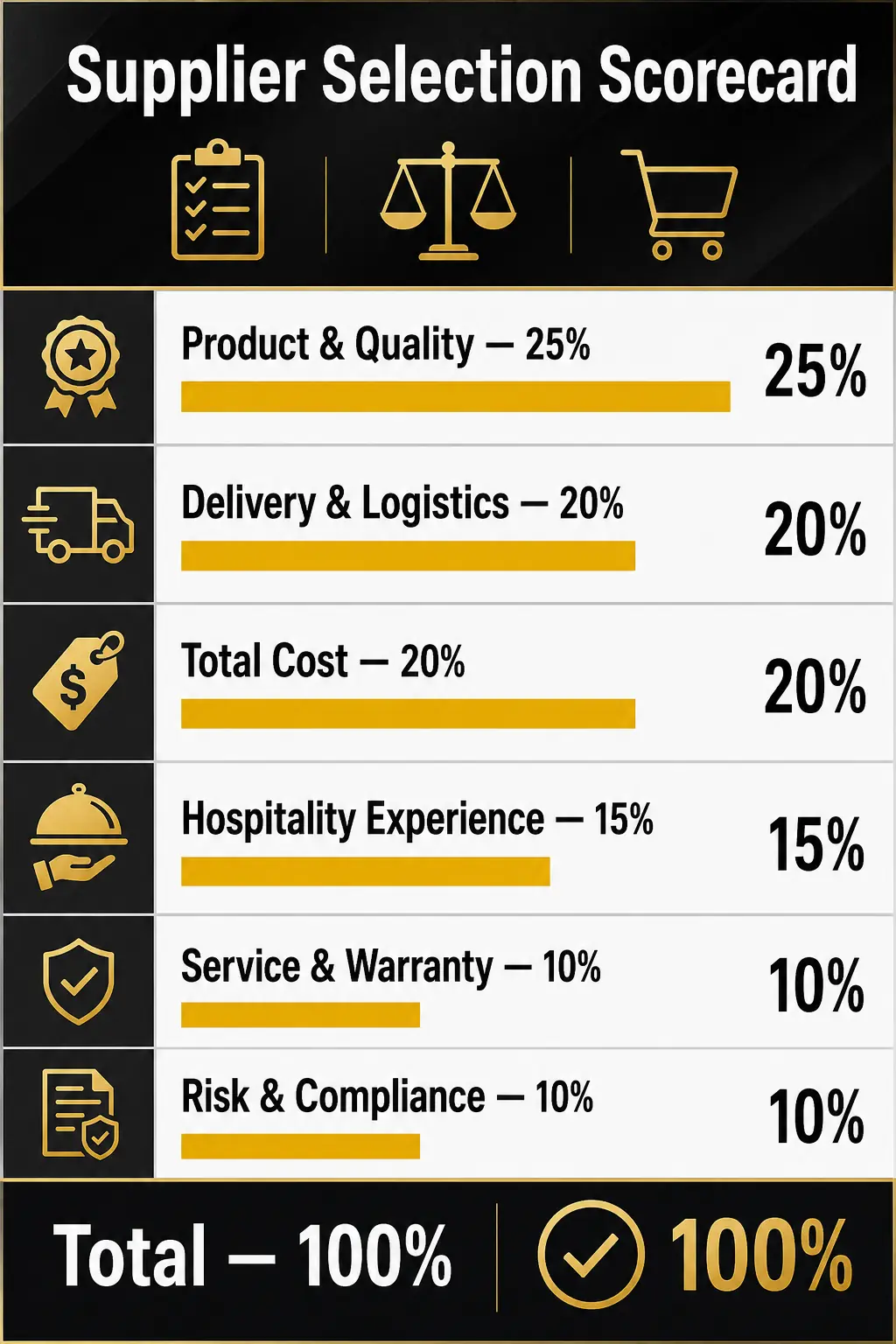
Require a short written reason for every score and keep the supporting document, sample result, reference note, or quotation field with the evaluation record. A score without evidence becomes opinion. Also establish nonnegotiable gates that a weighted average cannot overcome. Examples include an unresolved legal identity, failure to meet a mandatory specification, unacceptable sample, missing required insurance, impossible delivery date, prohibited substitution, or refusal to accept essential contract terms.
| Criterion | Weight | Evidence to Review | Scoring Prompt |
| Product and quality | 25% | Approved sample, specification match, durability, defect controls | 1 = material gap; 5 = fully verified |
| Delivery and logistics | 20% | Lead-time basis, inventory model, freight scope, milestones | 1 = uncertain; 5 = documented and resilient |
| Total delivered cost | 20% | Unit price, packaging, freight, duties, installation, lifecycle cost | 1 = opaque/high risk; 5 = complete and competitive |
| Hospitality experience | 15% | Comparable properties, category expertise, commercial-use knowledge | 1 = generic; 5 = directly comparable |
| Service and warranty | 10% | Response times, claims process, replacement parts, warranty terms | 1 = unclear; 5 = measurable commitments |
| Risk and compliance | 10% | Legal identity, insurance, documents, capacity, continuity | 1 = unresolved; 5 = low residual risk |
Use the editable workbook below to compare up to three shortlisted suppliers, record evidence, calculate weighted totals, and preserve the rationale for the award decision.
References should be verified through direct conversations, not accepted as a list of names. Ask the former client what was purchased, the approximate scale, whether the product matched the approved sample, whether delivery dates were met, how shortages or defects were resolved, and whether the client ordered again. Look for answers that describe both strengths and limitations. A supplier that has never encountered a claim may simply be offering an incomplete picture.
When the risk or order value is material, place a pilot order or controlled first phase. Use normal specifications, packaging, communication channels, payment controls, and receiving procedures so the test reflects the future relationship. Measure response time, document accuracy, sample-to-production consistency, packing quality, delivery performance, damage rate, claim handling, and user feedback. Do not allow a successful hand-delivered sample to substitute for testing the ordinary fulfillment process.
After award, turn the evaluation into supplier management. Record on-time-in-full delivery, defect and damage rates, response times, claim closure, price variance, substitutions, documentation accuracy, and internal user satisfaction. Review results on a schedule appropriate to the spend and operational risk. Strong suppliers should earn more business through measured performance, while recurring problems should trigger corrective action, reduced exposure, a second source, or replacement.
If your hotel, resort, restaurant, or development project needs coordinated hospitality products, prepare the purchasing brief and submit a detailed RFQ with quantities, specifications, destination, required date, reference images, and any customization needs. A complete request allows the sourcing team to evaluate product fit, commercial feasibility, quality controls, and delivery options more accurately.

Conclusion
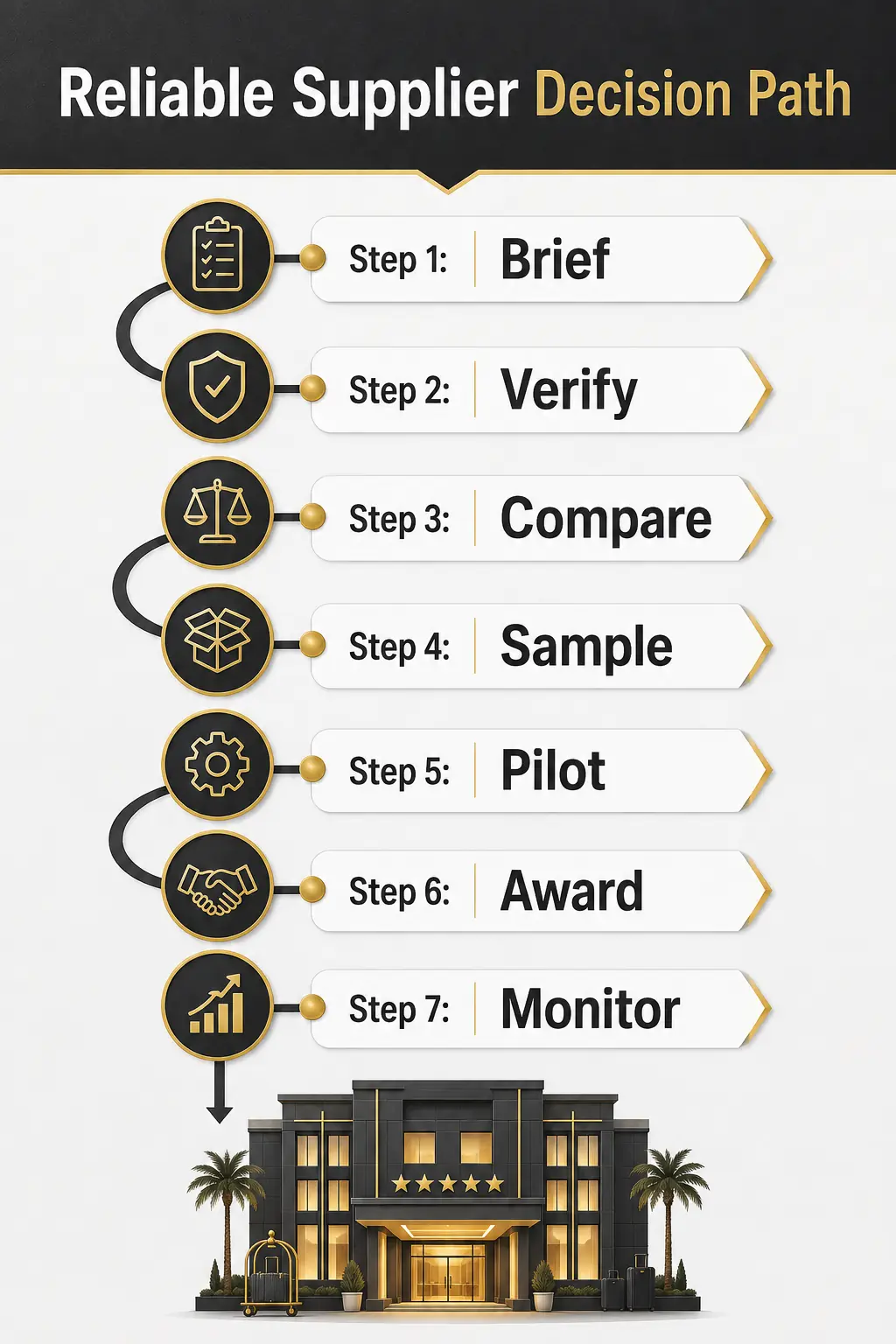
Finding a reliable hotel supply company in the USA is a verification and risk-control process, not a search for the most persuasive website. Start with a property-specific brief, confirm the legal and operating entity, test hospitality and product-category experience, compare total delivered value, approve the product standard, document quality and logistics checkpoints, and evaluate after-sales support. Then use a weighted scorecard, direct references, and a pilot order to convert claims into evidence. This sequence helps procurement teams protect specifications, opening schedules, operating continuity, and guest experience without making price irrelevant.
The strongest supplier relationship is one in which responsibilities are clear before the order and performance is measured after delivery. Keep the purchasing brief, approved sample, quotation comparison, contract terms, inspection records, receiving results, claims, and scorecard together. Update the record when products, ownership, warehouses, production sites, service contacts, or logistics conditions change. Reliability is not a permanent label; it is a pattern of documented performance that should be reviewed throughout the relationship.
For larger projects, avoid concentrating every category with one company merely for convenience. Consolidation can reduce coordination and freight cost, but category specialists, local replenishment sources, or backup suppliers may reduce operational risk. Choose the sourcing model that fits the property, category, schedule, and consequences of failure. A disciplined selection process gives the hotel a defensible award decision and gives the supplier a clear standard it can actually meet.
Frequently Asked Questions
The questions below address common situations that arise after a buyer has created a shortlist but before a final supplier award is made.
How many hotel supply companies should I compare?
For a routine, well-specified purchase, three qualified quotations often provide a useful comparison. Complex or unfamiliar categories may need a wider initial market scan followed by a shortlist. The correct number depends on value, urgency, category risk, and the time required to evaluate samples and terms. Do not invite more suppliers than the team can assess consistently.
Is it safer to buy only from a company with a U.S. warehouse?
A U.S. warehouse can shorten replenishment time and simplify returns, but it does not by itself prove product quality, stock availability, or service performance. Global production with strong U.S. project support can also work well. Verify the exact inventory location, ownership, reservation rules, delivery scope, claim process, and replacement plan for the quoted product.
Should I choose the lowest hotel supply quote?
Choose the lowest evaluated cost only after confirming that specifications, quantities, delivery scope, quality controls, payment terms, warranty, and timing are equivalent. A low unit price may exclude freight, installation, packaging, duties, spare parts, or risk. Normalize the quotations and document any premium paid for measurable advantages.
What documents should a hotel supplier provide?
The required documents depend on the company, product, service, and jurisdiction. Common business documents may include a written quotation, legal entity and tax information, insurance evidence, references, product specifications, care instructions, warranty terms, and relevant product-specific test or compliance records. Request only documents that connect to the actual purchase and verify their scope and validity.
When is a pilot order worth the extra time?
Use a pilot when the order is large, customized, operationally critical, difficult to return, or supplied by a new company. It is especially valuable when packaging, delivery coordination, installation, repeated laundering, heavy guest use, or after-sales response matters. Define success measures before the pilot so a visually attractive sample does not become the only acceptance test.
How often should supplier performance be reviewed?
Review frequency should match spend and operational risk. Critical equipment, high-volume consumables, opening projects, and suppliers with active corrective actions may need monthly or milestone reviews. Stable low-risk categories may be reviewed quarterly or annually. Reevaluate sooner after ownership changes, recurring defects, missed deliveries, unexplained substitutions, warehouse changes, or significant price increases.