
A hospitality property is ready for a bedding and bed linens order when the proposed products fit the actual beds, can reach the rooms, can be laundered and stored correctly, and allow staff to make and clean the beds safely. Approve those conditions before releasing dimensions or quantities for production. A room plan and a fabric sample are useful starting points, but neither proves that the complete bedding arrangement will work after delivery.
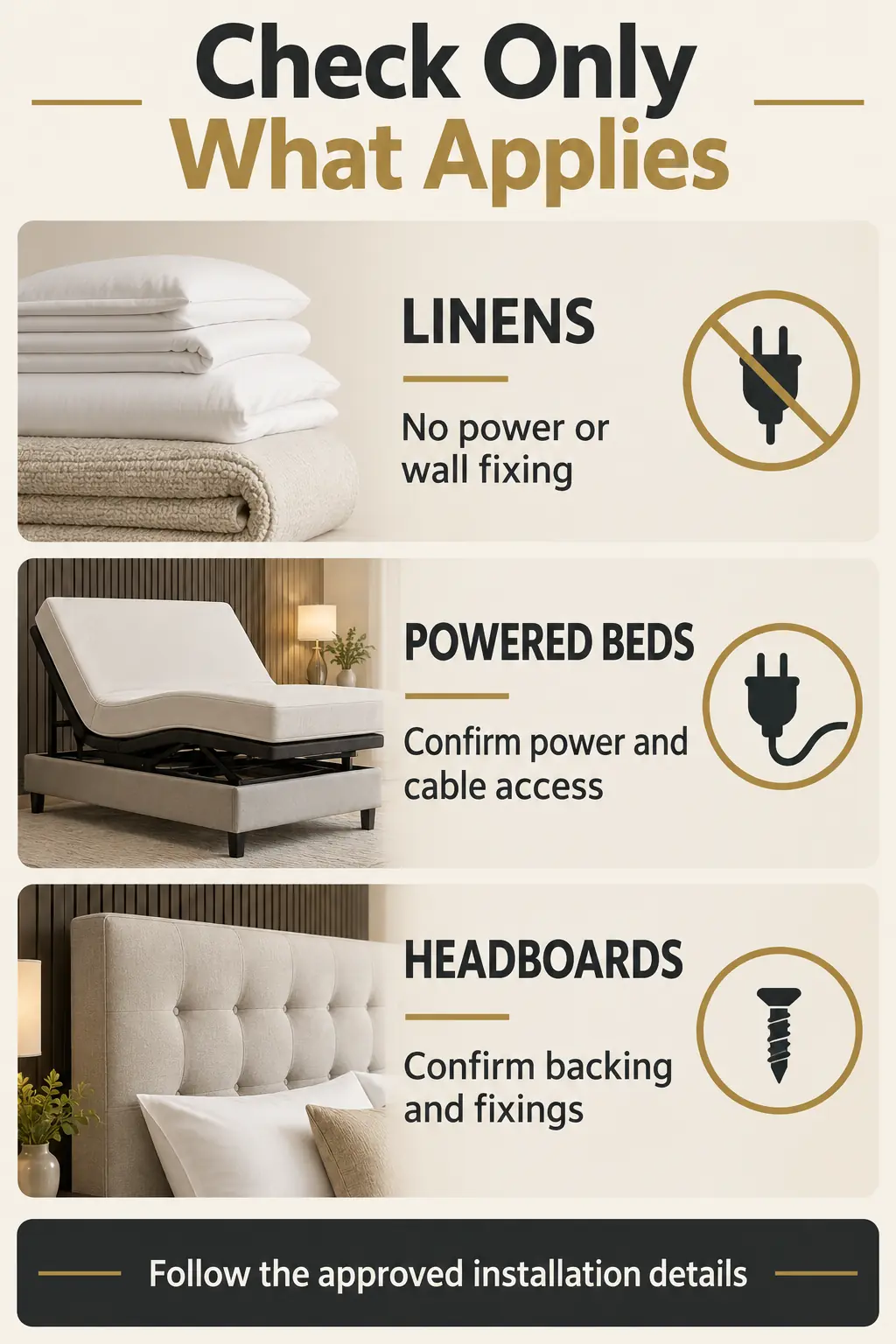
The scope matters. Ordinary sheets, pillowcases, duvet covers, blankets, and mattress protectors do not require electrical connections or wall mounting. Utilities and mounting details become relevant when the purchase includes powered bed bases, fixed headboards, bedside lighting, or associated furniture. Laundry utilities belong to the property’s processing operation. Keeping these interfaces explicit prevents a textile purchase from inheriting undefined construction responsibilities and prevents genuine installation requirements from disappearing between suppliers.
This checklist is intended for hotel procurement teams, opening managers, designers, engineering staff, and housekeeping leaders preparing a new opening, renovation, or replacement program. It focuses on site readiness rather than thread count, fabric selection, or supplier price ranking. Use one record for each materially different room and bed configuration, and identify exceptions instead of assuming that every room matches the model room.
Start with the approved bed schedule, supplier dimensions, packaging information, room drawings, and laundry process. Then confirm the finished site, dress a representative bed, and document the remaining decisions. The practical output is a release record: what was checked, what evidence supports acceptance, who owns any correction, and which revision the supplier should follow. The complete checklist below is also available in editable and printable formats so that the same requirements can follow the order from review to receiving. Project-specific accessibility and installation requirements must be verified for the actual property and products.

Verify Room Dimensions and the Delivery Route
Measure the space the finished bed will occupy and the route the delivered product will travel. Room area alone cannot establish fit: headboard projections, frame overhangs, bedside furniture, door swings, and a bench can consume the usable clearance around a bed. Likewise, a mattress that fits the room may arrive in packaging that cannot negotiate the service elevator or a corridor turn. Record actual measurements with units and fixed reference points, then compare them with the supplier’s dimensions and the approved room layout. Include the most constrained representative room, not just the largest or best-finished model room, before accepting a common configuration across the property.

Measure the complete furniture footprint
Capture finished wall-to-wall dimensions where the bed and casegoods sit. Note columns, skirting, curtains, heaters, floor transitions, and any wall that is out of square. Measure the frame at its widest and longest points rather than substituting the mattress size. Confirm the headboard width and projection separately, especially when it spans bedside tables.
For an initial dimensional check, subtract the overall bed-frame width and the space occupied by furniture or other obstructions from the available room width. The remainder is only the total space available across the sides; it does not prove that either individual side meets the layout requirement. Measure each side and the foot of the bed in the furnished room. Open connecting doors, wardrobe doors, and drawers during the trial.
In US guest rooms required to provide mobility features, sleeping-area clear floor space and turning space need a specific accessibility review. A permitted arrangement between two beds differs from clearance on both sides of one bed. Preserve the approved accessible layout and have the responsible reviewer verify the furnished condition. Do not treat a housekeeping preference or a generic bedside dimension as a universal compliance rule.
Trace delivery from unloading to placement
Ask for packaged dimensions and weight for the actual shipping method. A flat mattress, a compressed mattress, a split foundation, and an assembled frame have different handling constraints. Confirm any manufacturer restrictions on folding, bending, compression time, unpacking, and recovery before planning a tight delivery route.
Record loading arrangements, booking hours, clear door openings, elevator door and cab dimensions, rated elevator capacity, corridor turns, and the room entrance. The route must accommodate the load, handling equipment, and people together. Where a turn remains uncertain, arrange a physical template or trial delivery using the proposed package geometry rather than relying on a diagonal calculation alone.
Confirm clean, dry staging space and the removal route for packaging and replaced items. During phased renovation, separate the delivery operation from occupied guest circulation. Include an exception list for rooms with different access conditions and give the logistics provider the approved handling plan before dispatch.
Assign the boundary between supply and installation
Specify who unloads, moves, assembles, positions, unpacks, removes waste, and checks damage. For a mixed purchase, the distinction between furniture and operating supplies should appear in the responsibility schedule; the hotel FF&E and OS&E guide provides broader context for that coordination. A linen supplier should not silently become responsible for moving an existing bed or correcting a wall condition.

Confirm Bed Dimensions and Linen Fit After Laundering
Approve linen sizes against the complete sleeping arrangement, including any protector and topper, and verify the result after the intended laundering process. Labels such as queen or king are not sufficient specifications for an international purchase or a property with mixed mattress models. Record the actual width, length, and total covered depth, then identify the fitted-sheet construction, flat-sheet tuck, duvet relationship, and pillow dimensions needed for the chosen bed presentation. A sample that looks correct before washing can become difficult to fit after processing. The release decision should therefore connect measured dimensions, agreed tolerances, and a practical bed-making trial using representative processed samples.

Build a bed and linen matching schedule
Give each combination a stable identifier that links room type, frame, mattress, topper, protector, sheet, duvet insert, duvet cover, pillow, and pillowcase. Record dimensions in one primary unit system, with clearly labeled conversions where needed. Do not combine supplier measurements in inches and millimeters without checking the conversion and tolerance.
Measure the depth the fitted sheet actually covers. Include the protector and topper as used; exclude the base or foundation unless the linen is designed to enclose it. A stated pocket depth may describe construction rather than a guaranteed usable mattress-depth range. Ask the supplier to define the term, and trial the elastic, corner retention, and underside engagement on the selected bed.
For flat sheets, record the intended side coverage and tuck rather than choosing by name alone. For duvet covers, verify the insert’s dimensions, closure position, and any corner ties. For pillowcases, confirm both pillow size and closure allowance. Check bed-skirt drop separately from sheet depth so the fabric does not drag on the floor or catch moving components.
Specify an acceptance condition after processing
Agree the sample identity, wash and dry method, number of trial cycles, conditioning before measurement, dimensional tolerance, and required fit result before testing. Use the process planned for the property or contracted laundry. Do not select a hotter or harsher cycle merely to accelerate the trial if it no longer represents the approved care process.
Measure length and width separately before and after the trial. Dimensional loss percentage equals the original dimension minus the processed dimension, divided by the original dimension, multiplied by 100. As an illustrative calculation, a sample that changes from 100 inches to 97 inches has lost 3% in that direction. That example is not a predicted shrinkage rate or an acceptance limit.
If the required processed width were 100 inches and a verified directional loss were 3%, the calculated starting width would be 100 divided by 0.97, or about 103.1 inches, before any separately agreed manufacturing allowance. Use that calculation only as a planning check. Fabric behavior, seams, elastic, finishing, and repeat processing still require a physical sample and written supplier agreement.
Check the final sleeping height and presentation
Measure finished sleeping height from the finished floor to the top of the dressed sleeping surface using an agreed method. A replacement mattress or added topper can change guest transfer conditions, the relationship to bedside tables, and staff reach even when the bed footprint is unchanged. Ask the relevant reviewer to reassess affected accessible arrangements and controls.
Have housekeeping make the bed, strip it, and remake it with the processed sample. Record lifting, pulling, corner release, and excess fabric as observations rather than relying on appearance alone. If the fit is unresolved, contact KW Hospitality about the bedding specification with the bed schedule, measured dimensions, and trial findings before confirming bulk quantities.

Resolve Utilities and Mounting Details for Associated Equipment
Treat utilities and mounting as conditional checks tied to named equipment. A linen-only order can mark these items not applicable after confirming that no powered or fixed component is included. When the project also replaces bed bases, headboards, or bedside fixtures, engineering and the installer should review the actual model and the finished room together. The aim is to establish compatible power, supported fixings, protected cable routing, and practical service access before production or installation. Generic notes such as standard outlet or suitable wall are too vague to allocate responsibility. Record the controlling installation detail, the responsible trade, and the condition that must be satisfied before work proceeds.
Map power and service access
For powered bases or integrated equipment, obtain the manufacturer’s electrical requirements and installation instructions for the destination market. Have the responsible electrical professional verify the supply, connection, protection, outlet position, and any circuit work. An adapter or extension lead should not be assumed to resolve an incompatibility in the specification.
Review the equipment through its full intended movement. Cables must avoid pinch points and remain accessible for the approved isolation and service method. Check that a thicker mattress, headboard, or relocated table does not obstruct controls or outlets. Include the equipment removal path: maintenance access is incomplete if servicing requires uncontrolled dismantling of unrelated furniture.
Ordinary bedding does not need water or drainage in a guest room. If the project includes new on-site laundry machinery, its water, drainage, electrical or fuel supply, exhaust, ventilation, and maintenance requirements need a separate equipment review. For replacement linens processed by an existing laundry, confirm that the proposed product fits the existing approved workflow and capacity; do not infer that new plant connections are necessary.
Verify wall construction before selecting fixings
For a fixed headboard, identify the actual wall build-up, structural backing, bracket arrangement, finished height, and any concealed services. The installer must match the fixing method to the product load, substrate, and approved detail. A decorative finish or an apparently solid panel does not prove adequate support.
Confirm who supplies brackets and fasteners, who installs backing, who checks alignment, and who repairs finishes. Record any fire-rated or acoustically sensitive assembly that requires an approved penetration detail. Do not prescribe generic anchor sizes or drill depths without product and site information.
Check the relationship between headboard edges, reading lights, switches, bedside tables, and the finished mattress height. Review gaps and movement with the actual product configuration. A drilling template is useful only if it matches the current bracket revision and the verified mounting position.
Separate a supplier query from authority to proceed
A missing detail should remain an open question with an owner and due date. A supplier’s commercial quotation does not approve a structural or electrical condition. If production depends on the answer, hold the affected item until the responsible party issues the decision. Use the wider pre-purchase site review for guest room supplies when the same unresolved interface affects several product categories.

Test Housekeeping Access and Complete the Readiness Checklist
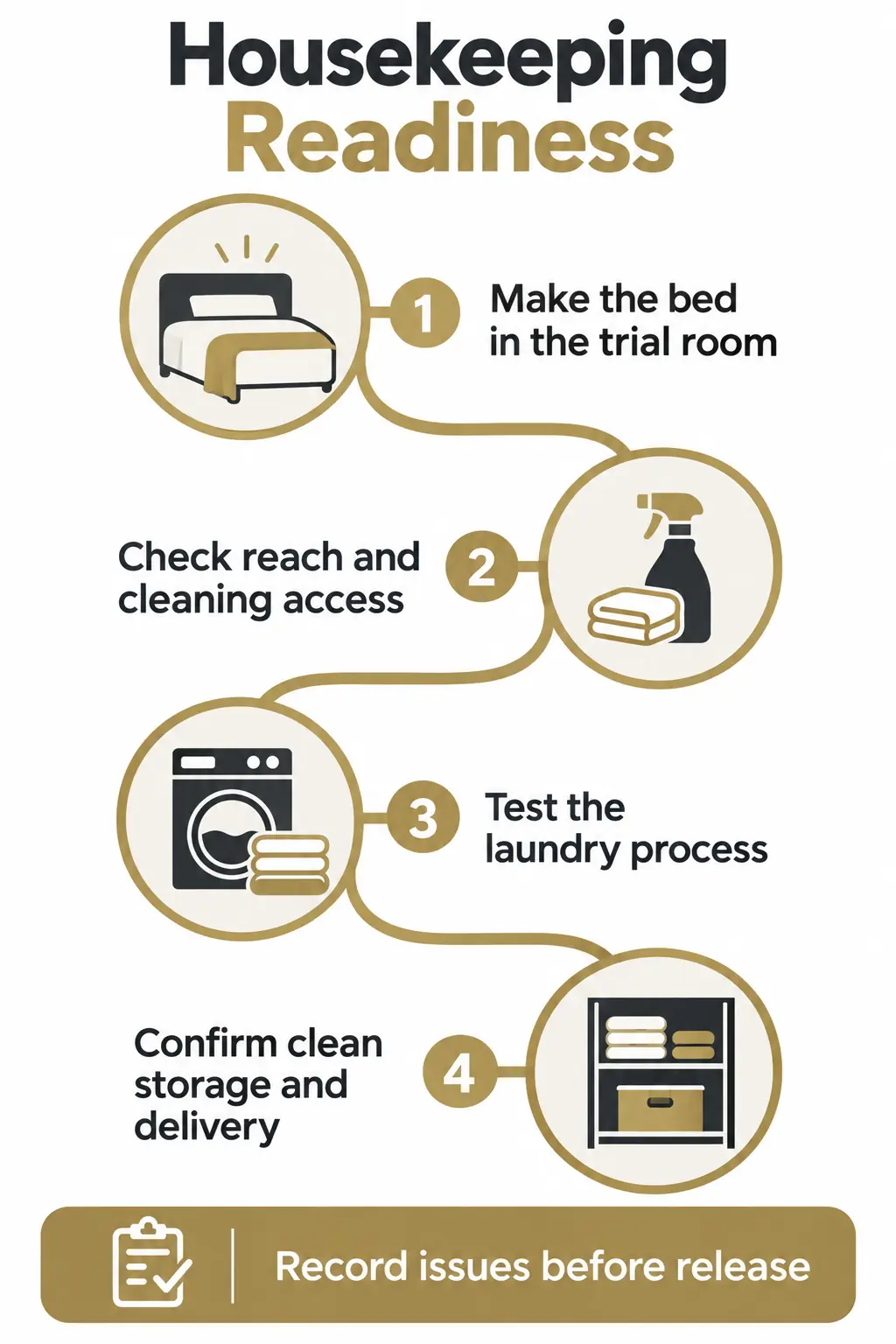
Run the room trial as a normal housekeeping task, with the actual bed arrangement, representative linen, and the equipment staff will use. A neatly staged room can conceal difficult reaches, trapped bed skirts, blocked vacuum access, or nowhere to place clean linen during a change. Include laundry processing, clean storage, trolley movement, and receiving arrangements in the same review because those conditions determine whether the new bedding can operate as intended. Use the checklist below as a release record rather than a score that averages away a critical problem. Each applicable item needs evidence and a named reviewer; unresolved fit, installation, or safety issues should block the affected scope.
Observe a complete change and cleaning cycle
Ask staff to demonstrate stripping, handling the used linen, retrieving a clean set, fitting the protector and sheets, filling the duvet cover, and finishing the bed. Observe whether workers can approach each task without excessive reaching, forceful pulling, or improvised movement of heavy furniture. Review the task with the property’s workplace-safety lead where concerns arise.
Test the vacuum or other approved cleaning tool around the frame, under accessible portions of the bed, and behind nearby furniture. A low base may need a different cleaning arrangement; an open base needs enough usable access for the actual tool. Follow the bed manufacturer’s movement instructions and do not assume that a heavy bed can be slid routinely without affecting flooring, cables, or fixings.
For laundry, confirm item compatibility with the actual processing, drying, folding, and finishing arrangements. Ask the laundry to assess expected peak batches and turnaround before accepting bulkier products. Reserve clean, dry storage for processed linen and define separate handling for used linen. The downloadable record supports this operational review; it is not a substitute for the property’s cleaning procedures.
Record the evidence and make a release decision
Use Ready only when the applicable requirement is met and supporting evidence is recorded. Use Conditional for an open, noncritical item with an agreed owner, deadline, and release restriction. Use Hold for an unresolved fit, safety, utility, or mounting issue that prevents the affected work. Mark N/A with a reason when an interface truly does not apply. Blank status means unreviewed, not accepted.
For each row, retain the room or bed identifier, drawing or product revision, measurement or photograph reference, reviewer, and review date. A project manager should decide whether unaffected items can proceed separately; conditional status alone is not authorization to release an entire order. The acceptance criteria below are project review recommendations and must be completed with the property’s actual dimensions, product instructions, and applicable requirements.
| ID / Group | Check | Acceptance evidence | Suggested reviewer |
| R01 / Room | Finished room geometry | Record finished dimensions, obstructions, and layout revision for each distinct configuration. | Design / site team |
| R02 / Room | Full bed footprint | Verify frame overhang, headboard projection, and furniture positions in the furnished room. | Design / operations |
| R03 / Room | Circulation and openings | Check each bedside and foot clearance with doors and drawers open against the approved layout. | Design / operations |
| R04 / Room | Accessible configuration | Obtain the responsible reviewer’s acceptance of affected clear spaces, turning space, and controls; record N/A reason if inapplicable. | Accessibility reviewer |
| R05 / Delivery | Package and handling data | Obtain actual shipping dimensions, weight, and manufacturer handling or recovery restrictions. | Supplier / logistics |
| R06 / Delivery | Complete delivery route | Verify unloading, door openings, elevator capacity and geometry, corridor turns, and room entry for the proposed load. | Logistics / site team |
| R07 / Delivery | Staging and responsibilities | Approve clean dry staging, receiving sequence, waste removal, and unloading or assembly responsibilities. | Operations / logistics |
| R08 / Bed fit | Bed and linen schedule | Link each room type to exact mattress, topper, protector, sheet, duvet, and pillow item codes. | Procurement |
| R09 / Bed fit | Covered mattress dimensions | Measure width, length, and depth including the protector and topper used in service. | Housekeeping / supplier |
| R10 / Bed fit | Sheet construction and coverage | Verify fitted-pocket meaning, corner retention, flat-sheet tuck, and skirt clearance on the selected bed. | Housekeeping |
| R11 / Bed fit | Duvet and pillow compatibility | Check insert and cover dimensions, closures, ties where provided, and pillowcase allowance. | Housekeeping / supplier |
| R12 / Bed fit | Processed sample acceptance | Record the agreed laundry trial, dimensional results, tolerance, and successful bed-making trial. | Laundry / housekeeping |
| R13 / Bed fit | Finished sleeping height | Measure the complete arrangement and obtain review of affected transfer conditions, bedside furniture, and controls. | Design / operations |
| R14 / Equipment | Conditional scope | Identify powered bases, fixed headboards, and other associated equipment; document genuine N/A items. | Procurement / engineering |
| R15 / Equipment | Electrical compatibility | For powered items, verify supply, connection, protection, and outlet position against approved product instructions. | Electrical professional |
| R16 / Equipment | Cable and service access | For powered items, check movement, pinch points, isolation, maintenance access, and removal route. | Engineering / installer |
| R17 / Mounting | Substrate and fixing detail | For fixed items, verify wall build-up, backing, brackets, concealed services, and approved fixing detail. | Installer / design |
| R18 / Mounting | Installation responsibilities | Assign brackets, backing, alignment, installation, and finish repair; record the controlling revision. | Contractor / procurement |
| R19 / Housekeeping | Complete linen change | Trial stripping and remaking; resolve difficult reach, forceful pulling, and improvised furniture movement. | Housekeeping / safety lead |
| R20 / Housekeeping | Cleaning tool access | Verify the approved tools and bed movement method can reach required cleaning areas. | Housekeeping / engineering |
| R21 / Laundry | Process and capacity | Confirm product compatibility, peak processing needs, turnaround, and any separate new-equipment utility review. | Laundry / operations |
| R22 / Storage | Clean and used linen handling | Approve clean dry storage, trolley route, and separate handling arrangements for used linen. | Housekeeping / laundry |
| R23 / Release | Open actions and approval | Record evidence, reviewer, status, owner, deadline, and restriction; hold affected scope for unresolved critical issues. | Project manager |
| R24 / Receiving | Order and change control | Carry approved codes, dimensions, samples, and revisions into receiving; reopen checks affected by a substitution or change. | Procurement / receiving |
Use the editable versions to record status, owners, deadlines, and evidence; use the PDF during the site walk. All versions contain the same base checks.
Carry the approved record into receiving
Put the approved room and bed schedule, sample references, dimensional tolerances, delivery method, and installation boundaries into the order documentation. Include the destination, room-type quantities, required delivery sequence, and the process for resolving substitutions. Assign someone to check incoming item codes and representative dimensions against that record before distributing the delivery throughout the property.
If a mattress model, topper depth, fabric construction, laundry process, bracket, or room layout changes, reopen the checks that depend on it. Reapproval should follow the dependency: a deeper topper affects sheet fit and sleeping height, while a packaging change primarily affects receiving and route clearance. Keep the previous decision traceable, but issue one clear current revision for implementation.

Conclusion
Release bedding and bed linens against a verified room and operating arrangement, with the evidence attached to the approved specification. The essential checks are the finished room footprint, delivery access, complete bed dimensions, fit after laundering, and the housekeeping process. Add utility and mounting checks only for the equipment and fixed components actually included. A disciplined review makes uncertainty visible before it becomes a production instruction and gives receiving staff a concrete acceptance baseline. Keep unresolved critical issues on hold, assign ownership to every remaining action, and repeat the affected checks whenever a product or site condition changes.

For a project quotation, send your bedding requirements to KW Hospitality with room-type quantities, measured bed dimensions, approved sample details, delivery destination, target dates, and the completed readiness record. Identify open items clearly so the quotation can distinguish confirmed requirements from decisions still awaiting approval.
Frequently Asked Questions
Can one model room approve every guest room?
Only when the relevant conditions are genuinely equivalent and exceptions have been checked. Different frames, connecting doors, columns, accessible layouts, or construction variations can change the result. Use the model room to approve the common arrangement, then verify each materially different configuration and document the rooms to which the decision applies.
What if the supplier cannot provide final packaging dimensions yet?
Treat delivery access as provisional and establish a deadline for the packaging data before dispatch. If a constrained route affects the available product or construction method, resolve it before production as well. Do not describe the route as approved using only unpackaged dimensions; record the uncertainty and the party responsible for confirming it.
Can an existing linen stock be used with a deeper replacement mattress?
It may be usable, but the nominal bed size does not establish fit. Trial representative processed stock on the replacement mattress with its protector and topper. Check corner retention, usable tuck, coverage, and staff effort. Separate any incompatible stock by bed configuration rather than forcing it into a common allocation.
Who approves readiness when the hotel uses an outside laundry?
Housekeeping and operations should approve the room workflow, while the laundry confirms processing compatibility, finished dimensions, delivery arrangements, and turnaround assumptions. Procurement should collect both decisions into the same record. Outsourcing laundering changes who supplies the evidence; it does not remove the need to verify the fit of the returned linen.
Does a completed checklist certify accessibility or installation compliance?
No. It records the project’s review and acceptance evidence. Accessibility, electrical work, structural support, and other regulated conditions require review by the responsible qualified parties against the requirements that apply to the property. Attach their decisions where relevant and do not use a high completion percentage to override an unresolved critical item.